(From the Captains perspective)
We spent 6 months in New Zealand. As we have written in other posts, we had numerous adventures in NZ with family and friends. Most of those were by car as visitors were more interested in visiting areas not easily assessable by boat. The result was that Quid Sea was based out of the Bay of Islands Marina for the entire 6 months. When not touring by land we sailed around the Bay of Islands and other nearby destinations. One of the many benefits of being based out of the Bay of Islands (BOI) Marina was the opportunity to get a lot of work done on Quid Sea. The BOI Marina doesn’t have a lot to offer with regards to restaurants and entertainment but it is surrounded by boat services and supply shops. For a boat owner and skipper, it was like a “kid in a candy shop”! I was able to get a lot of the work done while we were not on the boat but touring around NZ by car with family and friends.
Here is a list of the work that we were able to get done.
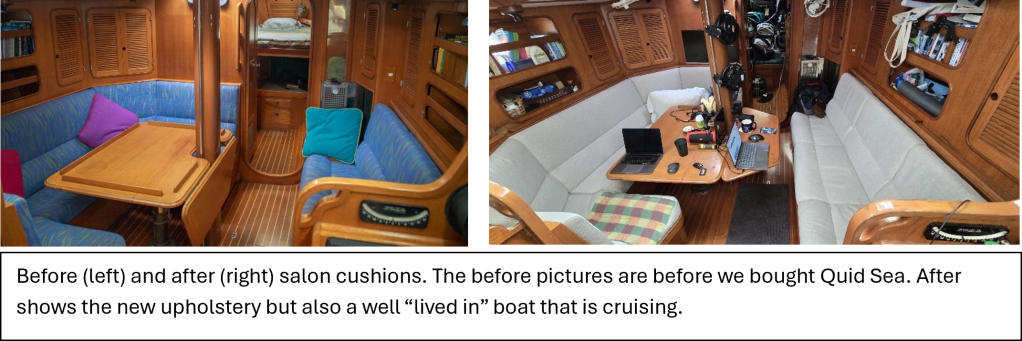
- Reupholstered cushions in the main salon
- New cockpit cushions
- The 40 year old original Ford Lehman diesel engine serviced and new motor mounts installed
- Transformer installed so Quid Sea can plug into 120V or 240V shore power
- Fresh bottom paint on the hull
- New headsail
- New anchor windless and chain
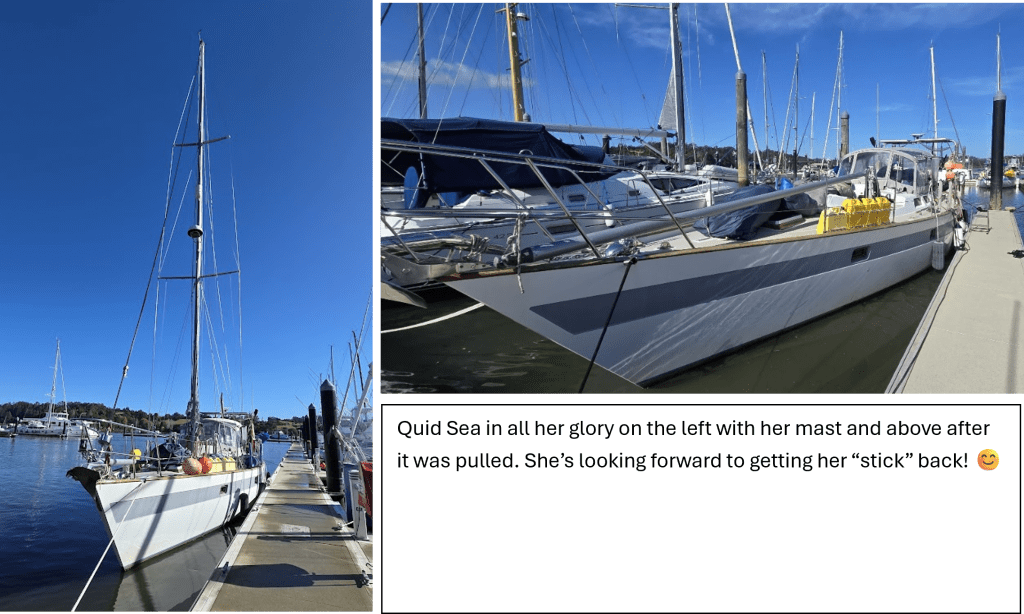
- Mast pulled for service and all new standing rigging installed
The workmanship was excellent and the work was relatively affordable mainly due to the exchange rate between the NZ dollar and the US dollar.
One reason I mention all the work is the last bit done was the mast pulling and new rigging. The mast was pulled on April 19th. I was targeting a departure for Fiji on the first good weather window starting May 1st . This means the mast had to be serviced and back in the boat and new rigging installed and tuned before May 1st. So, the clock was ticking…
Here’s a video of the mast being pulled if you are interested.
Cindy and I drove down to Auckland on April 28th, two days before my crew, Erik and and his son Ethan, were due to arrive. When Cindy and I left Quid Sea, she was still without a mast! While we were in Auckland waiting for Erik and Ethan to arrive, Quid Sea got her mast back. I picked Erik and Ethan up at the Auckland airport on the 30th and the 3 of us drove back up to Quid Sea in Opua. Cindy stayed in Auckland preparing to fly to Fiji. When Eric, Ethan, and I arrived back in Opua, she had her mast back and rigging in place but the rigging was not yet tuned and sails not yet refitted on the boat. Tuning the rigging means adjusting all the shrouds and stays to the proper tension. The shrouds and stays are wires that hold the mast straight and support the mast while under sailing loads. This rigging is critical to prevent the boat from being dismasted which is the mast breaking and crashing down on the boat. Pretty important…
The rigging was tuned and sails refitted on May 2nd. All the mast-mounted electronics were reconnected and Quid Sea was ready to go. My crew and I took her out for a shakedown sail on May 3rd to make sure there were no issues with the new rigging.
Meanwhile, the weather remained unsuitable for a departure to Fiji. Low-pressure systems east of Fiji and others moving across the Tasman Sea created unsafe conditions: strong winds and heavy seas from the wrong direction. In the end, although a major concern on my part the rigging work did not delay us.
Weather windows for a departure were very narrow and not ideal. I had hired a weather router to help us with this passage and was following his guidance on good departure times. A weather router is an experienced weatherman or sailor that offers routing guidance on a passage as a service. The router we used was the same person that routed us from Tonga to New Zealand.
To give a little taste of situation from the end of April to the first days of May, here are some examples of the communications between me and my weather router. Weather and rigging were not our only concerns. We also needed to coordinate our departure time with NZ Customs. When leaving NZ, a boat must schedule a checkout interview with customs. Once the interview is complete, the boat and crew must leave immediately.
April 28th
[Weather Router]
I have checked the way the weather ahead looks to be developing. It would seem it will be too rough to head directly towards Fiji for this passage as there looks likely to be a deepening low forming east of the direct route to Fiji around Friday(8-May) to 10-May.
Provided you can handle seas to around 11ft Wednesday(6-May) through Friday(8-May) and wind 20 to 25 knot from the ESE, then the passage could start on the 5-May but staying well west of the direct route to Fiji for the first 4 days at least, then turning towards Fiji. However, if this is too much then I will need to watch out for another possible weather window.
[Tracy]
Looks like my rigging will be back in 30-Apr. What would it look like if I pulled my departure up to 2-May or 3-May. Are those dates still looking bad also?
[Weather Router]
I think the best option is the 5-May. The 2 and 3 of May would have you in larger seas, maybe to around 12ft and winds 25 to 30 knots, so neither look good.
Hopefully we will see some improvement in the outlook over the next few days as it is still a long way ahead.
May 2nd
[Weather Router]
I trust all is well at Opua.
Looking ahead I now think it will be possible to get underway either late Monday 4-May or first thing on Tuesday.
Departing late on 4-May will tend to get you into a slightly larger swell but it has the offsetting benefit of having more east in the wind direction.
So, if it is possible to gain a customs clearance to allow you to depart as late as possible on Monday, this is now slightly preferred, although early on Tuesday, 5-May is also good.
If you can get away late on the 4th, there should be easterly winds 13 to 18 knots out of the Bay of Islands with a swell from close to the east around 6ft. This should enable you to get off onto a heading near 035T.
The tend more ENE then NE during the first 24 hours, mostly in the 13 to 18 knot range but around 20 knots at times Monday evening. The ENE swell should be building to around 8ft around 24 to 36 hours into the passage.
Wednesday the winds will become more ENE, probably in the 15 to 22 knot range. The swell from the ENE should be around 8.5ft.
May 3rd
[Tracy]
I am currently booked with Customs for a departure on Tuesday, 5-May, at 09:30. I will see if I can schedule a departure for Monday afternoon, 4-May.
I have a mast back in the boat and fresh rigging. Quid Sea is already to go. Just waiting now to hear back from NZ Customs if I can checkout Monday
Now it’s all about weather. How’s it shaping up?
[Weather Router]
It is great that the mast and rigging are now in place.
The weather seems to be shaping up pretty well as outlined yesterday. So overall, if there is a customs slot, I would push for a late Monday departure.
[Tracy]
I just heard from NZ Customs and they gave me a checkout time of 14:30 on Monday. I’m guessing I’ll be away from the dock and on our way by 15:00 or 15:30. I told my crew to fasten seatbelts! 🙂
So, we finally settled on a 4-May departure with rough conditions expected for the first few days then weather calming a bit. We were able to get our interview with Customs a little earlier and departed Opua at 14:30 on May 4th.
Passage has begun
4-May to 7-May
As forecast, the winds were ENE to E at 15 to 20 knots for these 3 days. We were steering a more northerly course, waiting for the wind to shift more ESE. Then we would be able to steer more NNE towards Fiji. Seas were about 8ft with 8 second period. The waves are mostly on our beam or forward of the beam. We were rolling 10˚ to 20˚and pitching. The conditions are pretty rough. Difficult to move about the boat and very uncomfortable for captain and crew.
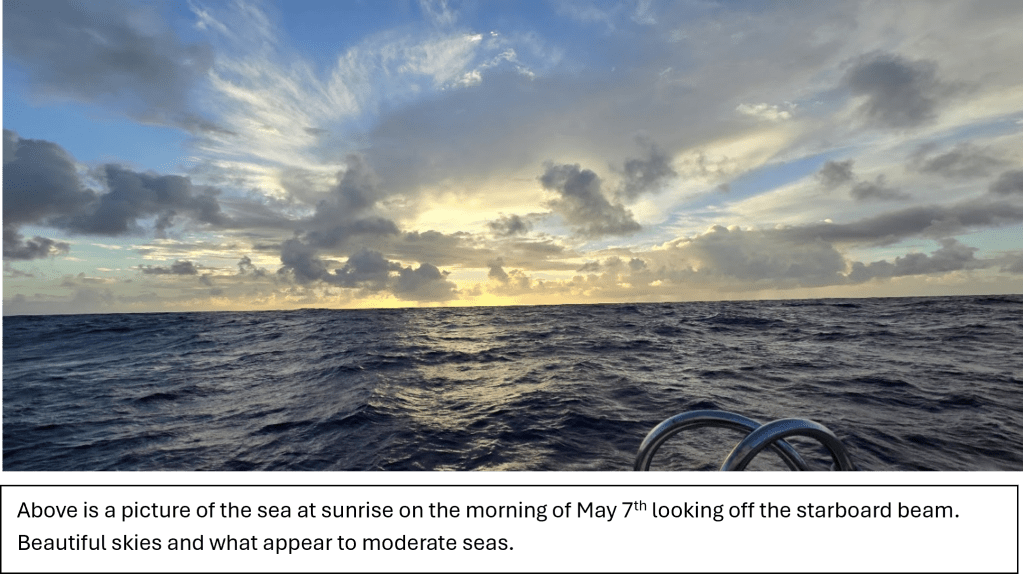
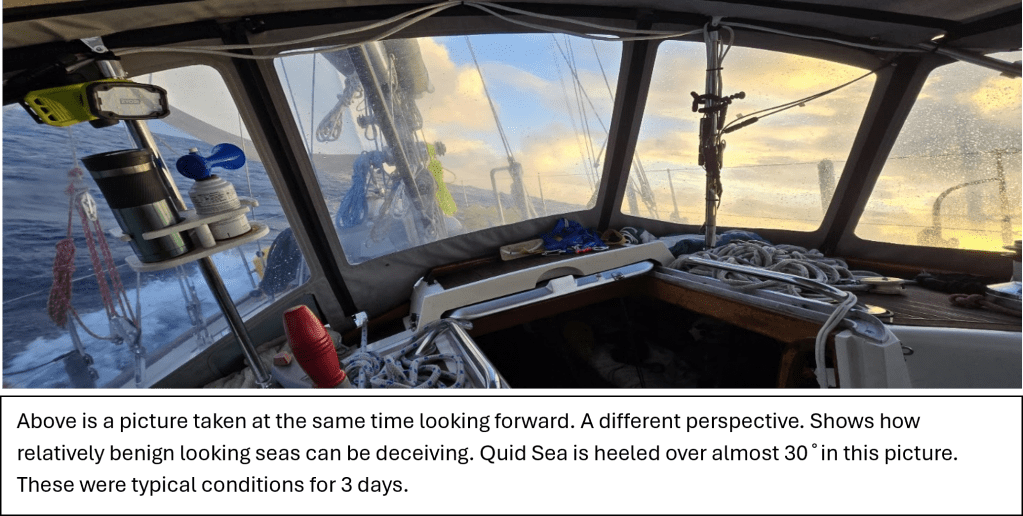
8-May
The swell period increased through the night and wind started to drop and by noon was less than 10 knots. The wind never did shift more ESE but instead was also shifting more northerly. The conditions were becoming a little more comfortable although still rolling a bit. In the afternoon the wind dropped to less than 10 knots so we started motoring into the wind on a more northerly heading towards Fiji.
9-May
We continued motoring until about noon. The wind had shifted more NW at about 8 knots. We were able to sail more NE’ly toward Fiji. At this point we were trying to get more east because after an approaching cold front passed, the winds would shift to the SE and force us again on a more northerly heading.
Something else that happened was the electronic autopilot failed after we switched off the engine and started sailing. I don’t know why it failed. Maybe shutting off the engine caused a voltage spike. In any case, we had to start using the Hydrovane mechanical autopilot. I have used the Hydrovane quite extensively and it works well. We were being a bit lazy on this shorter passage and not using it as it requires more attention. Anyway, we started using it and it worked great. Thank goodness for backups!
10-May
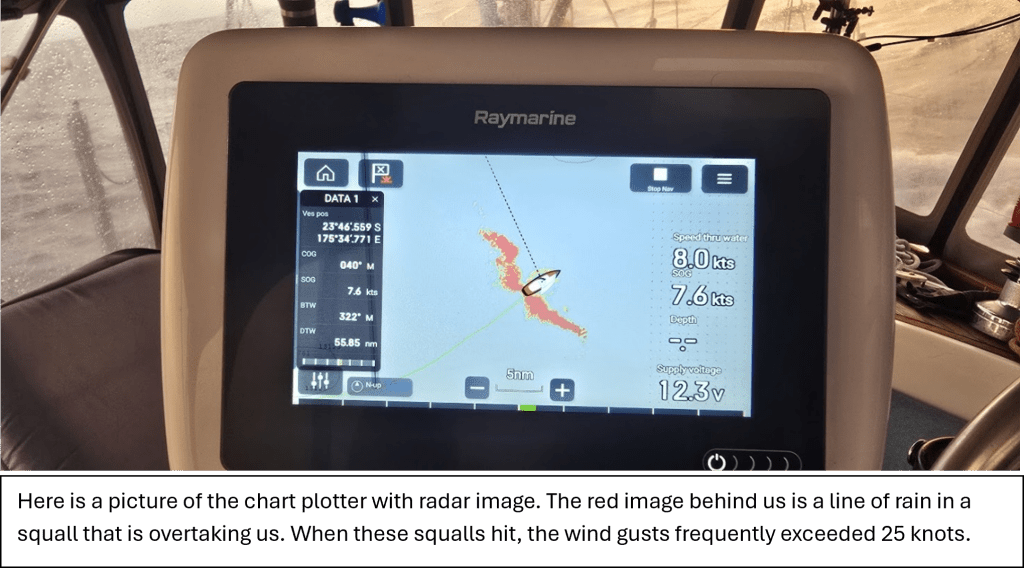
The cold front passed about 0700. We had wind gusts up to 35 knots and the wind shifted to the WSW. This was the first time we finally had the wind behind us. Later in the day the wind shifted to the SSE. We’re steering a northerly course towards Fiji but with the shifting winds and confused seas, it’s a rough ride and the Hydrovane has to be readjusted all the time to hold a northerly course. Confused seas means waves and swells coming from different directions. We have primary swell coming from the SSW, secondary swell coming from the E, and wind waves coming from the SSE.
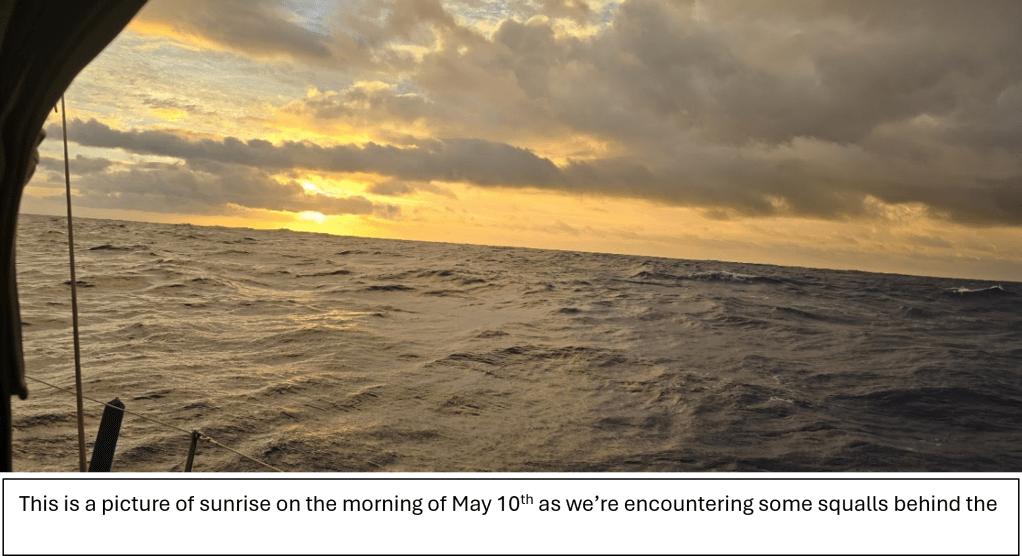
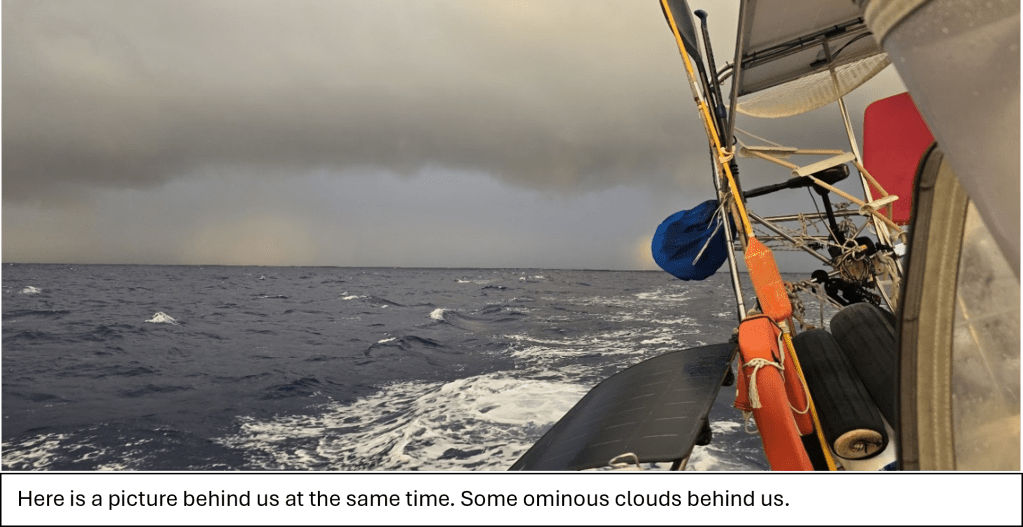
11-May
Wind and seas stayed about the same. The convergence line behind the cold front that passed had stalled and squally conditions continued. We expected to pass through that convergence line late at night.
12-May
We entered the convergence line early in the morning on Erik’s watch. Erik navigated and steered us through the worst of the squalls between 0100 and 0400. Some gusts in the squalls were over 30 knots.
We seemed to get out of the squall region by mid morning. By the afternoon, the winds had settled to about 11 knots out of the SSE. We had a good final run to Navula Pass. Winds picked up to about 20 knots as we approached Viti Levu, Fiji’s biggest island.
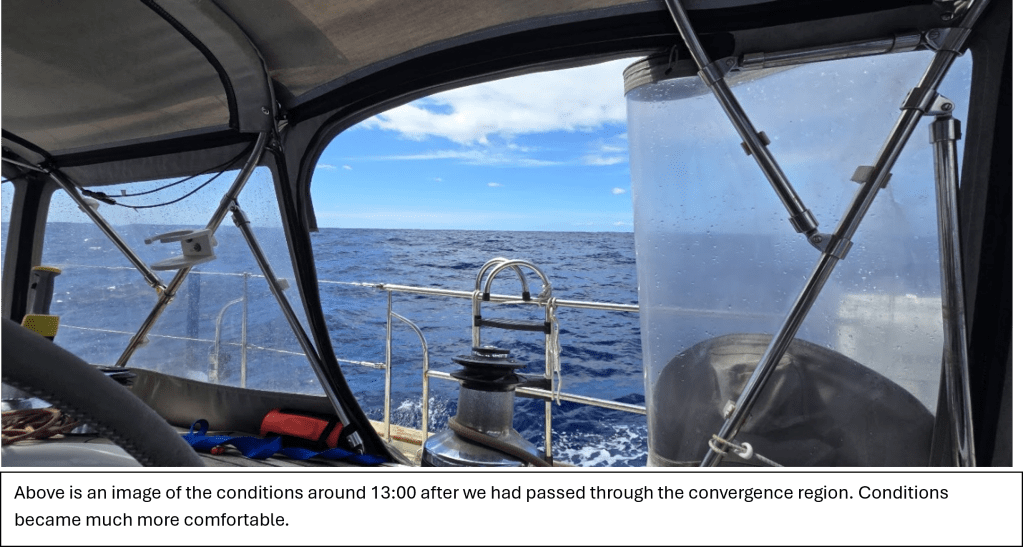
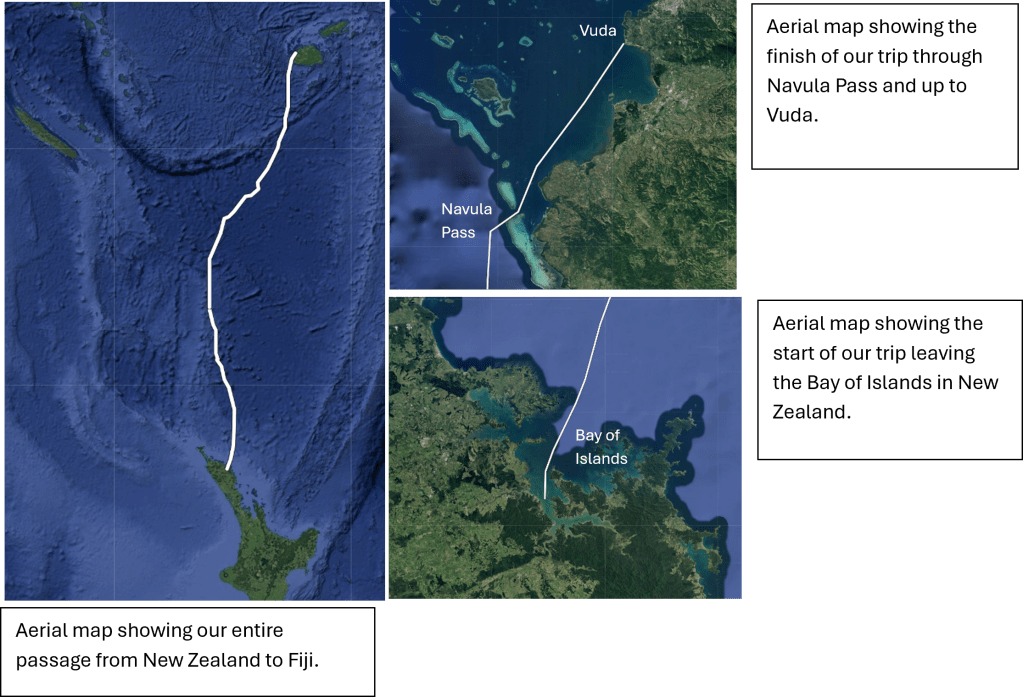
We entered Navula pass about 2030. Winds were still strong as we navigated the pass so we motor sailed through the pass and part of the way to Vuda Marina. We dropped the sails and motored to the anchorage off Vuda Marina. We anchored for the night waiting for permission to enter the marina to clear customs and immigration the next day.
13-May
We received permission to enter Vuda Marina about 0830 and tied up to the Customs dock about 0845. We cleared customs about 1100 and were tied up in our berth by about 1130.
Passage complete
To summarize the passage, it was one of my rougher ones. Waves were mostly in the 5-6 foot range but short periods in the 8 to 10 second range and either on our beam or ahead of us. It meant the boat was pitching and rolling considerably which made for a generally uncomfortable ride. Quid Sea and crew performed admirably but the crew was worn out by the time we arrived safely in Fiji. Another safe passage under our belts.
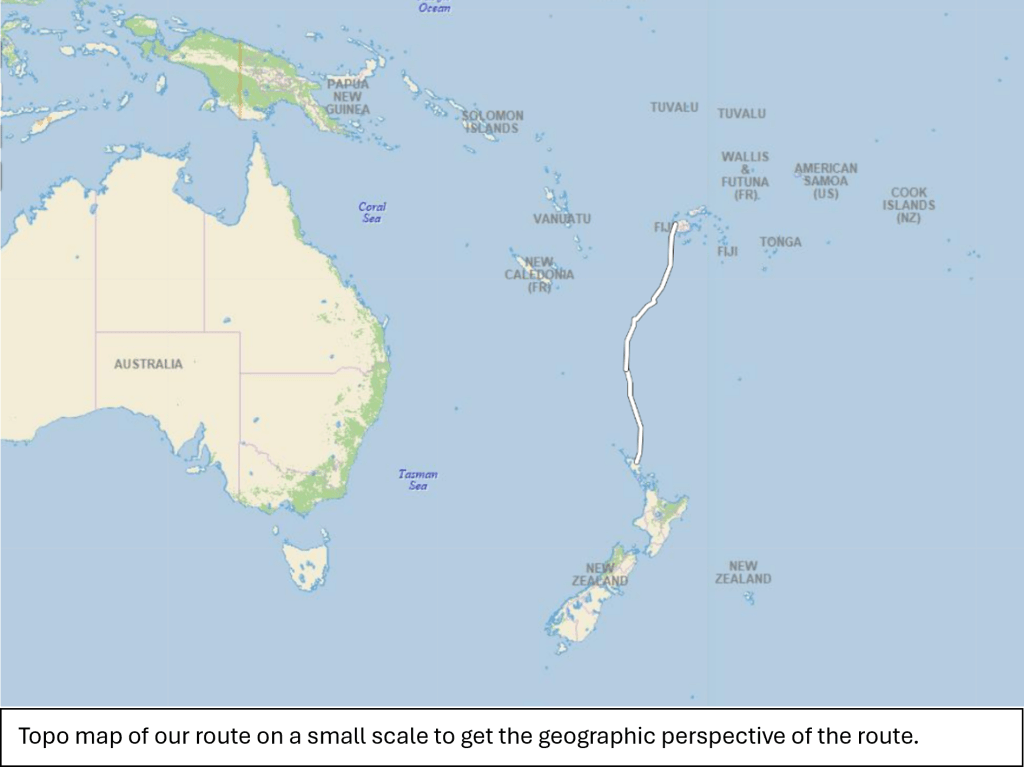
Below is our track for the whole passage shown on a topo map and on aerial maps.