We left the US on September 29th and arrived in Tonga on October 1st. Total travel time was 27 hours and 35 minutes. Included was a 4-hour layover in LA and a 7-hour layover in Fiji. To add further confusion, Tonga is also a day ahead because they are on the other side of the international date line. It was the longest flight I ever experienced, and we were happy to reach our destination. Tracy got to experience the same trip in reverse when he flew back to the US from Tonga. Yikes!
We had a great time at home in the Vancouver/Camas area visiting family and friends. We stayed with my sister and brother-in-law, caught up with lots of friends and enjoyed a few visits with Tracy’s brother and sister-in-law. It was extra special to spend some time with Lucas and his fiancé Annika who will be getting married next July! We are grateful to have so many wonderful people in our lives.
Besides enjoying our hometown, we spent time traveling to Ohio, Houston and Denver. In Ohio we visited Marina and Dakota and we were very happy to be there to celebrate their marriage. It was a beautiful and intimate ceremony with just family and Marina’s brother Lucas officiated. It was great spending time with them, seeing their new home and meeting Dakota’s family. We left them in good hands!
Tracy and Marina walking down the forest aisleMarina and Dakota officially married!Lucas and his fiance Annika walking through rows & rows of sunflowers.
We also traveled to Houston to visit Tracy’s Mom, sister and brother-in-law. It’s been a while since we visited and it’s always so nice to spend time with them. We enjoyed Jason’s cooking, playing games, great conversations and wonderful hospitality. What more could you ask for!
Tracy with his Mom in front of Texas A&M at Galveston where he went to College.Havaing lunch with family in Houston.We went to the Houston Aquarium and I recommend it to anyone else visiting Houston.
Last, we flew to Denver to see Madeleine, her boyfriend Evan, and their two dogs, Virgil and Frankie! It was a fun packed weekend exploring their neighborhood and doing the Georgetown loop to see the Aspen fall colors.
A couple of pictures of the Aspens beautiful fall colorsMadeleine on the Georgetown loop trainMadeleiene ran the Portland Marathon– her first marathon. I cheered her on from afar.
But now back to Tonga.
Our anchorage for about 10 days in Neiafu.
Tonga is the only Pacific Island nation that was never colonized, has a constitutional monarchy, and is nicknamed the “Friendly Islands”. It’s known for its unique wildlife, including migratory humpback whales and flying foxes that belong to the king. Sundays are a day of rest with a ban on most activities, and the Tongan alphabet only has 17 letters.
The island nation of Tonga is a deeply religious country with Christianity being the dominant and integral part of its culture and society. Religion is so central that it influences daily life and is even enshrined in its constitution, which prohibits most forms of work and trade on Sundays
October is the end of the dry season and the beginning of the wet season in Tonga. It is considered a “shoulder season” month, transitioning from the cooler, drier conditions of winter (May–October) to the hotter, more humid, and wetter conditions of summer (November–April). What this meant for us is that it was not as hot and humid but we experienced some rainy days.
We started out on the Island of Vava’u. Vava’u is an island group, consisting of one large island (Vava’u) and 40 smaller ones, in Tonga. It is part of Vava’u District, which includes several other individual islands. According to tradition, the Maui god created both Tongatapu and Vava’u but put a little more effort into the former. Vava’u rises 204 m (669 ft) above sea level at Mount Talau. The capital is Neiafu, situated at the Port of Refuge.
Our first 2 nights were spent in a hotel since the boat was still in the boat yard on the ‘hard’, (on land). On Friday, October 3rd, Quid Sea was going back in the water and so were we. It’s routine for the boat yard to have us start the engine once in the water, before detaching the bindings. We had a bit of scare when the engine wouldn’t start. Tracy tried to get it going without any luck. The owner of the boat yard came on board and also tried the engine without success. They were about to pull us back on shore when Tracy made one more attempt and this time it worked! They quickly detached us and we motored to our next stop in Neiafu where we tied up to a mooring ball.
Quid Sea is headed to Sea.Almost there!
We spent about 10 days in Neiafu and caught up with some cruising friends and shopped for provisions. It’s a great place for boaters because they offer many repair services and they are convenient to get to. Tracy continued to work on the original starter by spraying WD-40 into the starter to help lubricate the drive pinion. It seems to be working fine now. He also took his back up starter to the boat yard for servicing just in case we need it. We’ve been starting the engine every day to ensure we’re not continuing to have issues. Apparently leaving your boat out of the water for a couple of months is not good for the engine and other systems.
Neiafu is the second-largest town in Tonga with a population of 3,845 in 2021. It is situated beside the Port of Refuge, a deep-water harbor on the south coast of Vava’u. It is the administrative center of the Vavaʻu group and has government offices, banks, schools, a police station and a hospital. It is also an important center for tourism with many yachts anchoring in the Port of Refuge.
The town is now powered by a 300kW solar PV farm with battery backup in the hamlet of Kāmeli.
A large Catholic church in the center of Neiafu called St Joseph-the Worker Parrish.The Hideaway was small restaurant and bar on a floating raft which happened to be parked right next to Quid Sea. The owner’s name is ‘Bear’ and he is from Canada but has been living in Tonga for 10+ years. Pigs and dogs were popular in Tonga. One of the main streets in Neiafu.Outside the Kraken, a fun restaurant we enjoyed.A view from the inside.
We left Neiafu on Sunday October 12th and headed south to the island of Tongatapu. It was about a 30-hour passage, and the seas were rolling, yawing, and slapping, all at the same time. It was a rough journey early on but got a little better towards the end. On a fun note, as we were leaving the bay of Neiafu we saw a pair of humpback whales breaching. It’s like they came out to say good-bye.
We arrived Monday afternoon and anchored in Fanga’uta Lagoon near the town of Nuku’alofa. We needed to come here to pick up Tracy’s crew for the New Zealand passage, and for me to catch a flight to Auckland. Lots of changes this week!
We are anchored in a beautiful bay with several other boats at Pangaimotu Island. It’s a bit isolated but there’s a place called Big Mama Yacht Club on Pangaimotu. Big Mama’s is an iconic stop for cruisers but sadly it was damaged by the tsunami associated with the 2022 Hunga Tonga–Hunga Haʻapai eruption. It has more limited offerings today but is still a cruisers hangout and Big Mama and Earle are great hosts.
Another important service Big Mama’s provides is a water taxi to Nuku’alofa which we used almost daily. It’s about a mile across the bay to Nuku’alofa where customs, grocery stores and restaurants are located. But the waters can be choppy so having the water taxi option is great. It’s a shorter ride and we stay dry as opposed to taking the dinghy.
One of our neighbors in Fanga’uta Lagoon. Note the rainbow in the background.This old boat may have sunk from the Cyclone back in 2018. Now it’s resting in front of Big Mama’s advertising their name.
Our first task was to go to customs and check in. It’s interesting that we must check in and out of inter Islands even though they are all part of Tonga. After being responsible, we found a coffee shop and later went to a place called ‘Friends’ for lunch. We were also able to explore a few stores for provisioning.
Two cemetery sites as we walked through town.The Centennial Church, also known as the Free Church of Tonga, is an iconic structure in Nuku’alofa damaged by Cyclone Gita in 2018.Local High School on a street that also contained primary school, middle school and college.Two students on their lunch break across the street from the high school. Note the uniform and it is common to see boys & men in skirts.
After the water taxi ride and coming back to Quid Sea in our dinghy we discovered a snake climbing up the back of the boat. It turned out to be a sea snake which is extremely venomous. They rarely inject their venom when biting, so thankfully venomous bites to humans are rare. Tracy grabbed it and flung into the water but a minute later it was back. We pulled up our boat ladder, and he removed it again, but it kept returning. Next, we turned on the engine hoping the sound and diesel fumes would deter it and sure enough that worked. As an extra precaution, I plugged up all our drains in the 3 sinks to make sure it didn’t try to sneak in from the through hulls.
Black and white striped sea snake!
Nuku’alofa is the capital and largest city of Tonga. It is located on the north coast of the island of Tongatapu, in the country’s southernmost island group. The population of Nukuʻalofa, the capital of Tonga, is around 22,000 to 27,600.
We have seen lots of influence by China and Japan. Most of the grocery markets are owned by Chinese people and there was a Red Cross hospital ship from China in the harbor for a few days. They were offering free medical services to Tongans.
First western records of Nukuʻalofa
On 10 June 1777, British captain James Cook wrote of his arrival at their anchorage place. His description of the place confirmed, with his map, that this was the bay of Nukuʻalofa.
“At length, about two in the afternoon, we arrived at our intended station. It was a very snug place, formed by the shore of Tongataboo on the South East, and two small islands on the East and North East. Here we anchored in ten fathoms water, over a bottom of oozy sand; distant from the shore one-third of a mile [500 m].”
Cook never used the name Nuku’alofa or any alternative spelling for the reports of this voyage, but he mentioned the island of Pangaimotu (where Big Mama Yacht club is located) which was to the east of his anchorage position. Captain Cook also wrote that he traveled by canoes to visit Mu’a where Paulaho and other great men lived. The house that Paulaho provided was on the beach 500 metres (1⁄3 mi) from the ship. Reference to his map shows that he must have landed and stayed in the Siesia area, the eastern part of modern Nukuʻalofa. Cook also drafted the first map of the bay of Nukuʻalofa.
We enjoyed Tonga but didn’t really get enough time here to explore all the Islands. We’re thinking we may come back next May on our way to Fiji.
Our next stop is New Zealand. I will be spending about a week in Auckland and then meet up with Tracy and crew in Bay of Islands. Yay!
Cindy left on July 17th for the long voyage by air back home where I’ll be joining her after I sail Quid Sea to Tonga. My plan is to leave Bora Bora in a few days when the weather window looks good. I’ve booked a flight from Tonga back home on August 7th so I need to be in Tonga a few days before that flight.
Cindy and I waiting for the ferry that will take her to the airport in Bora Bora.Cindy waving goodbye from the ferry on her way to the airport. I’m on my own now and preparing for my upcoming solo trip to Tonga.
Day 1 – July 19th – The solo adventure begins!
I left the Bora Bora mooring at 10:00 to start my longest solo voyage yet. It’s with mixed feelings I leave Bora Bora. Leaving a lot of good cruising friends who will be following after me by about a week. Cindy and I both would like to have stayed and explored Bora Bora more but alas, our 90-day visa for French Polynesia was expiring on July 21st. I am looking forward to the “challenge” of a solo sail. I expect the 1300nm trip to take between 9 to 12 days.
I am a little concerned about the weather. A cold front is approaching Tonga from the south that will bring some heavy rain and high winds during the last part of my trip. I am using a weather router to provide guidance as well as talking with other cruisers that are out here near me (near meaning within a few hundred miles) and cruisers that are leaving Bora Bora after me. A few days before, the weather forecasting tool I use showed winds in excess of 40kts near the cold front. More recent forecasts though show the winds to be in the 30kt range which is more manageable. Hopefully, the forecast continues to improve. Based on weather models and input from my weather router, I started out on a more northerly heading to avoid the higher winds to the south and take advantage of the Edeerasterly trade winds more north.
I spent the morning before leaving getting the boat dialed in and ready for 9-12 days at sea by myself. I prepared a couple of meals ahead of time, made water, charged the batteries, and secured everything on deck and below deck. I also prepared the storm jib on the inner forestay and setup for a 3rd deep reef in my mainsail should the high winds forecast later in the voyage develop.
I exited the pass from Bora Bora about 10:30, shut off the engine, and set sail! It’s a beautiful sailing day. Clear skies and following winds in the 10-15kt range. Perfect for sailing. I’m sailing almost directly downwind so I am only using the genoa. I use the Hydrovane autopilot during the day to save power on the batteries. She is doing very well holding my course.
The difference between the Hydrovane and the electronic autopilot is that the Hydrovane is purely mechanical. The Hydrovane has a wind vane and auxiliary rudder. The direction of the wind vane is adjusted until it is pointed in the direction of the apparent wind. When adjusted properly, the wind vane controls the auxiliary rudder and keeps the boat at a constant angle to the wind holding the vessel’s course unless the wind shifts. The electronic autopilot has a hydraulic ram that is connected to the main rudder and controlled by electronics. It has several modes of operation but essentially keeps the vessel on course through the electronics. The main advantage of the Hydrovane is to save on battery power. Another advantage is the auxiliary rudder that is part of the Hydrovane system can serve as an emergency backup rudder should the primary steering system fail.
Around 18:00 (6:30pm), after the sun set, I turned on the electronic autopilot and prepared to get some sleep. The Hydrovane requires some attention and occasional adjustment, especially if the wind direction changes. The electronic autopilot generally requires almost no attention once set. I feel safer sleeping with the electronic autopilot.
Sleeping when sailing solo is complicated. Where to sleep and for how long is a challenge. With more than 1 person onboard, someone can sleep comfortably while another keeps watch. When alone, you need to decide how long you can safely sleep without keeping a lookout or checking on sails and wind. The current conditions are steady 10-15kt winds, 3 to 5 foot seas, and no traffic. I have not seen another vessel since leaving Bora Bora. Even though I don’t see any other traffic and the wind and sea conditions are nice, I still decided to sleep in the cockpit my first night. I can quickly manage any adjustments to the autopilot. I also set my radar and AIS alarms to warn me of any vessels that appear.
Day 2 – July 20th
Conditions are pretty much unchanged in the morning. Started out mainly downwind but then the wind shifted a bit, so I was able to raise the mainsail. The weather is beautiful, good Easterly trades and clear skies. Sailing with both sails and starting to relax and enjoy the experience. The first 24 hours are usually tough on a passage whether alone or with crew. The time is spent getting the boat dialed in, establishing routine, and adjusting to being at sea again.
In the afternoon, the wind dropped to about 10kts and my SOG (Speed Over Ground) dropped to 3-4kts. I turned more southerly for the night.
Sunset on my second day. Relatively calm seas and clear skies.
I’m still sleeping in the cockpit, but I’ve figured out how to make myself more comfortable with my beanbag chair, cushions, and a pillow.
A glimpse of life in the cockpit. The big blue and white bean bag helps me get comfortable.
Day 3 – July 21st
Continued on the same southwesterly tack. The winds had picked up a bit during the previous night to 10-15kts. Making better speed today, SOG averaging 5-6kts.
Clouds starting to build and some rain way off in the distance. Still great sailing conditions.
Passed through some rain squalls later in the day. No heavy winds or lightning in the squall and Quid Sea enjoyed the freshwater washdown.
As evening settles, rain is getting closer and looking a little ominous.
Still sleeping in the cockpit. Not sure how much confidence I have to be below and sleep in the cabin.
Day 4 – July 22nd
The wind is still consistent at 10-15kts but shifting more northerly. It started out coming from the NE but through the night shifted to the N and then the NW. I’m starting to approach the zone where the weather is changing.
Slept in the cockpit again because of the shifting winds, the autopilot needed a lot of adjusting.
Day 5 – July 23rd
The wind dropped to about 7kts, and my speed was about 3kts. Winds are getting light and variable. At this point I started motor sailing. Motor sailing is using the engine as well as the sails to make headway. It also helps charge the batteries . While motor sailing, I was making about 6kts SOG. I motor sailed for a couple hours until sunset and then went back to just sailing. It’s quieter and more peaceful but slow in these light winds. I’m back to about 3kts SOG.
Sunset on Day 5. Relatively clear skies and calm seas. Very pleasant sailing.
Day 6 – July 24th
Wind dropped to less than 4kts during the early morning and the water is like glass. At this point I started motor sailing again.
Wind has died and seas are flat. Clouds and rain look to be building in the distance. This is literally the calm before the storm.
Although conditions are calm, I know the strong southerly winds are coming so I decided to put the 3rd reef in the mainsail while conditions are calm, and I have daylight. The sky is clear but there are some darker clouds on the horizon.
About 9:30PM, I was hit by the first squall. Winds picked up to about 17kts, but Quid Sea is performing solidly with the 3rd reef in the main and the genoa fully deployed, no reef.
Wind is picking up now with more clouds developing and rain very visible in the distance.
Day 7 – July 25th
By morning the winds are now coming from the SSE at about 20kts and waves are about 10ft. That is combined wind waves and swell. It’s also overcast skies now. Sailing now with 3rd reef in the main and 2nd reef in the genoa. The wind was gusting to 25kts which is why I reefed the genoa. SOG is now about 7kts. Quid Sea is doing great under these conditions. We’re heeled over about 5 degrees and rolling an additional 5-10 degrees but occasionally the waves and swell align causing us to roll 35-40 degrees. It’s getting difficult to move around a lot below deck because of these rolls. Lunch and dinner is now just sandwiches. These are the conditions that start to wear me down physically and emotionally.
Day 8 – July 26th
Wind has built to 20-25kts and seas are now 15ft. Skies are still overcast. Quid Sea is still doing well although we are taking the occasional wave over the port side. The Hydrovane is performing great even in these rough conditions.
Day 9 – July 27th/July 28th
I decided to change the ships clocks to Tonga time today which is UTC+13. I am currently on French Polynesia time which is UTC-10. What that means is I will cross the international date line and change clocks one hour earlier and one day ahead. So, 09:00am on Sunday, July 27th, changes to 08:00am on Monday, July 28th. Confusing, right?
Winds built to over 30kts today. I trimmed the genoa more to take strain off the rigging and adjusted the heading to a wind angle that keeps the wind further abeam to reduce stress on the rigging.
The AIS alarm went off about 05:00 meaning another vessel is close. A trimaran, S/V Oceans Tribute, overtook me. She passed within about 1 mile but I never did get a visual sighting. Still, it was nice to know there was another boat out here. The only one I’ve seen since leaving Bora Bora.
About 09:30, the wind dropped back down to about 20kts and the sun came out. That really helped lift spirits. The heavier seas along with overcast skies definitely wears on a person.
Day 10– July 29th
Winds built overnight and are ESE at about 25kts. I’m doing about 7.5kts SOG with a DTG (Distance To Go) of about 240nm. If I maintain this speed, I’ll arrive in Tonga around 18:00 tomorrow, July 30th. It’ll be just before sunset. I’d prefer to enter a new place in daylight, especially since the dock I must go to in Tonga for customs check-in is tricky. If I can get some more speed, I’ll try for arrival tomorrow.
Day 11– July 30th
Winds are still blowing about 25kts but have shifted more Northerly and are coming from the ENE. It’s forcing me to gybe so that I am not sailing directly downwind. Gybing is changing course when the wind is from behind so that the wind direction changes from one side of the boat to the other and the boom swings from one side to the other. In heavy winds, a gybe can be dangerous if not well controlled. If the boom swings too quickly and not well controlled it can damage rigging and gear. I gybed to a starboard tack for a while. I noticed on my gybe that the viewport on the genoa was blown out. The viewport is a circular “window” in the sail about 8 inches in diameter that lets you see the telltales on the leeward side of the sail. Not sure how it blew out but now I have an 8 inch hole in the sail. I’m a little concerned a tear could start so I gybed back to a port tack and kept the sail furled enough that the view port is not exposed.
My navigation displays showing TWS (True Wind Speed) of 38.4kts on the upper display and Boat Speed of 8.4kts on the lower display.
By the afternoon the winds had built to over 30kts, gusting to 40kts. I furled the genoa completely and now I am just sailing with the mainsail, and it is still on the 3rd reef point. I’m lucky all this wind is behind me.
Looking through the aft cockpit windows in 30-40kt winds. Conditions like this, I really appreciate the fully enclosed cockpit. I am well protected from the wind and sea spray.
As I came around to the leeward side of Vava’u Island, the wind dropped to 25kts but still gusting over 30kts. At about 19:00, I approached Faihava Passage which is the entrance to Vava’u Island. At this point the wind is blowing 25kts, it’s pouring rain, it’s dark, and I have limited visibility. On top of that, a Tsunami alert was issued for the Pacific Ocean which included Tonga. Tonga itself had not issued an alert and the bay I am heading to is well protected and really not at risk. Still, with the weather, darkness, and now a tsunami alert, I decided to stay at sea and sail around until morning to enter. Forecasts are showing the rain and winds should reduce my morning.
Day 12– July 31st
By 07:00, the winds had dropped, the rain had cleared, and the sun was up. After a long night of sailing back and forth in 15-20kt winds and 10ft seas, it seemed like heaven as I entered Faihava Passage and came into the shelter of the island and bays. I had a very uneventful sail into Neiafu and tied up at the customs dock to clear customs. It took about an hour to clear customs. By this time the wind had picked up and Quid Sea was being pushed up against the dock. With the help of several other boaters, I got Quid Sea safely off the customs dock and picked up a moorage. By 14:15 I was comfortably moored and finally able to relax and enjoy a well-deserved cocktail!
Calmer seas and skies starting to clear as I enter Faihava Passage coming into Tonga.I’ve cleared customs and am motoring over to the mooring field in Neiafu to moor and relax after my trip.
August 1st to August 7th
The next several days involved getting Quid Sea “hauled out” and put “on the hard”. This means pulling her out of the water and storing her on land while I prepare to head home to join Cindy.
Quid Sea moored over by the Vava’u Boatyard waiting to get hauled out.
I arranged to have Quid Sea hauled out at the Fava’u BoatYard. It’s one of only a few places in Tonga where this can be done. They Fava’u BoatYard has a large hydraulic lift trailer for boat haulout. Unlike travel lifts which lift the boats out by straps, this hydraulic lift trailer is placed under the boat while in the water and listed up with underwater straps and hydraulic arms and then pulled out of the water with a tractor.
Quid Sea hauled out by the hydraulic trailer in the boatyard.Quid Sea off the trailer and secure on stands. Her resting place for the next 6 to 8 weeks. Me standing by Quid Sea on her stands. I stayed on Quid Sea for the 4 days between haulout and my flight home.
Quid Sea is safely tucked away on land. I left for home for a 6-8 week break to visit family and friends and take care of business items. Cindy and I will return to Quid Sea and Tonga in late September.
Our early view of Bora Bora as we were sailing towards the Island.
We arrived on July 12th and enjoyed a beautiful ‘short’ motor sail that took us about 5 hours. We decided to run the engine while sailing to charge our batteries. Tracy discovered earlier that the batteries were running at low voltage and needed to be re-calibrated. The voltage was showing a lower rate of power than the percentage of charge for the batteries and they need to be in alignment.
Bora Bora only allows boats to hook up to a mooring ball as opposed to anchoring. They charge $40 per day eliminating the free anchoring we’ve been enjoying over the rest of French Polynesia. We understand as this provides revenue for the island and will deter boats from overstaying their welcome. It also helps protect the coral from damage by anchors. Part of the fee includes a secure mooring ball and the collecting of our trash. We are moored right in front of the Bora Bora Yacht club which is not really a yacht club but is a nice restaurant. On our first day we took the dinghy in to explore the area and later went to dinner to at BBYC.
Our view of Bora Bora Yacht Club as we made our way to shore by dinghy.Another beautiful sunset at BBYC.Our anchorage
Bora Bora is a tropical island lying in the Society Islands of French Polynesia. A territory of France, French Polynesia has 118 islands lying in five island groups. They’re spread across an area the size of Europe.
Information about Bora Bora
• Bora Bora’s unique and sensational geographical formation is the remnants of an extinct volcano that is still above water.
• The main island of Bora Bora is surrounded by a ring of sandy, coral islets called motus. Luxury resorts are set on these motus, and most have incredible views across the blue lagoon to the black-rock peak of Mt. Otemanu which rises from the lush green slopes.
• The main language spoken is French and the islanders speak Polynesian at home. You can always find someone speaking English in the places frequented by tourists.
• The French influence can be experienced in the cuisine and some chefs create exotic gourmet dishes combining island ingredients.
• Bora Bora has several small villages. Vaitape, the main one, located on the western side of the main island, has a post office, banks, and a variety of small shops.
• Bora Bora has extraordinary white sand beaches, edging the lagoon, including one award winning 2 mile stretch of public beach.
• The Bora Bora lagoon only has only one pass opening to the ocean, which is what makes this lagoon such a warm, calm place to swim and snorkel. The water temperature averages 28 degrees Celsius.
• Bora Bora’s airport is on a small island! For safety reasons planes can only land in daylight. Unless you fly in by helicopter, everyone must take a boat to get to their hotel.
• Bora Bora’s main form of transport is boat.
Source: Bora Bora Island Guide
July 13th, we took the dinghy to town and located the ‘gendarmerie’ to begin our check out process from French Polynesia. We also found a couple of grocery stores for provisions and a great place to have lunch.
Gendarmerie is a police force that is part of the armed forces in France and some other countries where French is spoken. It has law enforcement duties among the civilian population.
Colorful church downtown in VaitapeCool mural in town of VaitapeMount Otemanu
July 14th, we rented a car for the day and drove around the island. We enjoyed finding a beautiful public beach but the most interesting site was hiking up to the cannons which were positioned to help the US during World War II.
Our car for the Island tour. We were encouraged to choose one of their small electric cars. It’s top speed was 45 km/hMatira Public BeachDuring our drive we discovered Matira Beach, the only a public beach on Bora Bora.Translation: Maohi Protestant Church Tona (Anau) ParishWe discovered this church during our drive around the Island.
The first missionaries arrived in 1797. After 1815 the majority of the population identified themselves with Christianity, and formed this national Protestant church which spread from Tahiti to the four archipelagos. The official founding date of the church is 1815.
Source: Wikipedia
Another view of Mount OtemanuBeautiful views along our driveHistorical cannons installed as part of Operation Bobcat during World War II.
Bora Bora and World War II
On December 7th, 1941, the Japanese air force attacked the US Pacific Fleet at Pearl Harbor in Hawaii, and the United States entered the Second World War. The US Navy needed a refueling depot between Australia (the last bastion of resistance to the Japanese offensive), and the Panama Canal. The strategic position of Bora Bora, the deep-water bay at Faanui and the fact that it had only one easy to control pass, made it the ideal candidate. In 1942, the Americans launched Operation Bobcat, and 3,500 US military personnel arrived in Bora Bora.
Canons that can still be seen today were positioned at strategic points to defend the island from an eventual Japanese attack, and the enormous logistic task of installing the base began. Roads and a quay had to be built, a fuel depot installed, and an airstrip constructed on one of the motu. (The airstrip remained the only international airport in French Polynesia until 1963.) Bora Bora was a tranquil little South Sea Island of 1,200 souls at that time, and suddenly 3,500 military personnel arrived with Admiral Tuner’s fleet of destroyers, cruisers, cargo ships and transport vessels. The base remained in Bora Bora until June 1946. A total of 1,000 ships were refueled at the military base on the “Pearl of the Pacific.” Today, vestiges of the American presence, including the canons, can still be see at various sites around the island.
The American presence in Bora Bora inevitably had an enormous influence on the local population. The entire face of the island was changed, with impressive new infrastructures, including an airport and a quay. Fortunately, the anticipated Japanese attack never materialized, so the canons never had to be fired in anger. However, their incongruous presence on this beautiful South Sea paradise is a reminder that nowhere is completely safe from tyranny. Remember, when you go hiking in Bora Bora, as with everywhere in The Islands of Tahiti, set off early to avoid the hottest part of the day, wear some kind of headwear and take plenty of water with you.
Source: TahitiTourism.com
We enjoyed wonderful sunsets in Bora Bora most nights. It never gets old!
July 16th we did work on the boat during the day and went into town for a Heiva cultural event. We met a few cruising friends and had dinner together before the event started.
What is Heiva i Bora Bora?
From June 27 to August 3, 2025, the island of Bora Bora is transformed into a living theater of dance, song, music and traditional sports. The Heiva i Bora Bora is an annual celebration that brings together the island’s six villages to share and preserve their cultural heritage.
The most colorful cultural experience in Bora Bora is surely Heiva i Bora Bora, the annual festival of song and dance. The Tahitian word Heiva (hei meaning to assemble, and va meaning community places) is also known as “The Celebration of Life.”
Taking place each year (mostly in July), Heiva occupies the square of Vaitape at Place Tu Vavau and is known for its soul-stirring music, dancing, singing and sporting events that highlight the beauty and culture of the Polynesian people of French Polynesia. The competitions of Heiva highlight ancestral traditions and legends, where participants are judged by a group of experts who specialize in dance, traditional percussions and musical compositions, singing and lyrics, all set to live music performances.
Entrance to the Heiva eventTwo dance events.
We continue to enjoy connecting with our cruising friends in Bora Bora. We met a couple of new cruisers, both from Sweden. We all met up for dinner a couple of the nights during our stay in Bora Bora. We also got to know one of the waiters, named Albun (sp?) who is from France but has been traveling and before Bora Bora, worked in Reunion Islands, and Argentina. France will pay their citizens a bit more to promote working in other French territories. He spoke great English and shared a few stories from his travels. He said it is great to travel alone because it forces you to meet people, and you acclimate quicker. He’s fallen in love with Bora Bora and plans to stay.
We loved Bora Bora and wished we could have stayed longer to explore other areas. All the islands we visited in French Polynesia were wonderful and each one a unique experience. Two of our favorites include Bora Bora and the Atoll, Fakarava.
As I wrap up this post, I have an update. We decided to take a pause and fly home for a few months. I left on the 17th of July and Tracy is making his way to Tonga doing a solo sail. While it’s worrisome that he is alone, it is something he has wanted to do for a while. He left Bora Bora on July 19th and should arrive in Tonga within 9-11 days, depending on weather. Tracy’s flight home is booked to leave Tonga on August 7th. We plan to head back and join Quid Sea around the end of September and then on to New Zealand.
Tracy is documenting his passage and we will share in the next blog. Cheers!
We left Tahiti and headed to Mo’orea on Thursday, July 3rd, the same day the kids left. It was about 5 hours, and it was a bit rough but helped that it was a short trip. We are quickly facing the end of our time in French Polynesia and planning to experience a few more destinations before our check out in Bora Bora. These will be briefer stays but hoping to prolong our adventure in FP by seeing as much as possible.
We arrived in the afternoon of 7/3 to lots of sunshine in a beautiful bay and anchored close to a public beach called Plage de Ta’ahiamanu.
Our views from Quid Sea in our anchorage
Mo’orea is tropical paradise not to be missed. Known as the sister island because of its proximity to Tahiti, Moorea, like Bora Bora, Raiatea and Huahine, is in the Society Islands. The distinguishing feature of the destination is its two large bays, Cook and Opunohu, which are separated by Mount Rotui and give the island its trident form. Formerly called “Aimeho” or “Eimeo”,
Moʻorea is an atoll whose main island consists mainly of igneous rocks. The island, like neighboring Tahiti, formed as part of the “Society Chain” from a hot spot on the Pacific Plate and is between 1.5 and 2 million years old.
The population for the commune of Mo’orea-Mai’ao, which includes Moorea and the smaller atoll of Mai’ao, had a population of 18,201 according to the 2022 census. Of this, 17,858 individuals resided on Moorea itself.
The main source of income is the tourism from the decade of 1960. An American company constructed in 1961 the Bali Shark Hotel, the first hotel of luxury of Moʻorea, in the north coast, near the town of Maharepa. Since then, the tourism has continuously increased, so that at the present time – according to affirm some guides of trips – Moʻorea has even more tourist hotels than Tahiti. The hotel complex are located mainly on the north and northwest coast. Most of the beaches on the northwest coast belong to hotels and are not open to the public. On the northeast coast, in Temaʻe, near the airfield, there is a public beach.
Until the end of the 20th century, coffee was still grown on Moʻorea. Due to falling coffee prices, this is no longer profitable and the cultivation of agricultural export crops has shifted to pineapple and Tahitian vanilla. Some small family farms continue to produce copra in the traditional way. Breadfruit, yams, taro, sweet potatoes, bananas, coconuts, and other tropical and subtropical fruits are grown for home consumption and hotel kitchens. Fishing continues to play an important, though declining, role in the island’s economy. Source: Wikipedia
We opted not to get a car in Mo’orea since Tracy and the kids had already explored some of the key areas of interest. So we settled in, enjoying the scenery and contacted our cruiser friends from Polaire Bear and made plans to go to lunch the next day. Unfortunately, a front rolled in and kept us on the boat for a day and we had to postpone. On Saturday the weather improved and we left in our dinghy to find our lunch spot. It was a unique place on the water where we could tie up and enter the restaurant from the beach.
We used a mooring ball to tie up our dinghy and walked to shore.Lunch place called Fare Maheata
Restaurants greeting sign: Hello! Suggestions of the day: Good thoughts, Good words and Good deeds.
The next day we went to shore on our own to explore and ended up at the Hilton resort for a drink and walked around the grounds. It’s beautiful hotel and we found out they have bungalows over the water for only $1200 a night. Yikes!
The bungalows over the water at the Hilton Resort
We walked back toward the public beach and went to a local poke bowl and smoothie restaurant. There was a long line, so we assumed it was good. We both got tuna poke bowls to go and headed back to the boat. After eating and relaxing we both went for a swim off the back of the boat.
Quid SeaNote the large yacht with the blue hull. They have been showing up in some of the same anchorages.
Raitaea
We left Mo’orea on July 7th, and headed to Raiatea. This was approximately a 16 hour passage and we left about 1:00 PM to ensure we don’t arrive in the dark. It was again a rough crossing with confused seas and winds. We didn’t sleep much but felt better as soon as found a place to drop anchor. We arrived about 10:00 AM on July 8th in Opoa Bay. We napped and took it easy our first day.
One of our views from Quid Sea.
Raiatea, meaning “faraway heaven” and “sky with soft light” is a volcanic island in French Polynesia. It’s the second largest island in the Society Islands and holds significant cultural and historical importance, being considered the center of religion and culture in French Polynesia for over a thousand years. It’s also known as the “Sacred Island” and the “Birthplace of Polynesia,” according to Tahiti.com.
The island of Raiatea, part of French Polynesia, has a population of approximately 12,500 people. It is the largest and most populated island in the Leeward Islands. Raiatea is the second-largest of the Society Islands.
The next morning (July 9th) we went to shore to visit a UNESCO World Heritage site called Taputapuatea in Opoa Ra’iatea. We did a hike up to the top and saw great views. After the hike we walked around the various cultural sites.
Taputapuātea is located at the centre of the “Polynesian Triangle”, a vast maritime area dotted with small remote islands between Hawai’i, Easter Island and New Zealand. A large oceanic territory called Te-Moana-Nui-O-Hiva, inhabited by the ancient Ma’ohi civilization. It is believed to be the last region to have been settled by human soicieties about 1000 years ago. A religious, intellectual, cutltural and political crossroads bringing together all the archipelagos of the Polynesian Triangel and beyond, Taputapuatea was the center of expansion and convergence of networks of lineage and sovereignty extending on a considerable scale, for centuries.
The remains of the site “Tahua Marae Taputapuateai Opoa” form an ancient religious, cultural and political ensemble that played a vital role in the immemorial history of the Ma’ohi people; it stretches over 14.82 acres, located between land and sea, on the tip of the Matahiraitera’I peninsula. Emblematic of the marae of the great chiefdoms who genealogies date the most ancient ones back to well before the 10th century, the history of this high place begins with the cosomongic myth and the creator god of the ma’ohi universe, Ta’aroa-Nui, and takes us to its last period with the god ‘Oro, whose cult was widely spread in Eastern Polynesia. Many marae Taputapuatea were founded on important islands in this vast oceanic expansion network, from an original stone of Taputapuatea i Opoa.
Marae
Marae are sacred, ceremonial and political paces of worship, of which the first mythical one was built by the Great Creator Spirit of Ta’aroa-Nui. The last marae constructions by the Ma’ohi people date between the 14th and 18th centuries. In the Society Islands, Marae generally have a quadrilateral paved courtyard, with a rectangular platform called ahu standing at one end.
Taputapuatea cultural landscape
The archaeological site “Tahua Marae Taputapuatea I Opoa” is at the heart of the Cultural Landscape inscribed on the World Heritage List. The entire property is bounded by natural elements carrying symbolism, and extends from the Te-A’e-Tapu Summit to beyond the Te-Ava-Mo’a sacred pass, including the Toa-Hiva and Toa-Tapu bays, the Fa’a-o-Hiva, and Fa’a-o-Hotopu’u valleys and the famous Matahiraitera’I Peninsula which harbors the large marae on it tip.
The marae Hauviri was the investiture temple of the paramount chiefs of the Tamatoas’ great lineage that would rule the Leeward Isalnds until Christianization.
The marae of the Tau-‘aitu or Hititai was where ascetic priests consecrated the rites of the rahui watched over the image of the god (to’o) and fed the two guardian sharks of the sovereigns. Human sacrifices were perpetrated on the Ofa-i-tapu-ta’ata’ stone placed in front of the courtyard.
The Taura’-tapu Beach was where the large canoes of the allied or younger chiefdoms, invited to major inter-island gatherings or returning to their origins, besides their elders to renew alliances or share and acquire knowledge, drew up.
The Opu-teina’ marae was that of the younger lineages, who left for the great ocean during the expansion period, following the great maritime routes plotted out by the mythical octopus Tumu-Ra’i-Fenua.
The great marae Taputapuatea is the most emblematic and deified element of the site. Erected in primordial times as a founding marae by the creator god Ta’aroa, it would be dedicated to the god of peace and war.
Raiatea
Entering Faaroa BayNotice the same boat from Mo’orea. This is how the billionaires cruise. haha
We left for another anchorage soon after our UNESCO tour and headed to another spot on Raiatea called Faaroa Bay. It only took us an hour to get there. We met up with cruiser boats, Kallisti and Polaire Bear and took a tour of fruit farm hosted by Andre. He met us in Faaroa river traveling by Kayak and we were traveling by dinghy.
The river is located on the eastern side of Raiatea, flowing into Faaroa Bay. It is the only navigable river in French Polynesia. The river winds through the lush interior of the island, offering a scenic route through dense tropical vegetation.
Andre was waiting for us and eager to help us ashore. His farm boasted star apples, lychees, bananas, coconut, passion fruit, guava, green beans, vanilla beans, turmeric, breadfruit, Polynesia papaya’s seedless variety. . pampelmousse, rambutan (Lychee’s fuzzy cousin), abiu which looks like a lemon, He provided samples and he climbed the trees to harvest the fruit as needed. We ended up with several bags of fresh fruit which we split among the 3 boats. After touring the fruit farm we went across to the other side of the river and walked through a lovely botanical garden.
Later on, we all met on SV Polaire Bear to divy up our fruit and enjoy happy hour.
Robin and Simon following Andre to the farmOur host Andre.Drinking coconut water from a freshly cut coconut.We all want bananas and we typically get them green so they last longer on the boat.Andre cutting off some green beans for the group. Notice the length.Lychees!Andre harvesting fruit, I’m not sure what kind.Andre showing us the best way to cut off a bunch of bananas.Four pictures above from our walk through the botanical garden.
Taha’a
We left July 11th and headed to Point Toamaro on the Island of Taha’a. We enjoyed a beautiful sail that took us approximately 2 hours. We are only here for one night and glad we were able to make it even if our stay is short.
Taha’a is also known as the Vanilla Island. Its fertile land and climate produce what chefs and gourmets around the world think is the tastiest, most fragrant vanilla on earth. Tahitian pearls are also produced in Taha’a.
The island offers a more laid-back and authentic Polynesian experience compared to some of its busier neighbors.Visitors can enjoy breathtaking views of Bora Bora on the horizon, especially during sunset.Taha’a is surrounded by a coral reef, creating a calm lagoon perfect for water activities such as snorkeling and kayaking.
Taha’a, formerly named Uporu, has a rich cultural heritage, with ancient Polynesian marae (temples) and traditions still present on the island. An ancient tradition called “rock fishing” (tautai-taora in the local language) was once popular on Taha’a and is still practiced during the October festival.
The local economy is based on fishing, vanilla and pearl farming, and tourism,
This tree had split an fallen but continues to grow out towards the sea.Taking a stroll around part of Point of Toamaro.The green fruit is breadfruit.
We signed up for a Champon Pearl Farm tour in the afternoon.
Champon Pearl Farm is a family-run pearl farm that has been in operation for over 20 years.Originally founded by Bernard and Monique Champon, the farm is now gradually being taken over by their children, Aymeric and Maeva. Aymeric, who has managed the production side of things for over 15 years, has now acquired a certain expertise and still maintains the same goal of prioritizing quality over quantity. Maeva, after a master’s degree in environment, is in charge of various projects in partnership with research institutes such as IFREMER ( French Research Institute for the Exploitation of the Sea), CRIOBE(Island Research Center and Environmental Observatory) or the DRM (Directorate of Marine Resources of French Polynesia) for the improvement of production techniques.This is to make our farm more ecological and sustainable by improving the quality of the pearls.Our farm is a small structure with a young, local and dynamic team focused on improving the quality of pearls with a view to sustainability.
Attention paid to the environment
We want to have the least possible impact on the environment and that is why we have chosen to develop more sustainable production methods.
In particular, we are moving towards natural oyster cleaning rather than manual cleaning, which can be harmful to the environment and is still commonly used. Indeed, we have encouraged the establishment of a colony of small fish that “gently” eliminate the parasites that disrupt the growth of mother-of-pearl.
We also limit the number of oysters we farm so as not to disrupt the lagoon’s natural ecosystem. We work with the seasons to optimize:
the pearl oyster grafting operation
to avoid stressing them as much as possible
to ensure a better retention rate
better quality pearls.
Finally, a water harvesting and solar energy production project is also under development. Our goal is to achieve a production method that is in symbiosis with the rich environment that surrounds us. Source: Champon Pearl Website
Our guide talked about their unique process of harvesting pearls. It was an interesting tour and we were all impressed by her knowledge and passion. The pearls were exquisite.
The next morning, July 12th, we left for Bora Bora.
We arrived in Tahiti on June 14th around 9:30 PM and anchored at Point Venus in the dark. Fortunately, it went smoothly, and it helped that we were the only boat in the bay. In preparing for this trip, we talked to other cruisers and were told Point Venus has a sandy bottom without any bommies. That’s good news because they would be hard to see in the dark.
A little history on Point Venus: It’s located on the northern coast. On June 3rd, 1769, Captain James Cook, naturalist Joseph Banks and naturalist Daniel Solander recorded the transit of Venus from the island of Tahiti during Cook’s first voyage around the world. Transits of Venus occur in a pattern that repeats itself every 243 years, with two transits that are eight years apart, separated by breaks of 121.5 and 105.5 years. These men along with a crew of scientists, were commissioned by the Royal Society of London for the primary purpose of viewing the transit of Venus. Not only would their findings help expand scientific knowledge, but it would also help with navigation by accurately calculating the observer’s longitude. At this time, longitude was difficult to determine and not always precise.
Source: Wikipedia
Our views from our anchorage in Point Venus.
We woke to a beautiful bay and sunshine. We headed over to Marina Taina where we had a slip reservation for 18 days! We decided to motor through the scenic pass going by the airport, resorts and other sites. It was a bit harrowing experience docking as Tracy had to back up down the fairway to get to our reserved dock. It was narrow and then we had to back into our ‘slip’ which was really on a quay where we tied up on one side. We also had a boat in front of us, another one alongside and the dock behind us. We made it without hitting anything and we both felt proud of that accomplishment. Tracy did the heavy lifting in the steering the boat. My job was to fend off other boats, or dock when we got to close. We settled in for a bit and then went to a late lunch to celebrate Father’s Day, June 15th, 2025.
We passed the Island of Moorea on our way to Taina Marina.Happy Father’s Day! Our first meal out in Tahiti.
The marina is great and reminds us of how easy it is to just step from your boat onto land. Taina Marina is one of 2 marinas in Tahiti, and it is the bigger of the two.
Details about Taina Marina:
Since 2012, the Taina marina has been awarded the “Blue Flag” ecolabel, which recognizes the efforts of municipalities and marinas to promote a quality environment. The marina can accommodate approximately 550 boats or pleasure craft at the quay, on the quay or in the dry port. It is equipped with a quay dedicated to large yachts, a fuel station, a pump for black water, a laundry, a harbour master’s office, sanitary facilities, three restaurants, technical workshops and access to the beach, WI FI Internet coverage and nearby shops.
Definition of quay: A concrete, stone, or metal platform lying alongside or projecting into water for loadings and unloading ships.
Quid Sea tied up next to the Quay. Our home for the next 18 days!Marina Taina
We spent the first week taking care of the boat, doing laundry and stocking up on groceries. We took down the mainsail for repairs which was a big project for the 2 of us. The main sail measures about 408 square feet. Tracy removed it and then we both laid it out on the quay to fold up, so it fit in a sail bag. The sail repair service (Tristan) will come pick it up and take to the sail loft where they will make repairs as needed. We later decided to have the head sail services as well. The head sail is about 720 square feet. We may not have another chance to have this work done before New Zealand and the sails have been well used and it’s worth getting this done for safety reasons. Tracy serviced the genoa cars which control the sheeting angle of the genoa so the sail has a more efficient shape. He also purchased new sheets (lines) for the genoa. The existing sheets were a bit frayed in spots. We’re working to make sure everything is in good working order as we make our way to New Zealand. Last, he went up the mast to make sure everything is order. The top of the mast is 58 and 1/2 feet off the water and he uses his ‘mast mate’ canvas steps to climb up to the very top. Not an easy job!
Tracy going up the mast-he looks pretty small at the very top. Notice the ‘mast mate’ steps.A picture of one of the genoa cars (there are two) and new head sail lines.
We met up with cruising friends again and our happy hours continued. Kallisti, (New Zealand), Terrapin, (North Carolina) and Polaire Bear from Canada. We also met some new cruisers (Nimue) from the UK.
We enjoyed a shopping center called Carrefour that was within walking distance from the Marina. It reminded us of a Fred Meyer back home where they not only sell food, but also, electronics, tools, kitchen supplies, towels, etc. It felt a bit overwhelming at first because we had become used to the small magasin’s within French Polynesia. Within the shopping center, we were able to get our hair cut and pick up some basic needs from the pharmacy.
Pictures from the American aisle at Carrefour.
Interesting Facts about Tahiti
Tahiti is made up of 118 islands and atolls spread out over five archipelagos. The whole archipelago spans 4.000.000 square km, which is the equivalent size of Europe.
The Tahitian alphabet is made up of 13 letters; the vowels a, e, i, o, u and the consonants f, h, m, n, p, r, t and v. Noticed that there is no b? That’s why Bora Bora is actually pronounced “Pora Pora”. It means “first-born”, but early visitors heard it as Bora Bora.
A typical Las Vegas hotel has more rooms than on all 118 islands of French Polynesia.
The shopping and retail on the island is monopolized by the Chinese population. When you hear Tahitians talk about going shopping, they say they are going to “la Chine” or to the Chinese.
In ancient Tahiti, archery was considered to be a sacred sport, and only people of high rank could participate. And while they were expert marksmen, bows and arrows were never used as weapons of war.
There are no poisonous snakes or insects in French Polynesia.Tahitians are considered to be the most genuinely friendly people in the world.
The official languages of the islands are Tahitian and French, however, English is widely spoken on most of the islands.
The word tattoo originated in French Polynesia. Tattoos have long been considered signs of beauty in Polynesian culture, and in ancient times were ceremoniously applied to the body when reaching adolescence. The English word ‘tattoo’ comes from the Tahitian word ‘tatau’.
Hawaii receives more tourists in a day than Tahiti does in a year. Tahiti is therefore one of the most exclusive destinations in the world.
Tahiti” or “The Islands of Tahiti” is technically an ‘Overseas Country of France’, though it has it’s own government which makes all international decisions on behalf of French Polynesia.More than half of the population of Tahiti is under the age of 20 years old.
The overwater bungalow was invented in Tahiti in the 1960’s on the island of Moorea.
If you were new to the island, you would think the boxes outside the homes of Tahitian residents were for mail. They are actually for French bread delivery. Residents get a fresh loaf dropped off twice a day.
The Tiare flower is the national symbol of Tahiti. Both men and women wear these flower, either as a necklace, crown or behind the ear. You wear a Tiare flower on your left ear if you’re taken, on your right ear to indicate you’re available.
Our pace picked up when Tracy’s kids (Lucas & Marina) and their significant others (Annika & Dakota) arrived. Their visit started on Monday, June 23rd and they booked an Airbnb about a 12-minute drive from us. We rented a car for most of their stay so we could get back and forth easily.
Marina and Dakota were the first to arrive and landed about 5:30 AM. They picked up their rental car and came right to the boat since they couldn’t check into their Airbnb. We went to the Tahiti Market which is a bustling marketplace where locals and tourists alike can find items like hand-woven hats, bags, jewelry, wood carvings, Tahitian pearls, and local textiles. You can also find fresh flowers, fruits, vegetables, and ingredients for traditional Tahitian dishes like raw fish in coconut milk.
We found a place to have lunch and then drove to Point Venus to check out our first anchorage from land. It’s a nice park, with black sand beach and is a great area for swimming, sunbathing and walking around. Point Venus lighthouse marks the north of the island and marks the bay of Matavai. It was the first lighthouse in the South Pacific, and remains the only lighthouse in Tahiti.
Marina and Dakota enjoying the beach.Point Venus LighthousePictures at Point Venus from the shore.
We decided to explore Tahiti by car and drive around the Island. Unfortunately the forecast is rain for most of the day. There is one main road, and the entire loop is approximately 72 miles. Our first stop was Grotte De Mara’s where the site is composed of three natural caves hollowed out of the rock. The permanent trickle has formed pools of cool clear water and the ceilings of the caves are covered with ferns and moss. An optical illusion gives the impression that its arched ceiling stoops down at the edges making it seem much smaller than it is.
Pictures from Grotte de Mara.
Next, we stopped at Vaiphai Water Gardens, a little haven of peace and beauty with waterfalls and pools that make it a refreshing break. The gardens are built on the site of an ancient marae. Marae are portals between Po, the world of the gods and darkness, and the Ao, the everyday world of people and light, so that people could communicate with their ancestors.
Torch Ginger Flower- photo by LucasBlue Lotus Flower – photo by LucasAnnika and Lucas touring the water garden.Vaiphai Water Garden photos.
We found a nice place to have lunch inside (still raining) but with view of the bay. We enjoyed great seafood dishes and drinks before heading out to the Peninsula west coast of Tahiti, referred to as Tahiti Iti. The peninsula is known worldwide because of the legendary wave at Teahupoo. It is one of the best and heaviest left-breaking waves in the world and is only suitable for the very best surfers. Each year it is home to an international surfing competition.
Surfing at the 2024 Summer Olympics took place 27 July – 5 August 2024 in Teahupo’o reef pass, breaking the record for the farthest away a medal competition has been staged from the host city. A total of 48 surfers (24 for the men’s and women’s competitions each) competed in the shortboard events, eight more than in Tokyo 2020. Source: Wickipedia
Trying to capture the waves out on the reef.Fauoro River near Teahupoo.
Dakota found a waterfall off the beaten path, and we headed their next. It felt like we were miles into the jungle but it was 10 minutes off the main highway with a parking lot for visitors. Below are some photos:
We spent several days hanging out at the Airbnb with the kids, snorkeling, swimming, playing games and catching up. Dakota purchased a spear gun at Carrefour and he speared a parrot fish, squirrel fish and a white banded goat fish. He cleaned them and prepared them for us so we could try a bite. They were small and didn’t provide a meal for all of us but tasted pretty good.
Dakota’s drone shot of the snorkeling area off the Airbnb!beautiful pool and right off the pool is the beach!Annika, Lucas and Marina hanging out on the patio in the Airbnb.Dakota cooking!Nice dinner out at a restaurant right on the beach that we walked to from the Airbnb.
Tracy is writing the next 2 posts because I missed the trip to Moorea and the 4X4 tour of the Island. I wasn’t feeling well. Bummer!
June 29th we took the ferry from Tahiti to Moorea to explore Moorea. Moorea is a small island just NW of Tahiti, about a 45 minute ferry ride. Our plan in Moorea was to circumnavigate the island, do some snorkeling, and check out Belvédère Lookout. We walked of the ferry and rented a car directly across from the ferry landing. Then we were off! Our first stop on our trip was a public beach called Plage de Ta’ahiamanu It was a lovely beach with quite a few sailboats anchored just off the beach. We thought that maybe we would come back later to swim.
Our next stop was Belvédère Lookout. Belvédère Lookout is at about 240M elevation and overlooks Mount Rotui, Cook Bay and Opunohu Bay.
After Belvédère Lookout, we went to find a beach or snorkeling spot. We talked to some locals and looked on No Foreign Land and decided to head for Plage de Tiahura to snorkel and grab lunch. Apparently, there are an abundance of sea anemones at this plage (beach). We had a nice lunch at Restaurant le Sunset and then Lucas, Annika, Marina, and Dakota went snorkeling. As I had decided not to bring my snorkeling gear, I hung out at Restaurant le Sunset and had a beer while they snorkeled. After snorkeling, we continued around the island heading back to the ferry landing. We then dropped the car off, boarded the ferry, and headed back to Tahiti. It was a nice day on Moorea.
Beach on MooreaBelvédère Lookout
June 30th we took a 4X4 tour across the island of Tahiti. There is a road that crosses the island that is only passable with high clearance vehicles. Our guide was Noa and he was of Marquesian and Tahitian descent but had spent a lot of time in the US. His English and grasp of American Music was fantastic and he blared songs from the 60’s and 70’s that were appropriate for particular parts of the road. Here’s a shot of us in the back of the 4X4. It’s a Toyota pickup with benches and rails in the bed.
Noa educated us on a lot of the plants on the island and we sampled a lot of the fruit. We stopped at so many beautiful viewpoints. There were numerous waterfalls across the interior of the island along with some small rivers and lakes. There were a few dams as these small rivers are a source of hydroelectric power for the island. Here are some pictures from the center of the island.
Dakota took this great drone shot above Tahiti during the 4X4 tour.
For Lucas, his trip to Tahiti included bigger plans than just a vacation. He planned to propose to his girlfriend Annika. It was surprise for Annika but everyone else knew and of course we couldn’t talk about it. We were getting a bit nervous as the days went by and no proposal! In his defense, he wanted to propose on the beach at sunset, and we had quite a few rainy days during their visit. But in the end, he found the right day and place. On July 1st, he proposed, and Annika said yes! It was wonderful to be part of the event and share in the celebration. Afterwards we went to dinner and continued to celebrate.
Now both Marina and Lucas are engaged to be married. We were excited to hear the news of Dakota and Marina’s engagement in March and we are very happy for them.
Luca and Annika engagement photos off the beach of the Airbnb.The six of us raising a glass to their engagement!
Wednesday, July 2nd
Our last Day in Tahiti for all of us. We spent a good part of the day getting the boat ready for our departure on Thursday morning. This includes things like bringing the dinghy up to the bow of the boat and tying it down. Tracy had to put the repaired main and head sails back on. We went shopping for final provisions as this will be our last big store until we get to Bora Bora. I also did a couple loads of laundry because who knows when will have laundry service again. It will be back to washing a few things in the sink and hanging them out to dry.
We had dinner with the kids on our last night together and took a few more pictures. Is it OK to call them kids when they are in their 20’s and early 30’s? Some things never change. We really enjoyed having them here and appreciate the effort they made to come see us. Part of this incredible journey is making great memories with family and friends.
Until next time, I hope you all are well and enjoying your summer.
We ended up leaving Fakarava as scheduled on Sunday June 8th for better or worse. It was an interesting morning. We knew there was rain forecasted with some wind during our passage on Sunday, but didn’t look too bad. We raised the anchor around 11:00 AM and soon realized it was stuck on something, probably a rock or a bommie. Tracy did a free dive to check and ruptured his ear drum. In the process he discovered our anchor chain was wrapped around the tip of a rock. With his ruptured ear drum, he couldn’t put his diving gear on to go down to unwrap the anchor chain so we were thinking we would stay another day. We radioed our friends to let them know and Simon from New Zealand offered to put his diving gear on and see if he could unsnag our chain. By now it is raining hard. Simon dives, following our anchor chain to the bottom, unwraps it from not one rock but two, and in less than 10 minutes, he is giving us the good news. Since the anchor is up, we quickly start the engine and make our way to sea. In spite of these challenges, we end up being only 30 minutes behind schedule.
It is still raining as we make our way out of the Atoll. We timed it so we would be leaving at slack tide and going out with the current. All went well. The passage to Rangiroa is about 140 nautical miles and ETA is Monday afternoon. As we head out to sea, the wind is picking up and we are experiencing beam seas which are not very comfortable. The wind is now about 35 knots, and we decide it is too windy to raise the sails. I am seasick, and Tracy is uncomfortable. The high winds last for about 5 hours, but beam seas continue. It calms down during the night, the rain stops, the direction of the wind changes and we can sail again. We both start feeling better and can catch a few hours’ sleep, taking turns of course. The next morning is beautiful with sunny skies and light winds. We got through the Rangiroa pass around 2:00 pm during slack tide, riding a current of 3 to 4 knots. We were happy to find a mooring ball to tie up to instead of anchoring.
Rangiroa is in French Polynesia. It is in the Tuamotu Island group and part of a subgroup of islands called the Palliser group. It is home to about 2,500 people on almost 80 km2 (31 sq mi). The chief town is Avatoru, in the atoll’s northwest.
Because of their large size, and the existence of only two passes, each high tide creates a strong incoming current, while each low tide creates a strong outgoing current within the two passes. While flowing inward through Tiputa Pass, nearly 200 individual sharks will gather at the entrance to the pass, at a depth of 50 meters (160 ft). Led by the strong current, sharks can remain motionless. Divers are able to observe them without difficulty. Large manta ray, green sea turtle, and humphead wrasse are also seen. During summer (December-March), tiger and hammerhead shark are present. In January, large numbers of stingray gather in the Tiputa Pass, as do the hammerheads that feed on them.
It is believed the first settlers arrived on Rangiroa around the 10th century AD.[2] The first recorded Europeans to arrive on Rangiroa were Dutch explorers Jacob le Maire and Willem Schouten during their 1615-1616 Pacific journey.
During the 1950s, the economy of Rangiroa was driven by fishing and the production of copra. The inauguration of the Rangiroa Airport in 1965 allowed rapid development of the tourism industry as underwater diving facilities and hotels were built.
As in the rest of the Tuamotu Islands, the majority of the inhabitants are Christians, as a consequence of missionary activity by both Catholic and Protestant groups.
Pearl farming is done in more than 30 atolls of French Polynesia and is the main activity for numerous families in the Tuamotu archipelago. In Rangiroa, a few farms exploited about 1,000 acres (4.0 km2) of water surface in the lagoon loaned by the Tahitian government. The biggest farm, Gauguin’s Pearl[15] employed more than 50 local workers, with a strong impact on the economy of this 2,000 person atoll. A school dedicated to the pearl farming techniques and a research center on pearl oysters are also implanted on the atoll of Rangiroa, which make it a kind of pearl center for this industry.
Tourism is a major economic activity of the island: daily connections with Tahiti, an exceptional lagoon and passes which are good sites for scuba diving attract a steady number of tourists. These are accommodated in hotels and family-run guesthouses, a small number of which exist on the island.
Source: Wikipedia
Here are some fun facts about Rangiroa Atoll in French Polynesia:
World-Class Diving: Rangiroa is renowned as one of the world’s top diving destinations, with legendary sites like the Tiputa Pass, famous for its strong currents and abundance of marine life, including various shark species like grey reef sharks, silky sharks, lemon sharks, and even hammerheads in season.
Vast Lagoon: The atoll boasts one of the largest lagoons in the world, so large that the island of Tahiti could fit inside.
“Vast Sky” Name: Rangiroa’s name in the local language, Tuamotuan, translates to “vast sky,” fitting its expansive lagoon and open ocean views.
Unique Vineyard: Rangiroa is home to the only vineyard in French Polynesia.
Dolphin Encounters: Tiputa Pass is known for dolphins that jump in the waves, especially in the late afternoon, offering a special natural spectacle.
Abundant Marine Life: The atoll’s lagoon is teeming with diverse marine life, including dolphins, manta rays, sea turtles, sharks, and a wide variety of colorful fish.
Pink Sand Beaches: Rangiroa offers excursions to stunning locations like the Blue Lagoon and Reef Island, which feature unique pink sand beaches.
“Infinite Lagoon”: Rangiroa is often referred to as “the infinite lagoon” due to its immense size and breathtaking beauty.
The “City of Sharks”: The waters around Rangiroa are a popular location for encountering various shark species, sometimes referred to as the “City of Sharks,” offering incredible diving experiences.
It turns out we were lucky to leave Fakarava when we did, in spite of the rough weather. We were told later by our cruising friends that Rotoava bay was hit by 35 knot winds and rain in the anchorage on Sunday. A catamaran slammed into Kallisti, our friends who helped clear our anchor during the storm and took off. Our other friends were moving around trying to secure a better spot and their anchor also was hung up on a rock. Kallisti ended up helping them too.
We were happy to get a secure mooring in Rangiroa and catch up on our sleep. Another cruiser (Terrapin) stopped by to say hello and we made plans to meet them the next day at the pointe with the hopes of seeing dolphins.
We rented bikes on our first day on shore and rode about 5 miles where they had a few markets or ‘magasin’ as they are called here. We stopped and had lunch on the way back and headed back to the boat. We met our friends from Terrapin to see the dolphins but alas they did not come by. Instead we ended up going to a beautiful resort for happy hour and that did not disappoint.
Rangiroa was not as eventful as we hoped. It is known for great diving and snorkeling but with Tracy’s ruptured ear drum, we crossed that off our list. We were also hit by a storm with rain and high winds that kept us on the boat for 24 hours. Once we saw a good weather window, we decided to head to Tahiti sooner than originally planned.
On Thursday evening, we met up with our friends from Terrapin to discuss our exit strategy through the pass. We planned to leave the next day, Friday, June 13th since the weather forecast looked good. We left on Friday around noon which was 2 hours before slack tide. We experienced 4 to 5 foot standing waves and took a couple over the bow but safely made it out of the Atoll. Fortunately, we ‘buddy’ sailed with Terrapin and another boat called Tui, making our way towards Tahiti. We anticipate arriving Sunday, June 15th, also Father’s Day.
We weighed anchor at noon on May 14th in Taiohae Bay on Nuku Hiva, starting passage to Fakarava. We planned our ETA at Fakarava for 0730 (7:30AM) on May 18th. This is slack tide which is when entry into an atoll is safest. No fighting tidal currents through the narrow passes. The trip is about 550nm and we planned for 5.5-6kts average speed to make our ETA. The course to steer for Fakarava is southwest at about 220˚. We raised sails at 1300 (1PM) and started sailing with full main and 2nd reef in the genoa. Winds were 16-18 kts, gusting to 22 kts out of the ESE as we left Nuku Hiva. Typical trade winds for this time of year. About 1600 (4PM) we put 1 reef in the main for the night. Just before sunset, the wind dropped to 9-10 kts and it was a little difficult to keep the sails full but after the sun went down, the wind picked back up to 16 kts. On day 2, May 15th, we still had the Easterly trade winds at 15-20 kts. We had 8 foot swells on our port beam which made for “rolly” conditions. We also passed by and through several squalls but no winds over 25 kts and no thunder or lightning. By 1700 (5PM) the squalls had dissipated, and swell dropped a bit for calmer and more comfortable conditions. For the rest of the passage we steered about 220˚with ESE trades at 15-20 kts on port tack and a broad reach. Great sailing conditions but the problem was we were going too fast! We were averaging 6.5-7.5 kts which would put us at the north pass into Fakarava 12 or more hours ahead of schedule on a flood tide. We found ourselves in a position where we needed to “put the brakes on” a little bit. The best way to slow down is to reduce sail area. To do this, we left the 1 reef in the main and kept putting 1 to 2 reefs in the genoa. One day out from Fakarava, May 17th, we actually dropped the main and sailed with genoa only to slow us down more. We still arrived at the north pass a little early at about 0600 (6AM) on May 18th. There was a passenger/cargo ship heading into Fakarava that we had to allow ahead of us. That added some delay and we ended up entering the north pass at about 0640 (6:40AM). Close enough to slack tide and we had no issues making it through the pass. We motored up to Rotoava and dropped anchor about 0830 (8:30AM). All in all a great passage, one tack all the way and mostly on a broad reach. Perfect sailing conditions! Now turning it over to Cindy as I have boat stuff to do. 🙂
The crossing from Nuku Hiva to Fakarava took us 89 hours, a little over 3.5 days. The seas were lumpy the first night but they improved over the next few days, and I got used to it. I recognize now, that the first night is always the worst and it gets better. Tracy and I took naps during the day and we both took turns doing the night watch. Admittedly, Tracy did more of the night watch than I did, but I like to think I helped some.
We were speechless at the beauty of this atoll. It met and surpassed our expectations. We anchored in white sand around 08:30 AM and avoided all of the coral bommies. The water is a vibrant mix of colors, most notably turquoise with various shades of blue. No need to edit your photos here. We spent the rest of Sunday putting the boat back together, enjoying the view and resting.
Fakarava is a rectangular atoll located in the Tuamotu Islands of French Polynesia. It’s the second-largest atoll in French Polynesia, after Rangiroa. It is in the Tuamotu Islands of French Polynesia, about 260 miles northeast of Tahiti. It has been classified as a biosphere reserve by UNESCO because of its exceptional ecological value. The Atoll is 60 km long and about 25 km wide and the population is approximately 855 people.
Fakarava is famed for its incredible biodiversity and breathtaking underwater scenery (including a ‘wall of sharks!’). Diving enthusiasts come from all over the world to swim with the majestic gray sharks in the waters of Fakarava, explore the coral reef and drop-off, and admire the sea turtles, rays, barracudas and a host of other marine species. A veritable natural sanctuary where each dive is even more magical and thrilling than the last.
After catching up on sleep, we ventured into the village of Rotoava to explore the area and meet a couple of friends for lunch. We first met Linda and Alan back in La Cruz, Mexico, where we were neighbors in the marina, and met up with them again in Nuku Hiva. It’s a small world! We decided to buddy sail to Fakarava and are having a nice time catching up.
Before lunch, we located all the markets, (there are 3), and discovered the post office, ATM, Medical office, bike rentals, City Hall, and a few restaurants. It is a charming little village with wonderful people and all the necessary amenities.
City Hall and medical officeOur favorite lunch spotOne of our favorite dishes at our favorite lunch spot (poisson cru)
Tuesday, May 20th, we went into town again to drop off laundry and rented bikes to explore the atoll. During our ride Tracy was able to finally find some pearl floats to attach to our anchor chain to protect our chain from hitting any coral by floating it above the coral. We found a beautiful spot for lunch at the Havaiki lodge. You have your choice of sitting at a table in the water or under a thatched roof. We chose undercover since were not in our swimsuits. While enjoying our lunch, we were able to watch several sharks swim by very close to shore. It’s incredible to see as they cruise by people swimming or having lunch nearby at one of the tables in the water. We are told they are well fed and not interested in humans.
Wednesday, May 21st, the supply ship came in and word spread that if you want fresh produce you should arrive at the market by 10:00 AM. Tracy and I arrived about 9:00 and we are glad we came early. There was already a small line of people waiting for the produce to be put in the bins for purchase. Once we were able to select our fresh produce there was probably about 20 other people waiting in line for their turn at the bin. We spent about $60 on a couple of cucumbers, kiwis, onions, pears, apples, 2 avocados, carrots, Pamplemousee (pomelo grapefruit) and tomatoes. The supply boat comes in once a week, so this is big day for the boaters and the locals.
Later, we met up with our friends for dinner at the local pizza place and spent time talking about our snorkeling outing tomorrow scheduled with Rotoava Excursions. The pizza was very good and the place was busy as they provide take out as well.
Pizza!
Thursday, May 22nd, we arrived at the dinghy dock by 7:20 as our guide boat was meeting us at 7:30 AM. We left the dock with 6 people and picked up 5 more along the way with our Captain Swami (sp?), and our guide Paui (sp?). We headed to the southern side of the island which took about 90 minutes on a ‘fast’ boat. Along the way, Paui started making each of us sun hats made from palm fronds. It was fun to watch him at work. Especially as the boat is traveling at a good speed with plenty of bumps and rolls. During our boat ride we had a brief squall. This happens occasionally but doesn’t typically last long and makes the skies look dramatic. They brought out raincoats for us to wear to give us some cover.
We then stopped at a lovely snorkeling spot where we snorkeled with a nice current pushing us along the reef. The sea life was amazing and once again we saw several large sharks swimming in the deeper waters. I think I have snorkeled twice in my life many years ago and I was a little nervous. Fortunately, I bought the mask and fins in Mexico at a professional shop, and they fit great. It was a phenomenal experience, and I look forward to doing it again. It doesn’t hurt that the water is a very comfortable temperature too. Of course, Tracy was there for support as he is experienced in snorkeling, boating, swimming and diving–pretty much anything to do with the water.
This is the area where we snorkeled. We walked into the water and swam around a coral reef not far from shore.
After snorkeling our guides took us to a ‘pink’ sand beach where we could jump in the water and walk along the beach. Sharks were plentiful here too but we’re losing our fear of them. I’m not sure if that’s good or bad!
Posing with our Canadian friends wearing our sun hats our guide made for us.
Next, we went to Hirifa Beach in South Fakarava and enjoyed more snorkeling and a BBQ on the Beach. It was a beautiful sandy beach with picnic tables, several hammocks, and a small restaurant. Our tour guides were preparing lunch on a huge grill. There were at least 5 piglets along with 3 or 4 sows roaming around the area as well. No, they were not part of our lunch but I’m sure they will be someone’s meal at some point. Our menu consisted of poisson cru (translates to raw fish) with coconut milk, mango, onion, cucumber, and lime juice. We also helped make coconut bread after our guide picked a coconut, cut it open and shred it. He added it to a mixture of flour, sugar and coconut milk to create a dough. We then rolled out the dough, added more shredded coconut for a filling and rolled it up like an empanada. They also served BBQ chicken, pork skewers with vegetables and grilled fish. It was quite the feast!
Paui making coconut bread.Our lunch spot!Pigs are resting after they were fed lunch
While lunch was cooking, they took anyone who wanted to do more snorkeling to an area just off the beach. Of course, Tracy went while I took a nap in one of the hammocks. After lunch, our tour guide demonstrated how he weaved our sun hats and then let us all try. We got back to our boat about 6:00 PM after we picked up our laundry. Yes, Fakarava has a laundry service! A nice woman provides the service out of her home. They have washing machine(s) and hang everything on the line to dry. We waited 2 days to pick it up and cost was $25. This was helpful for our bigger items like our sheets and towels. We tend to wash most of our clothes by hand and hang them on the back of the boat to dry.
The weekend was quiet after our big snorkeling outing. We had some heavier winds keeping us on the boat, so Tracy and I did some chores cleaning the inside and outside of the boat. Tracy cleaned the hull, changed oil, made water several days and we both cleaned the cockpit. I cleaned the heads, galley and all of our general living space.
We watched a few movies, read books, played a game called Skipbo several times for entertainment.
We also used the time to research and plan for some of our next travels. For example, we plan to be in Tahiti by mid-June so we reached out to a couple of marina’s to see if we can reserve a slip. Tracy needs to get the main sail serviced and he inquired about where and how to get that done. We applied for New Zealand Visa’s and are in the process of reserving slips there as well.
As we end this post, we decided to leave our current anchorage and head to the south side of Fakarava where we were going to meet up with our friends. We were waiting to for the next supply boat to come in so we could pick up more provisions because the new location is very remote without any supplies. We also decided we wanted pizza on our last night here and ordered take out to pick up about 6:15 Wednesday evening. By the time evening rolled around, the winds had picked up and it was raining. But we jumped in our dingy anyhow and went into town to pick up our 2 pizza’s; one to eat for dinner and one for lunch or dinner tomorrow during our sail over to the south side. It’s about a 10 minute ride in the dinghy to the dock, and from shore it’s another 10 minute walk to the pizza restaurant. Needless to say we got wet but we did remember to bring a garbage bag to wrap the pizza boxes in to keep them dry. Once back on Quid Sea, we appreciated eating our pizza on our nice dry boat, sipping our drinks and talking about our next adventure.
We left on Tuesday, May 6th at 1:00 in the afternoon for our passage from Hiva Oa to Nuku Hiva. We left later in the day to avoid arriving at night and were able to sail most of the way at various speeds depending on the wind. The engine was turned on for a couple of hours to make water. We set anchor in Nuku Hiva at 11:00 AM on May 7th.
Taioha’e Bay is much larger than Atuonan Bay in Hiva Oa and we were able to find a good spot and only had to move once because a neighboring boat thought we were too close. So being a good neighbor we agreed to move.
Nuku Hiva is the largest Island and the capital of the Marquesas Islands. The population is 3,025 as of the 2022 census. Residents are mostly Polynesian with a small proportion of Europeans, mostly from Metropolitan France.
The primary diet of people tends to be breadfruit, taro, manioc (a starchy root vegetable), coconut and many kinds of fruit, which grow in abundance. Goats, fish and, more rarely, pigs, are the main sources of meat but there is a growing amount of local beef available. Imported food is also available, including apples, grapes, celery, and even sliced bread from New Zealand. Considerable amounts of rice are also eaten. There is a large population of wild pigs on the island which are a cross between the Polynesia pigs brought by the first settlers from peninsular Southeast Asia and the wild boars brought by the Europeans.
Most of the the island’s population, as is the case in the Marquesas Islands, is Christian because of European colonization and the activity of both Roman Catholic and Protestant missionaries.
We explored town on our first day, which was easily done in an afternoon. We found 3 good grocery stores along with a fresh market in the town square area. Fresh fruits and vegetables are limited and if you find something of interest, don’t hesitate to buy it or someone else will. We found apples, pears, bananas, potatoes, cucumbers and green beans at the fresh market. Dinner was pizza out at a restaurant called Moana Nui. It was a bit different from what we’re used to, but still tasty. It’s hard to mess up pizza.
It rained continuously May 8th and 9th and we stayed on the boat to keep dry. We experienced quite a down pour and because we dinghy to shore and walk everywhere, there’s no escaping it. On the bright side, the boat got a good washing, and we were able to find all the leaks. The mast that runs through our dining table was the most annoying. We had to wrap towels around it to absorb the water and change them twice daily. This will be a project for Tracy to solve later. A couple of smaller leaks showed up but were easier to manage.
Dingy Dock (that’s Tracy standing up looking down)The locals clean their fish here and drop the waste in the bay where the sharks come to feed. See video.
On Saturday, May 10th the sun returned, and we decided to rent a car for the day and drive around the Island. The car was a very small Renault and the person who rented us the car assured us that it would be able to get us up the curvy, mountainous roads. We were thrilled it had air conditioning and at one point we talked about sleeping in the car! Driving was an adventure and part of the time I had my eyes closed. Thankfully, Tracy was driving. It was recommended to drive to a town called Hatihe’u and then reverse course. This is about as far as you can go before the roads turn to dirt and we were told our car would not make it through the mud from all the rain.
The countryside is very green and lush, and we saw numerous horses, goats, cows and pigs along the roadside. Most horses and cows were tied up along the side of the road. Everything else ran free and you had to keep a close look out for goats darting across the road. We learned horses were brought here from Chile in the 1800’s.
Once we found Hatihe’u we decided to have lunch. Most restaurants offered a grilled or fried fish dish, or goat, or boar with sides of starch like breadfruit, rice or potatoes. Often a small green salad was served as well. Average cost of dining out for 2 was about $50.00, including a beverage.
Tracy and I are in agreement that we didn’t enjoy this stopover as much as we anticipated. The continuous rain is the major reason but, the rolly anchorage was a strong second. We had to wait for a good weather window before we could leave. In talking to the locals, this much rain, this time of year is not normal. It did cool things off a bit, but the humidity hung on, making everything on the boat feel damp. Not fun times!
I also experienced some travel sickness and had to go to the doctor for antibiotics. It was probably something I ate or drank but will remain a mystery. My visit to the doctor was $25.00 and my 2 prescriptions were another $20.00. I am feeling much better as I’m writing this. I’m envious of Tracy with his ‘iron’ stomach.
After some discussion about our next destination, we decided to head south faster to find better weather. The chosen location is Fakarava, one of the Atolls in the Tuamotus. On the plus side, once we reach Fakarava we will be about a 48 hour sail to Tahiti which we are both excited to visit. On the down side, (for me only) it will take us 4 days to get there. Fortunately, Tracy lives for this part of the adventure. Overall, we are optimistic about this next trip and hopefully it includes less rain and good health!
Since our Chronicler David for the pacific crossing has returned home, Cindy and I need to resume our full duties as chroniclers.
David, Erik, and I left Fatu Hiva the morning of April 21st and arrived in Hiva Oa late in the afternoon where we dropped anchor in a rather crowded anchorage. The port is rather small. There is one dock for small passenger vessels and supply ships. There are no docks for sailboats. You must anchor. There was a supply ship at the dock when we anchored. Fortunately we anchored in a spot that gave the ship enough room to leave. You can see where the ship is docked, leaving the dock, and squeezing out behind us.
I
The next day we had an agent that picked us up at the dinghy dock and took us to the local gendarmerie where she helped us check-in. The check-in is for our visa and customs processing. Once we check-in, we get a 90 day visa for all of French Polynesia. The clock starts ticking and I’ll need to depart French Polynesia in 90 days. After check-in we came back to the boat. Erik departed in the afternoon. He had arranged for a hotel for a few days before his flight out. David stayed on the boat where he worked remotely. I made some assessments of items on the boat that needed work after our crossing.
April 23rd was a day for anchor practice! Some other boats anchored near us and we had to move location several times. I didn’t keep track but I think we moved about 10 times trying to find a safe place to anchor. Found what finally seemed a good spot only to find that we were in the way of a Passenger Supply ship that came in at 3AM on April 24th. We had to weigh anchor along with about 7 or 8 other sailboats to get out of the way. After the ship got to the dock, I dropped anchor in the same spot knowing I would need to move the next day at some time.
Later on April 24th was not as bad. I lifted anchor and moved to a new location further back in the bay. Was kind of close to a couple of boats but it seemed like a location I could stay at for some time. Took me 4 tries to get the anchor placed well. More anchor practice.
By the end of the day, a couple of boats seemed a little close. I wasn’t inclined to move but didn’t feel comfortable leaving the boat alone. David and I had made reservations for dinner but I decided to cancel. After his work day was done, David ended up going into town on his own to explore. I dropped him off at the dinghy dock around 3pm. It’s about a 35 to 40 minute walk to town from there. I hung out on the boat to keep an eye on the boats around me. In the end, iut ended up being fine in that I didn’t swing too close to any boats and could have gone with David. He ended up grabbing dinner in town and getting back to the dock around 8pm where I picked him up with the dinghy. Most of the restaurants and supermarkets will give you a ride back to the dock after shopping or eating. The people here are extremely friendly.
The next day, April 25th, I dropped David off at the dinghy dock to catch his taxi to the airport for his flight to Tahiti. I came back to the boat and raised the anchor to move it about 50 feet as I was still swinging a little close to other boats. I just relaxed for the day on the boat and started cleaning and rearranging, getting ready for Cindy’s arrival on the 30th.
April 26 was another day at the same anchorage spot although another boat came in an anchored close by. I decided to stay put and see how the day went. I continued to relax and work on boat cleanup and organizing. Towards the end of the day, I was getting close again to the other boats. I decided to stay in place for the night but I slept in the cockpit so I could keep a close eye on things. I also got the boat hook ready and a couple of fenders in case I need to fend off a boat that came too close. Made it through the night but it’s exhausting sleeping in the cockpit and continuously waking up to check surrounding boats.
April 27 I decided to move Quid Sea to an anchorage location outside the breakwater. The swells out there cause the boat to roll a lot more but there is a lot of space between boats. The water is also much cleaner in the outer harbor so I was able to start the water maker and make water. I decided to stay in the outer anchorage until Cindy arrives. Over the next couple of days I topped off fuel tanks and made some repairs. I carry 20 gallons of spare diesel onboard in four 5 gallon jerry cans. I emptied the 4 cans into the fuel tank I used when running the motor during the crossing from Mexico to French Polynesia. The 20 gallons topped off the fuel tank. It was all we used on the crossing. I then took 4 jerry cans ashore and refilled them. In most places out here there is no fuel dock to tie up to so refueling means ferrying those jerry cans ashore on the dinghy, filling them, and bringing them back to the boat.
April 30th, Cindy Arrives!! Her flight from Tahiti to Atuona was late by two hours. She finally made it to the dock about 2:30PM. Yay!! We are still in the outer anchorage at this point and the boats rolls a lot. We did not sleep well Cindys first night.
The next day, a few boats moved out of the inner harbor and we decided to try again anchoring inside. Found a good spot and we ended up staying there until our departure from Hiva Oa.
We went into town to do some grocery shopping and to introduce Cindy to Atuona. That evening we had dinner at the Hanakee Lodge Hotel. We were away from the boat most of the day, leaving Quid Sea alone. She did great and we are finally at a stable anchorage with no concerns about neighboring boats. Peace at last!
May 2nd was check-in day for Cindy which went very smoothly. She now has permission to be here for 90 days.
I, (Cindy) arrived Hiva Oa by plane on April 30th, about 12 days after Tracy and his crew. It took them just under 23 days and it only took me two days, so hard to complain. 🙂 We are happy to be together again!
Lying northeast of Tahiti, Hiva Oa is one of the two largest of the Marquesas Islands. The village of Atuona with its bay of black sand is the last resting place of two world famous artists: the painter Paul Gauguin and the singer Jacques Brel. It is the second largest island in the Marqueses with population of about 2200. Subsistence agriculture, a combination of fishing, pig and chicken farming, and the cultivation of staple crops such as breadfruit, coconut, yam, taro, sweet potatoes and bananas, remains the basis of the island’s economy. Copra is grown for export and is the dried, white flesh of the coconut from which coconut oil is extracted. Tourism has so far existed only to a small extent, but is economically important, as otherwise there are few jobs on the island. The currency is the CFP franc, which is pegged to the euro. Source: Wikipedia
Local MarketWalking around town we noticed this banana plant.
We learned France provides subsidies to the Marquesas Islands which are part of French Polynesia. These subsidies support the islands’ legal system, healthcare, education, and security, according to Triptahiti. Additionally, French nationals living and working in the Marquesas Islands receive a 1.8% higher salary than they would in France, a measure also extending to other Europeans. This system of subsidies has been in place since the early days of French Polynesia’s settlement, reflecting the challenges of attracting and retaining a population in a remote area.
Atuona, the main village and port of the Marquesas Islands, located in Taaoa Bay, is the starting point for many visits to the island. It is hot and very humid! So far, this is our biggest challenge. It zaps your energy and sanity. haha. Fortunately, it cools off at night so we are able to sleep. The people are very nice and common languages spoken are French and Marquesan. Thankfully, most speak a little english and we are able to get by. The 30 boats in this port are from all over the world and US. We met people from Germany, Australia, England, Florida, Arizona, Seattle, and other locations.
Tracy made dinner reservations for May 1st at one of the hotels in town. I think there are only 3 and the one he chose is Hanakee Lodge. The restaurant offers shuttle service which makes it easy since we don’t have a car. Dinner was great and felt quite elegant after leaving the boat. We discovered they also offer a sailors package and for $42 dollars, we get lunch, access to the pool and WIFI, from noon to 4:00 PM. We took advantage of this offer on May 2nd and enjoyed the break from the heat and use of the beautiful pool with fabulous view. Lunch was pretty good too!
Top 5 pictures are from the Hanakee Lodge
On May 3rd, we took a guided tour around the entire island. It included seeing the archeology sites with the original Tiki statues. During the tour we visited a local family who’s business is creating tiki statues and other artistic carvings using the natural wood found on the island. This is typically oceania rosewood (Miro), oceana walnut (tou), and ironwood (aito). The coconut tree (tumu ha’ari or tumu ‘ehi) is also sometimes used.
The Husband was taught this art by his father & grandfather and they were taught by their ancestors. He has now taught his wife and they are teaching their 2 young children to carry on this practice and way of life.The end of the tour included a meal at a local spot, where we were served goat and boar dishes with a few vegetables. The feast also included white fish ceviche, and french fries made out of bread fruit–delicious! Two different desserts made out of bananas were also part of the menu. It was all very tasty!
In Hiva Oa’s history, tiki represent a powerful blend of spiritual and ancestral significance. They symbolize the connection between the Marquesan people and their gods, ancestors, and the natural world. Hiva Oa, and the Marquesas Islands in general, are known for their many tiki sculptures, which are often found at sacred sites and are believed to hold mana, or spiritual power.
Tiki are often depicted as half-human, half-god, reflecting the belief in the power of ancestors and their connection to the divine. They can represent important chiefs, priests, or other individuals considered sacred. For example, the Takaii tiki, the largest in the Marquesas, is believed to be a representation of a powerful chief and warrior.
Tikis are not just representations of ancestors but also symbols of power, knowledge, wisdom, and wealth. They are believed to hold mana, a spiritual energy that connects the physical and spiritual worlds. Some myths suggest that tikis act as protectors, guarding sacred sites and warding off evil spirits. They can also guide and protect individuals in their daily lives. Source: Wikipedia.
Views from the top of Hiva OaYoung foal and her Mama
On May 4th, we pulled anchor to head to Nuku Hiva–our next stop before the Atolls. On our way we stopped at a small island called Tahuata. It’s known for white sandy beaches and manta rays. We planned to spend a couple of nights before continuing to Nuku Hiva. However, not too long after we arrived, Tracy noticed a potentially serious issue with our anchor chain. There was some excessive corrosion on the links connected to the anchor. It was concerning enough that we ultimately decided on going back to Hiva Oa to consult with experts. The majority of places we intend to go require use of an anchor as there are no marinas or docks so any potential issues need to be dealt with. Luckily we were able to get some good suggestions and Tracy ended up just removing the corroded links with an angle grinder and reattaching the anchor to fresh links. That’s it for now. Next stop Nuku Hiva!
Once again, I’m posting on behalf of Tracy, David and Erik, using David’s final updates.
Quid Sea Pacific Crossing 2025 – Day #15 ~ Noon, April 11-12
Captain’s Log, after day#15
VESSEL: Quid Sea DATE: 12-Apr-2025 TIME: 1200 (GMT-8) LATITUDE: 00° 06′ S LONGITUDE: 130° 48′ W COURSE: 207 T SPEED: 2.5 kts
Also known as ludicrous speed. WIND DIRECTION: 90 T WIND SPEED: 5 Kts SWELL: 4 ft COMMENTS: Noon to Noon distance (24hr) 74 nm. Total Distance: 2104 nm. Wind was 5-6 kts until evening and eventually dropped to less than 2 kts after midnight. Motored for about 5 hours at 4 kts to keep some wind in the sails. Turned off the engine at 0730 and sailed across the equator at 0804. Wind gradually picked up and is now back at 5-6 kts.
Sunset
It never gets old
The Southern Cross
We are close enough to the southern hemisphere to see the southern cross. This was my first time to see it, and I saw it at sea. Did you see what I did there? Sí?
It wasn’t possible to take a photo. You’ll have to come see it for yourself.
Chasing the storm
My 8PM-12 midnight watch had some excitement. It started off slow, with a 5kt wind and perhaps 2 kt speed over ground (SOG). Then, there was a squall coming in I could see on the horizon, interrupting, the book I was reading. It is a book by Attika Locke, called Cutting Season. My wife, Krista recommended it. It was starting off slow, but there seems to be a murder tied into the storyline, which is always intriguing. But more about that later.
So, I woke Tracy up to turn on the radar and see how severe it was. The first one was a small one and missed us, so Tracy went back to sleep and left the radar on for me to monitor. The navigation station has WiFi, so I was able to connect to it with my phone and monitor the display. I was using an older version of the Raymarine app, called Rayview, but that app is no longer available, so don’t try to look for it in the app store. Unless you have Android. Then… still don’t bother. But, I digress.
Then I woke him up to another in-coming squall. We battened down the hatches, literally. No metaphor required. It passed in front of us, and we saw a max wind speed of only 20 kts, but Quid Sea got a needed heavy shower, clearing the decks of the flying fish scales and squid goo. Our speed over ground picked up to over 5 kts. Our new navigation plan is to seek out the squalls and sling shot around them for a turbo boost.
Queue: Riding the Storm Out, by REO Speedwagon. Because yes, we are seasoned. Or perhaps we should say vintage, like the midcentury modern furniture that is all the rage but costs three times more.
The crossing!
TIME: 0804 (GMT-8). Pacific Time: 9AM, Sat. April 12th!
The wind had dropped to 2 kts overnight, so we approached the equator by motoring. Then we turned off the engine and ever so slowly crossed the finish line. We didn’t see a line, likely due to budget cuts, and it isn’t the finish. This time, the “finish line” is a “metaphor”. (Krista is going to cringe at the quotes around metaphor. 😊 )
Promotion!
Big day for us polliwogs: Captain Tracy officially promoted Erik and me to Shellbacks in honor of our first equator crossing. He donned his ceremonial Norseman garb and christened us with the sacred West Marine HD 6-14 boat hook—bestowed upon him by a mermaid one dark and stormy night, probably after happy hour. We toasted with the finest champagne from the Kirkland vineyards.
Shellback Pirate Oath
By the barnacles on Blackbeard’s beard and Quid Sea’s hull,
By the soggy socks of Davy Jones,
I solemnly swear, upon West Marine’s sacred boat hook, that I:
· Shall honor the mighty crossing of the equator, with one foot in the north, and the other in the south,
· Shall respect the sea, her moods, her creatures, and the Sirens I hear while on watch
· Shall forever renounce my polliwog status, and embrace my true nature as a Shellback, A child of Neptune, Poseidon, and possibly Aquaman.
After which, we each took turns plunging into the ocean and swimming behind the boat. Erik tracked his swim on his Garmin watch, so I did something similar.
Quid Sea Pacific Crossing 2025 – Day #16 ~ Noon, April 12-13
Captain’s Log, after day#16
VESSEL: Quid Sea DATE: 13-Apr-2025 TIME: 1200 (GMT-8) LATITUDE: 00° 55′ S LONGITUDE: 131° 13′ W COURSE: 207 T SPEED: 3 kts WIND DIRECTION: 110 T WIND SPEED: 5 Kts SWELL: 6 ft COMMENTS: Noon to Noon distance (24hr) 56 nm. Total Distance: 2160 nm. Wind was ❤ kts until late this morning. Picked up to about 6kts. The crew (new Shellbacks ) did not want to motor feeling it might be an insult to Neptune, so we sailed at 1-2kts through the night. Relaxing although slow.
Sunset
The moon over glassy water in the morning
The sunrise
The doldrums
We are in the doldrums of the Intertropical Convergence Zone. As you can see from the photos above, it is very peaceful where we are. As we get closer to 2 degrees South on Monday late morning, we expect to encounter squalls again, or at least rain. So, we need to rest while we can.
Barnacles, Speed over water and articles of constitution (it is a bit of a stream or prevailing current)
When we went swimming yesterday, we saw all the barnacles growing under the boat. It looks like Quid Sea is growing a beard at the same time as the crew. Last night the paddle wheel under the boat stopped reporting the speed through the water. Tracy and Erik tried running a rope under the boat, but it didn’t free it up. Tracy had to pull the thru hull out from inside the boat to clean it and restore the function.
We talked about how to clean the hull while at sea, including holding onto a line and cleaning the side. Low and behold this is a form of punishment.
Keelhauling is a form of punishment and potential execution once meted out to sailors at sea. The sailor was tied to a line looped beneath the vessel, thrown overboard on one side of the ship, and dragged under the ship’s keel, either from one side of the ship to the other, or the length of the ship
Later we mentioned we started exploring the form of government aboard the ship. Tracy laughed when we said it was a democracy, then it evolved (perhaps a poor word choice) to this:
Letter of Constitution
The Benevolent Dictatorship of Captain Tracy
Aboard the SV Quid Sea
Let it be known throughout the known waters and distant horizons, that on this day, aboard the good ship Quid Sea, the Benevolent Dictatorship of Captain Tracy is hereby founded, in the spirit of safe passage, high adventure, and occasional rum.
Article I – The Captaincy
Captain Tracy, rightful and wise, shall hold ultimate authority over all matters nautical, navigational, culinary, and moral aboard Quid Sea. His word is law, unless contradicted by common sense or weather reports, in which case it is still law, but with discussion allowed—briefly.
Article II – The Crew
The loyal and seaworthy crew, comprised of Erik the Resourceful and David the Steady, shall execute the captain’s directives with good humor and salty competence. They may offer counsel, jokes, and the occasional mutinous glare, but must always defer to the Captain’s final say.
Article III – The Code of Conduct
1. No one shall go hungry, unhydrated, or uninspired.
2. All watches shall be stood, all sails trimmed, and all beers shared.
3. Disputes shall be settled with logic, laughter, or rock-paper-scissors.
4. Land shall not be spoken of unless within sight.
5. All crew shall contribute to merriment, morale, and maintenance.
Article IV – Amendments
This Constitution may be amended at any time, provided Captain Tracy is in a good mood and the sun is over the yardarm.
Let this document serve as both compass and creed, as Quid Sea sails forth under stars and sovereignty.
Signed this day by
Captain Tracy – Supreme Leader of the Quid Sea
Erik – First Mate & Purveyor of Solutions
David – Chief Officer of Sanity & Snacks
As you can tell, it is a slow news day in the doldrums.
The equator crossing!
I forgot to mention yesterday that our equator crossing music selection was Space Oddity (Major Tom), by David Bowie. It seemed poetic for the crossing and the peaceful scene.
Quid Sea Pacific Crossing 2025 – Day #17 ~ Noon, April 13-14
Captain’s Log, after day#17
VESSEL: Quid Sea DATE: 14-Apr-2025 TIME: 1200 (GMT-8) LATITUDE: 02° 05′ S LONGITUDE: 131° 37′ W COURSE: 250 T SPEED: 3 kts WIND DIRECTION: 035 T WIND SPEED: 7 Kts SWELL: 4 ft COMMENTS: Noon to Noon distance (24hr) 74 nm. Total Distance: 2234 nm. Still relatively light winds, 5-8kts, but no squalls and mostly sunny.
Dinner
Tracy cooked pork and bean burritos. I was able to score a seat with a view!
Sunset
The sunsets are an over an hour long and 180 degree multicolored light show. No two are ever the same.
Panoramic image
Rainbow at sea
Quid Sea Pacific Crossing 2025 – Day #18 ~ Noon, April 14-15
Captain’s Log, after day#18
VESSEL: Quid Sea DATE: 15-Apr-2025 TIME: 1200 (GMT-8) LATITUDE: 03° 41′ S LONGITUDE: 132° 42′ W COURSE: 206 T SPEED: 7 kts WIND DIRECTION: 060 T WIND SPEED: 20 Kts SWELL: 6-9 ft COMMENTS: Noon to Noon distance (24hr) 116 nm. Total Distance: 2350 nm. In the active ITCZ now. Winds 17kts to 25kts in squalls with gusts to 30+ kts. Rolly ride but starting to make some time after a couple slow days. Current DTG 519 nm.
Dinner
Sunset
The two birds circled the boat three times, so I had to reward the effort with a photo.
A perfect night to sail
From 8PM to Midnight, I had a perfect night to sail. A nearly full moon, clear skies, calm waters, winds in the right direction and making great time. From midnight to 4AM, Tracy had some weather from a passing squall, but it was not bad. When Erik came on watch at 4AM, he ran into heavy squalls, 30 kt winds and rough seas. Tracy helped him with the entire watch, while napping in the cockpit. We made good time, but the hard way.
Today has been a mix of rain and rainbows.
We expect to see land on Saturday, the 22nd day, if all goes well.
Quid Sea Pacific Crossing 2025 – Day #19 ~ Noon, April 15-16
Captain’s Log, after day#19
VESSEL: Quid Sea DATE: 16-Apr-2025 TIME: 1200 (GMT-8) LATITUDE: 05° 41′ S LONGITUDE: 134′ 01′ W COURSE: 217 T SPEED: 7 kts WIND DIRECTION: 100 T WIND SPEED: 15 Kts SWELL: 6ft COMMENTS: Noon to Noon distance (24hr) 142 nm. Total Distance: 2492 nm. Lots of squall activity with some lightning during the night. This morning, steady winds at about 15kts with some squall activity but much less frequent. DTG ~381nm.
Dinner
Mac-n-cheese with a window seat. Reservations are not required, but you do have to fight the swell for your table.
Sunset
Not as dramatic as the others, but still a good way to end the day.
Lightning
As Tracy reported, we started seeing lightning around 8PM on Tuesday. As you can imagine, sailing around with a 58-foot lightning rod “a.k.a., the mast”, can attack some undesirable attention from Thor. Flashes lit up the sky for about an hour, and we navigated our way around the squalls. Thanks to radar and some unplanned course changes, we avoided a lengthy insurance claim.
Faraday Cage
Since a single strike can fry critical electronics, including navigation and Spotify, we needed to mitigate the risk. Science to the resuce. The solution is to shield the electonics in a Faraday cage.
What is a Faraday and how does it work you may ask? Good question. A Faraday cage is a conductive enclosure that shields your electronics from electric fields. Since the outer surface is conductive, it will be an equipotential surface. Even if the potential changes, ohh I don’t know, by 300 million Volts when the lightning strikes, there won’t be an electric field (V/m in standard Si units) inside of the cage since the outer surface is at the same potential (yes, assuming that there aren’t any sources or sinks inside of the cage).
But, where does one find a Faraday cage? Another good question. Easy. Gimballed stainless steel oven, meet iPhone. Insert your iPhone, iPad, etc. add cinnamon sugar and butter, 375°F for 45min and you have an Apple pie, or well shielded electronics.
Who is Faraday?
Michael Faraday: experimental genius, father of electromagnetism and perhaps Tracy’s long lost relative.
Erik and I have long known that Tracy’s favorite crew member isn’t human. It’s the Hydrovane. The dependable mechanical windvane and rudder, which is quiet, always points us in the right direction, and never complains. Now, Tracy has started calling it “Heidi.”
Only three days to go. Morale is high. Still plenty of food. Heidi remains the silent crew member.
Quid Sea Pacific Crossing 2025 – Day #20 & 21, but who’s counting?
~ Noon, April 16-18
Captain’s Log, after day#20
VESSEL: Quid Sea DATE: 17-Apr-2025 TIME: 1200 (GMT-8) LATITUDE: 07°33′ S LONGITUDE: 135′ 57′ W COURSE: 213 T SPEED: 6 kts WIND DIRECTION: 90 T WIND SPEED: 14 Kts SWELL: 6ft COMMENTS: Noon to Noon distance (24hr) 161 nm. Total Distance: 2653 nm. Good 24 hours of sailing. Squalls and lightning all north of us. 15-18 kt winds through the night. Sailed with 2nd reef in Main and Genoa. Heading to Fatu-Hiva first. DTG 244 nm.
Captain’s Log, after day#21
VESSEL: Quid Sea DATE: 18-Apr-2025 TIME: 1200 (GMT-8) LATITUDE: 08° 55′ S LONGITUDE: 137° 45′ W COURSE: 220 T SPEED: 6.5 kts WIND DIRECTION: 110 T WIND SPEED: 15 Kts SWELL: 6ft COMMENTS: Noon to Noon distance (24hr) 135 nm. Total Distance: 2788 nm. Mostly 15-20kt ESE winds excet when we hit a squally region where wind shifted to SSE with sustained speeds of 22-25 kts gusting to 30 kts for about 2 hours. Been sailing with 2nd reef in Main and reefing and unreefing Genoa as appropriate for the last 24 hours. All working well. Heading to Fatu-Hiva first. DTG 115 nm.
Dinner – April 16
Tracy cooked a fine meal for the crew, consisting of
– Chicken and cheese quesadilla (Quid-sea-adilla?) on corn tortillas
– Peas and onions (Tracy REALLY likes onions. They tasted great, but my eyes were watering while he was cooking)
Another dinner with a view. Reservations are not required, but a good sense of balance is needed to navigate the fork to your mouth.
Dinner – April 17
Warning – this dinner is not yet rated and may contain language inappropriate for landlubbers. Reader’s discretion is advised.
Krista is a great cook. One of my favorite dishes that she makes is roasted cauliflower, which seems deceptively simple yet elegant. Whenever she has made it, I have provided glowing praise, like “Tastes good. Thanks.” I know, I can be over the top gushing sometimes. I had never made it myself, but she makes it look easy, so into the breach I go.
On the menu:
– 3- or 4-day old tuna, freshly thawed and pan seared, or cooked to death while waiting for the cauliflower
– A package of something from Mexico. Katie, help me out with the translation: “Arroz Estilo Risotto con Chapinones”. There is a “~” above the n, what is that all about?
– Roasted cauliflower, since how hard can it be…
The cauliflower prep was fine. Rip off the stem, cut up the “florets” (no need for the air quotes, it is just part of the drama), toss them with some olive oil. A little more olive oil. You can never have too much olive oil. Spread them out on a cookie sheet and add some salt. You can never have too much salt.
Loading into the oven while it was swaying +/- 20 degrees from the swells went okay. Not a single “floret” dropped into the oven. I tried baking at 375F, because the oven doesn’t have a scale for Celsius. Then 400F. Then 425F…. Fine, I’ll switch to the broiler that Tracy has never used before. What could go wrong. The oven finally started roasting them, not a minute too soon since the “Arroz… ” something or other was getting cold. Finally, cooked to perfection, like I remember Krista making a long-long-time-ago back in America, then I placed it on top of the stove because I didn’t want to burn the counters. A wave tilts the oven and the cookie sheet slips off the back of the gimballed stove and behind the oven. Gosh darn it! (I apologize for the sailor’s language. You were warned).
Tracy rescued the cauliflower by pushing back the stove and scooping the bounty, with some added flavor drippings, onto our plates. I think I will leave the cooking to the professionals.
Meanwhile,
Tracy has commented about how the food has taken center stage, while some other contributions of the voyage have gone unrecognized, such as
1. Adding 350W of solar power over the bimini, routing the wires, installing a controller, and adding it to the ViktronController network, while in 6-9 foot swells, 20kt winds and adding enough power to cover the Skynet internet service that enables these e-mails
2. Adding freon to the refrigerator to keep the Pacifico beer cold, if anyone would remember to put a warm one in when they take out a cold one.
3. Reefing the main any hour of the day and night.
4. Downloading the weather report vectors from PredictWind (only available with a subscription. No point in trying this at home), then transferring them to a phone, then the finicky Raymarine chartplotter, every morning.
5. Single Side band and VHF communications at the ready
6. Fuel filter monitoring, preventing water from getting to the engine while we are recharging the engines on cloudy days
7. Hatch leak patrol
8. I am sure there is much more, but you get the point…
Duly noted. 😊
Lightning
On the night of the 16th, there was more lightning on the horizon. At least 20 flashes around us, but we could see the moon and stars above us and nothing on the 24-mile radar, so we felt safe. No need to break out the Faraday cage to protect the iPads and little Kindles. They are still recovering from the April 15th lightning storm when we put them in the oven and the rest of us were roasted by Uncle Sam.
The moon
It is hard to capture an image of illusive lightning.
Sunrise
From the chartplotter
A couple of things to note in this image
1. There is a sailboat following us. The key word is “following”. We spotted it on the morning of the 18th. It is called the “Aegin-Ran” and has a following on Tumblr. All we know is that it is following us. Literally. None of that “hit the like button below” stuff for us. As he got within 6 nm of us, we may have let out the head sail which increased our speed to 7 kts. We just have places to be. Knot racing.
2. There is a land mass in the photo. We haven’t seen that for, I don’t know, 3 weeks!. Tomorrow we arrive in French Polynesia!
Quid Sea Pacific Crossing 2025 – 22 days and 22 hours!
~ Noon, April 18-19
Captain’s Log, after day#23-ish
VESSEL: Quid Sea DATE: 19-Apr-2025 TIME: 1200 (GMT-9.5) LATITUDE: 10° 28′ S LONGITUDE: 138° 40′ W COURSE: Anchored SPEED: Anchored WIND DIRECTION: 90 T WIND SPEED: 10 Kts SWELL: calm COMMENTS: Noon to Fatu-Hiva distance (22hr) 110 nm. Total Distance 2798 nm. Anchored Baie Hanavavae Fatu-Hiva at 0730 Local Time. Total Passage time: 22d 22h. My noon report is a little late as we relaxed and celebrated a bit completing the passage!🥳
Dinner – April 18
Granola bars and dried fruit.
Land-Ho
The sun rising over Fata Hiva
Anchor
This seems like a good place to anchor for a few days.
Walking on land after 3 weeks
It seems that this is one of the floating islands that you hear so much about. We looked like drunken sailors after sunrise.
We went looking for a waterfall that we heard about but never found it. The directions were left at the blue house and right at the red rock and you can’t miss it. We missed it. Perhaps tomorrow.
Our plans so far are –
Tonight, Saturday the 19th, there is an Easter service that we have been invited to. The entire island has ~600 people and this bay may be home to 100 people. It sounds like fun.
Sunday morning there is a 250 passenger tourist vessel arriving to see the waterfalls. Perhaps we should follow the crowd so that we don’t get lost.
Sunday, we have been invited to have dinner at Poi’s house. It would be rude not to go.
Thanks to Tracy for having Erik and I along. It was a once in a lifetime opportunity.
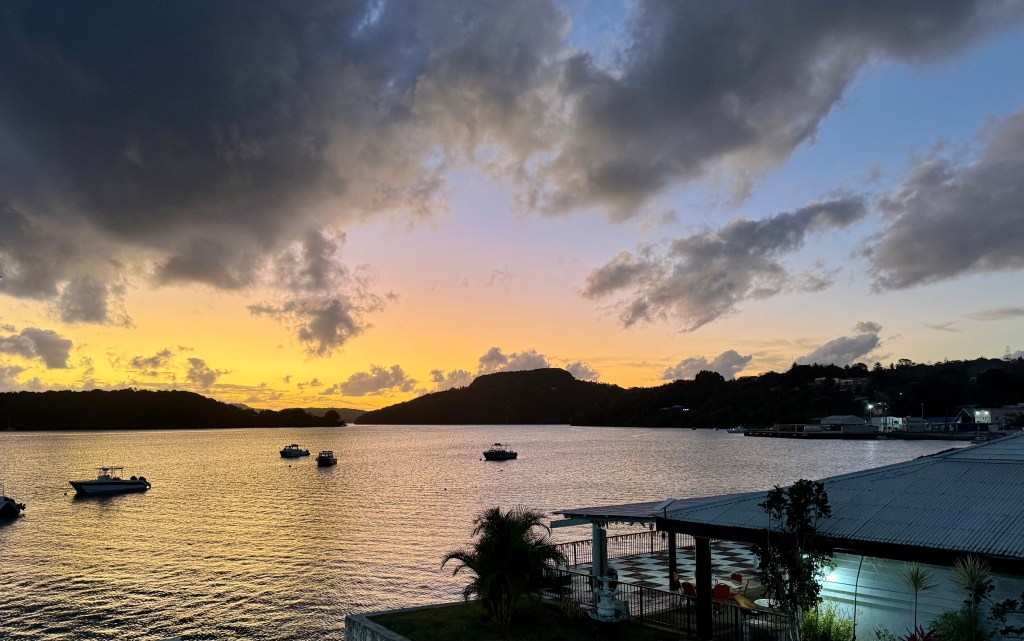
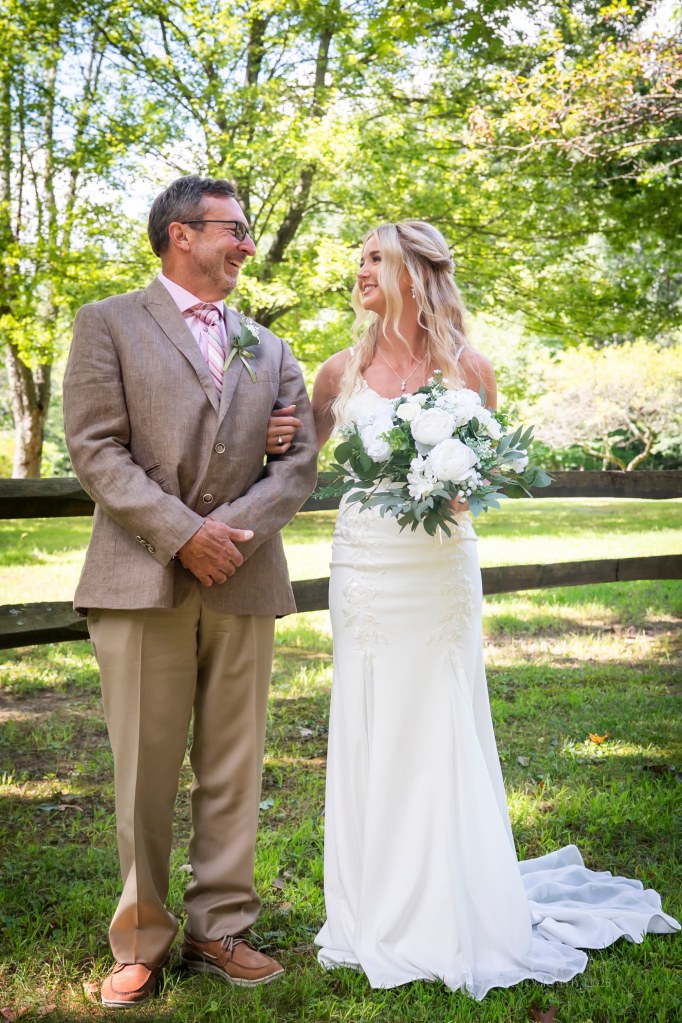
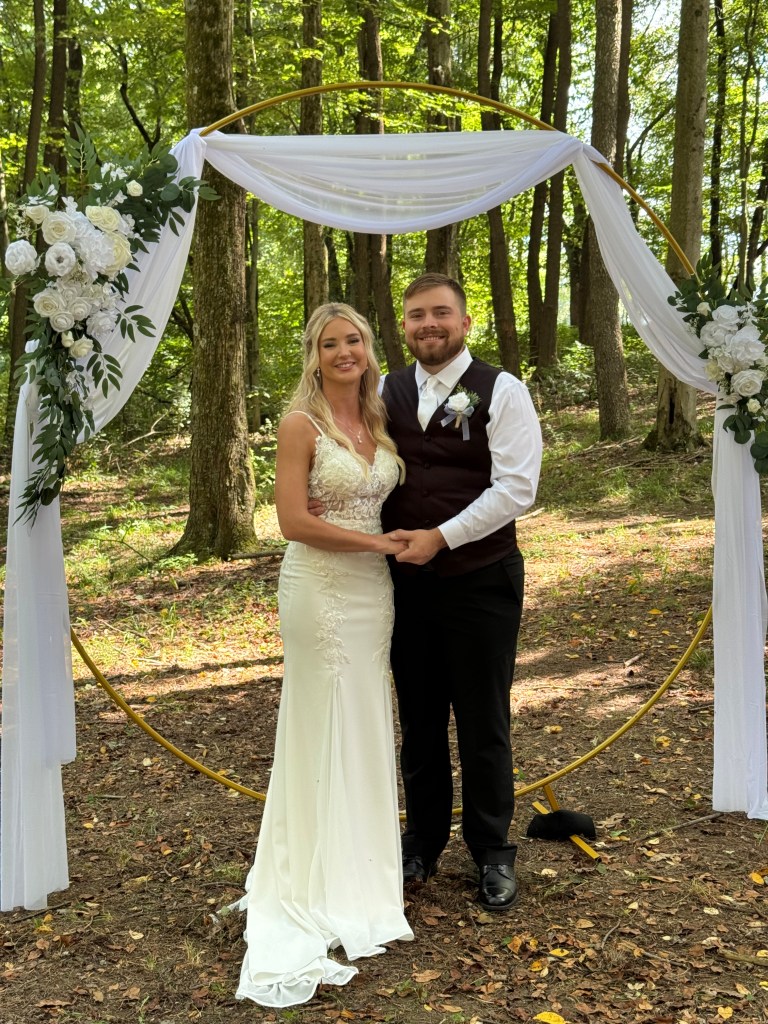
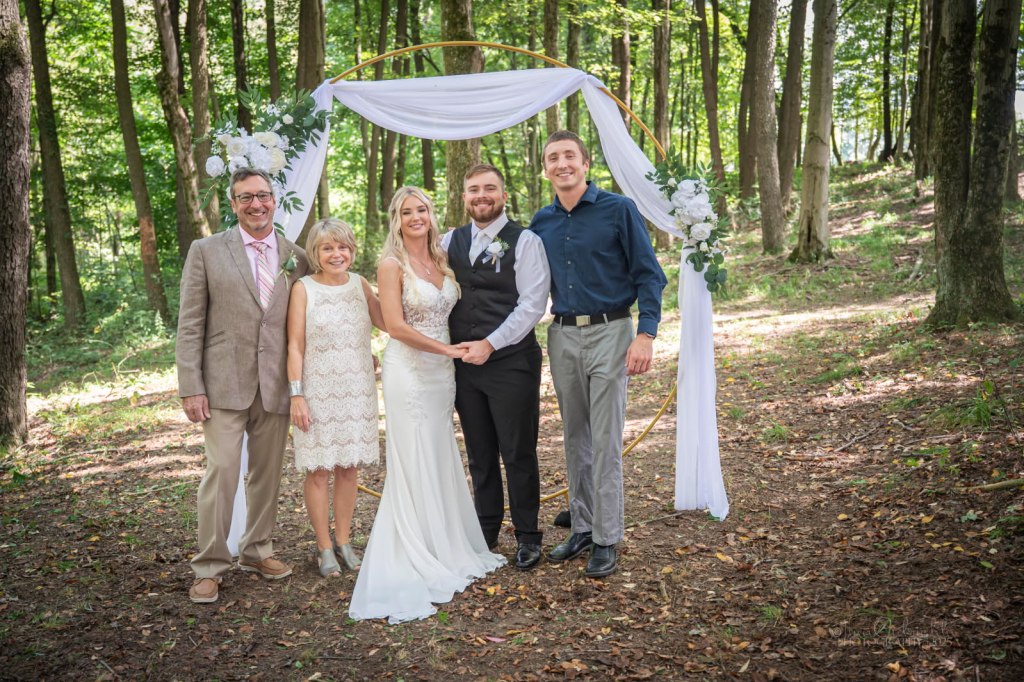

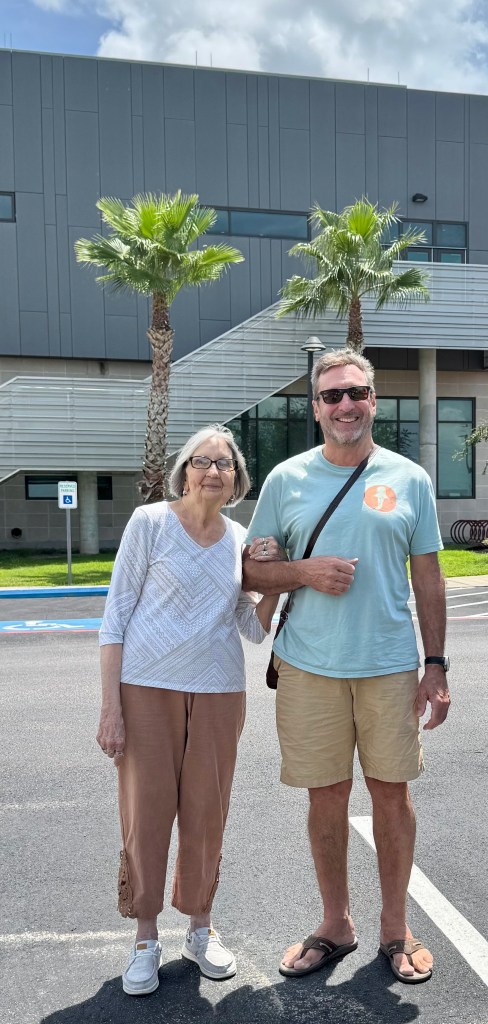
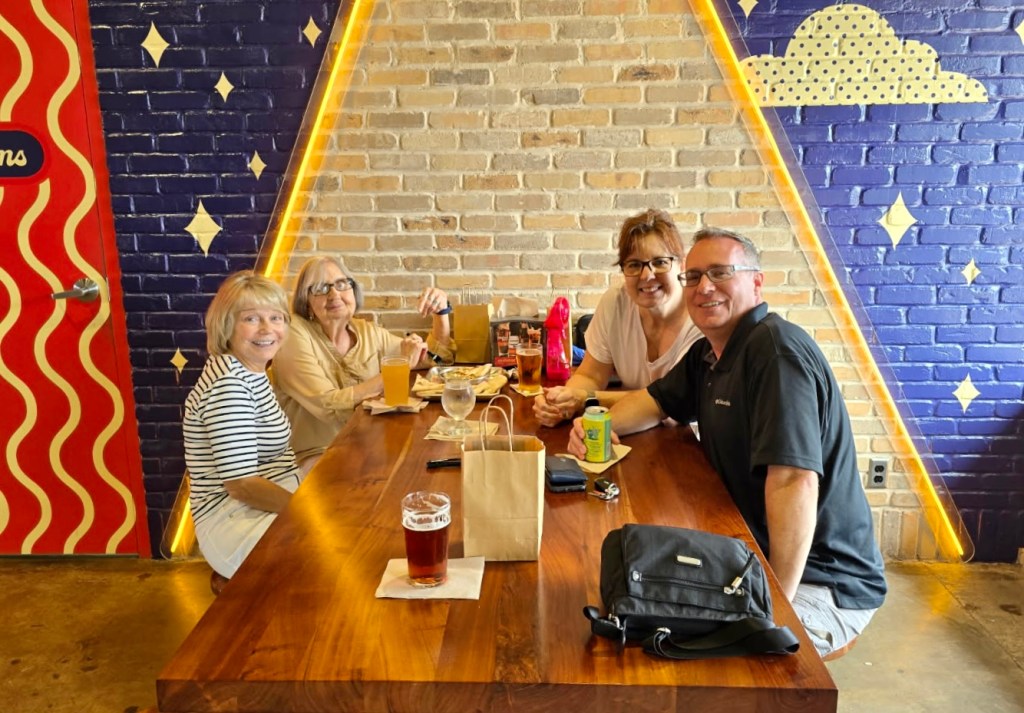
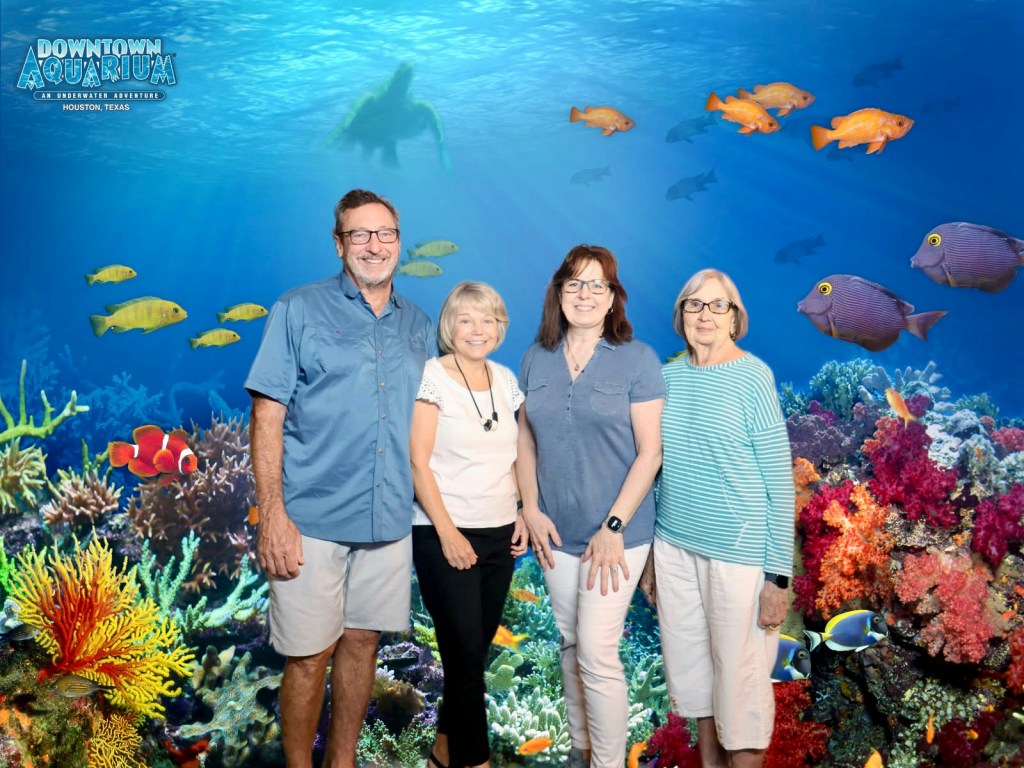

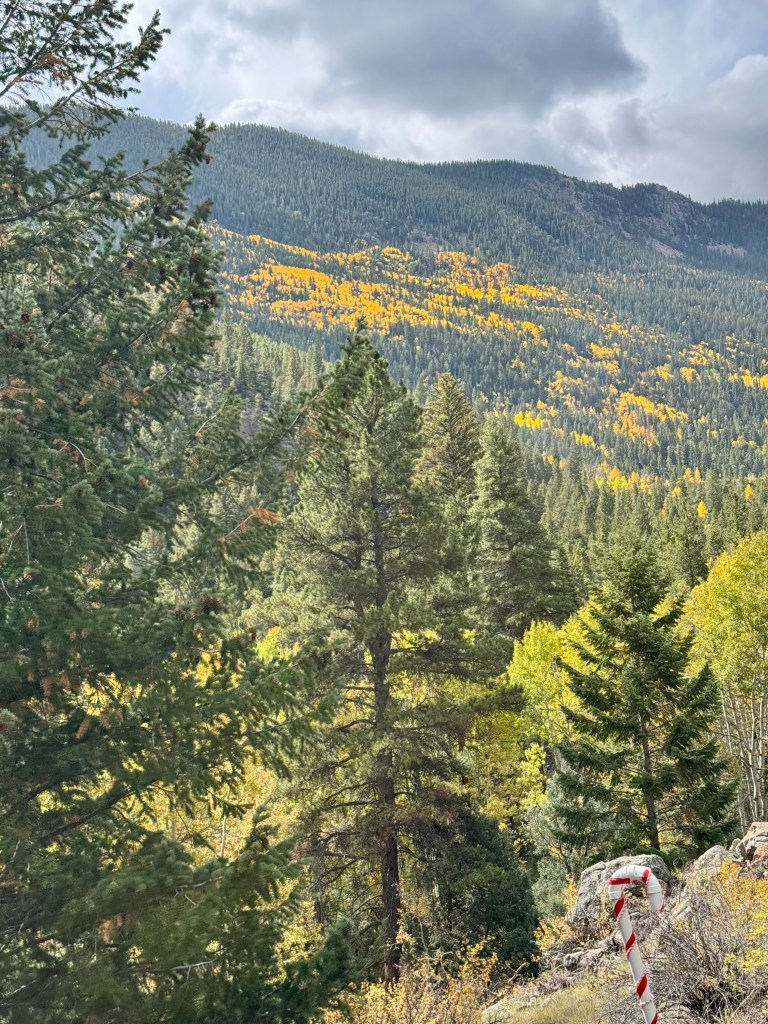
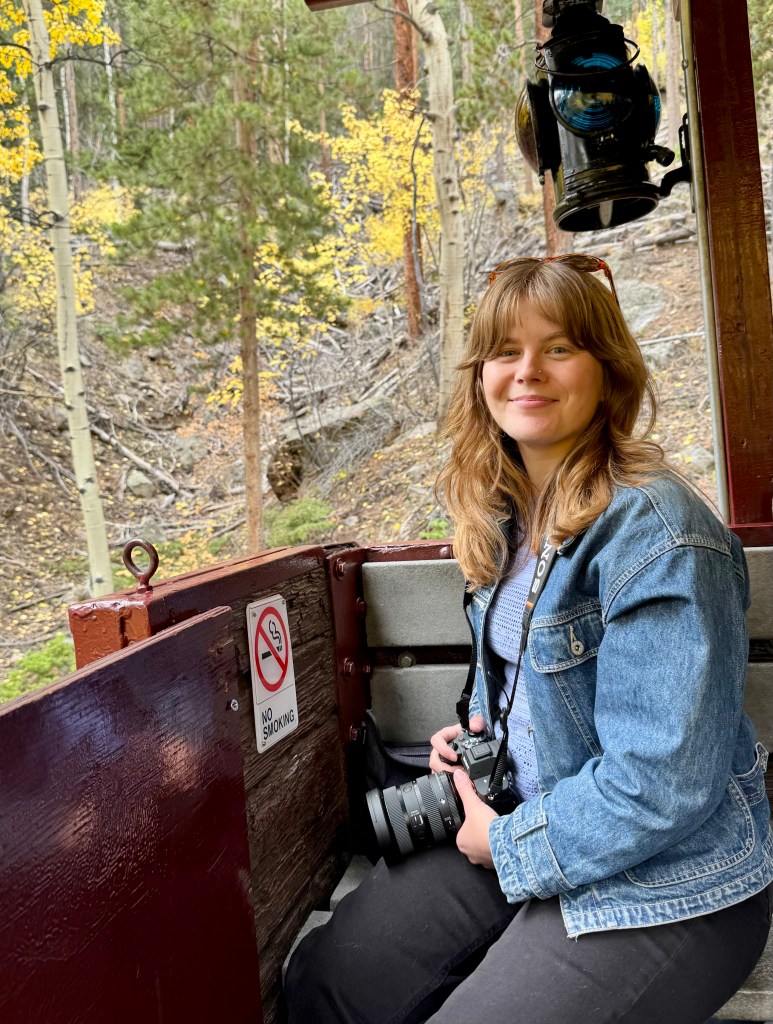
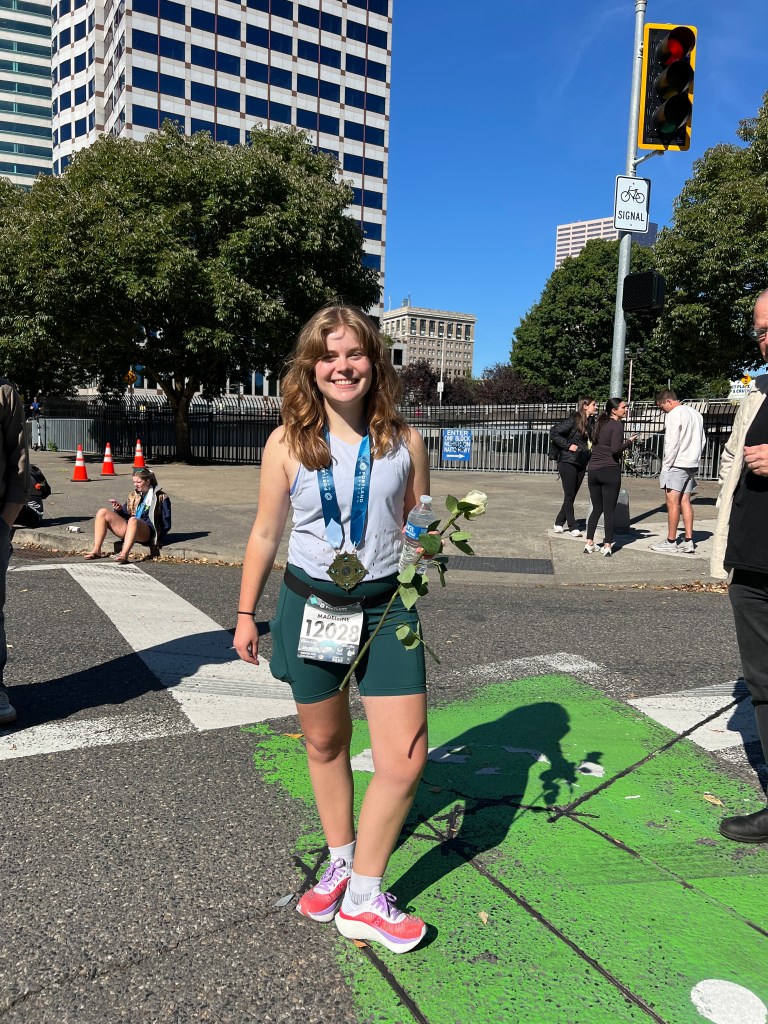
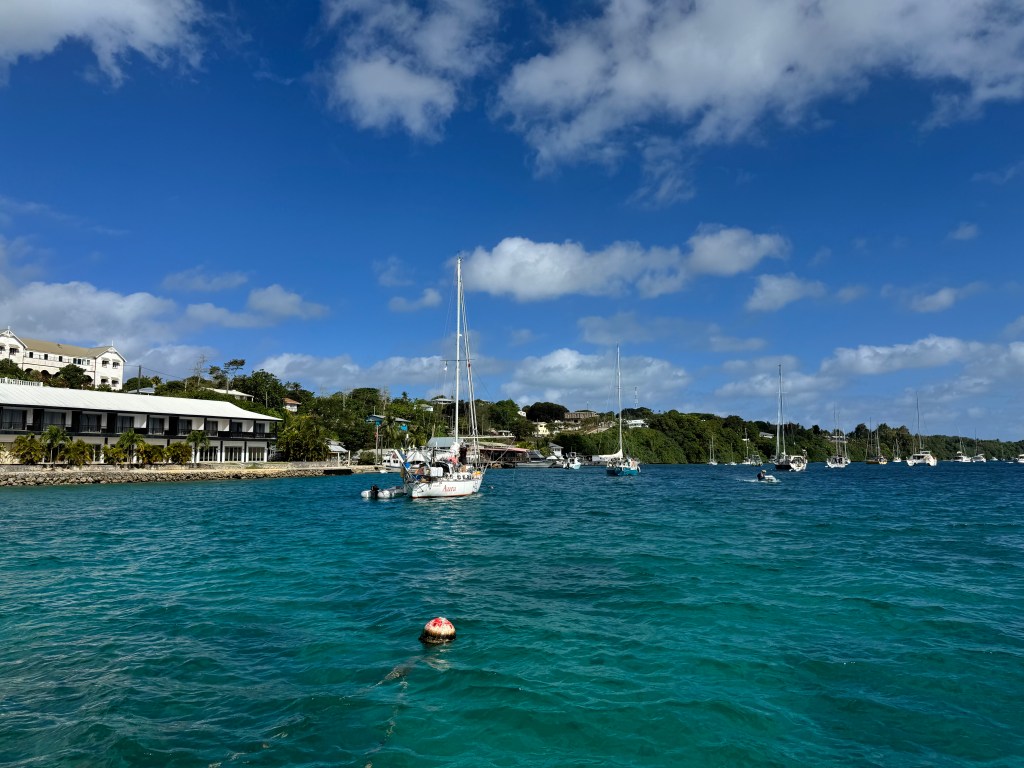
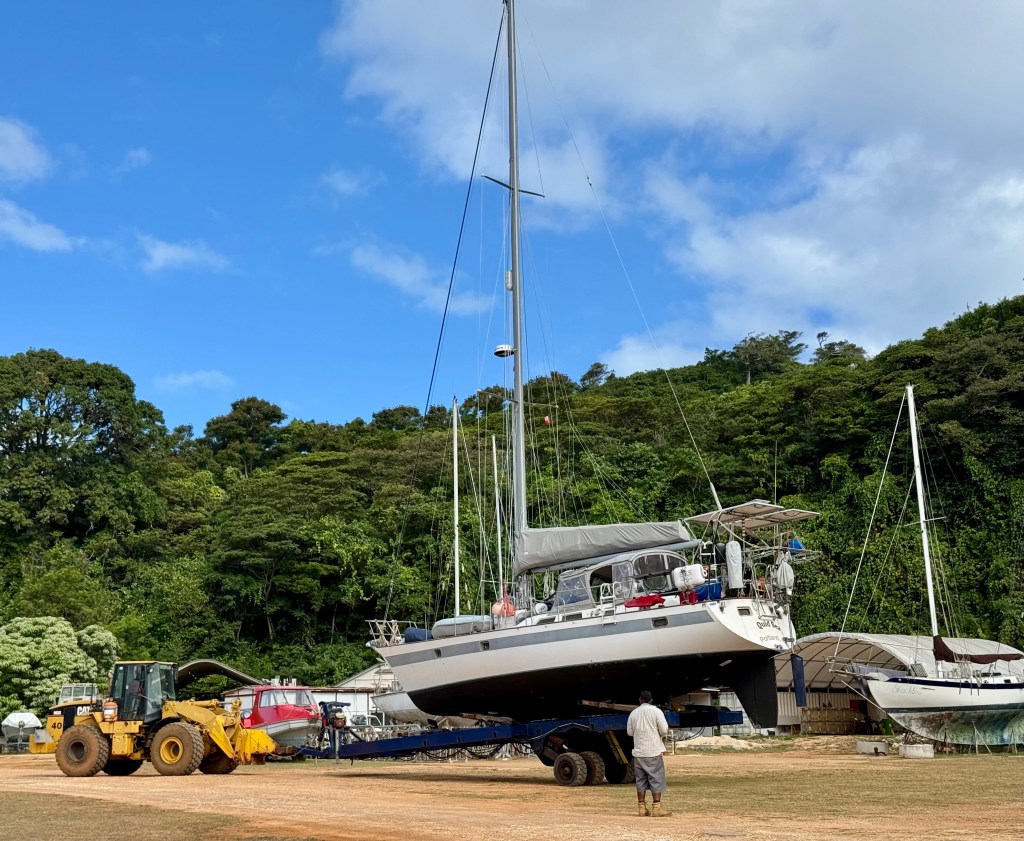
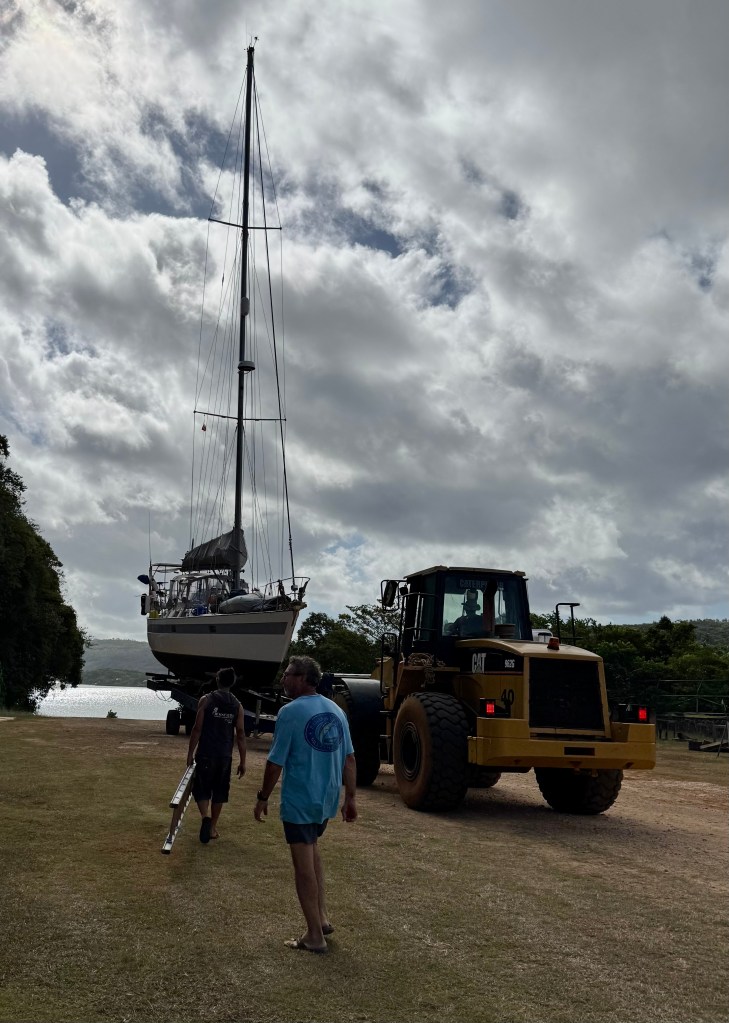

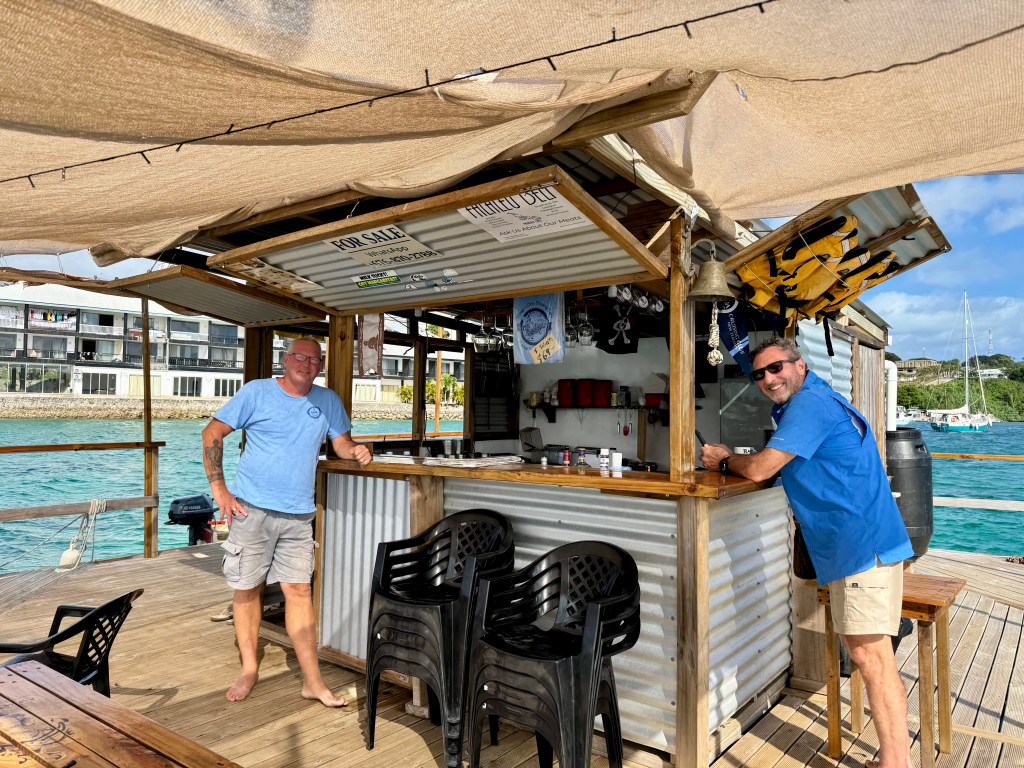

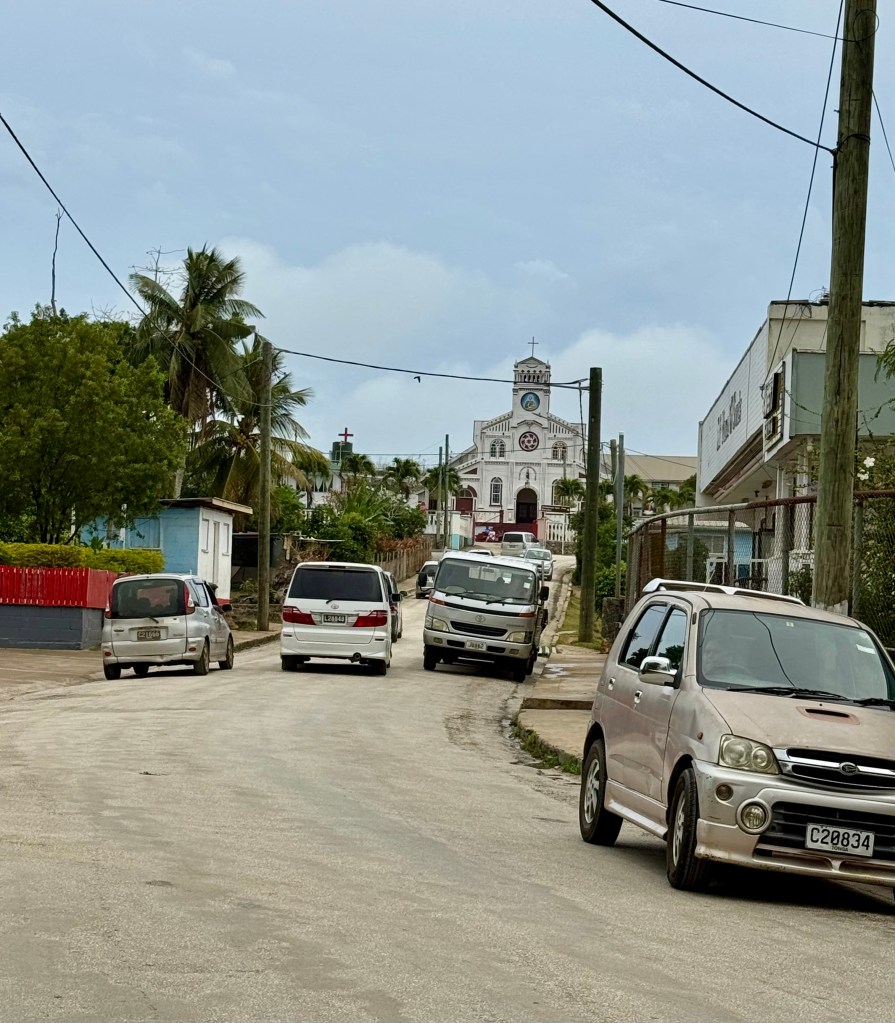
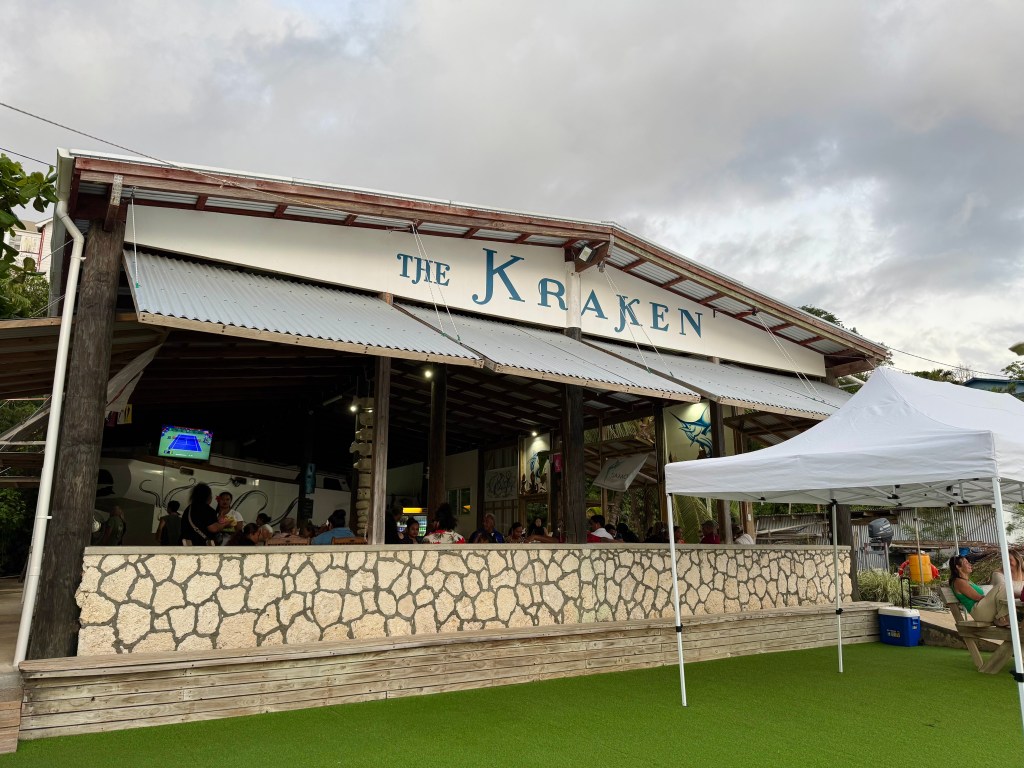
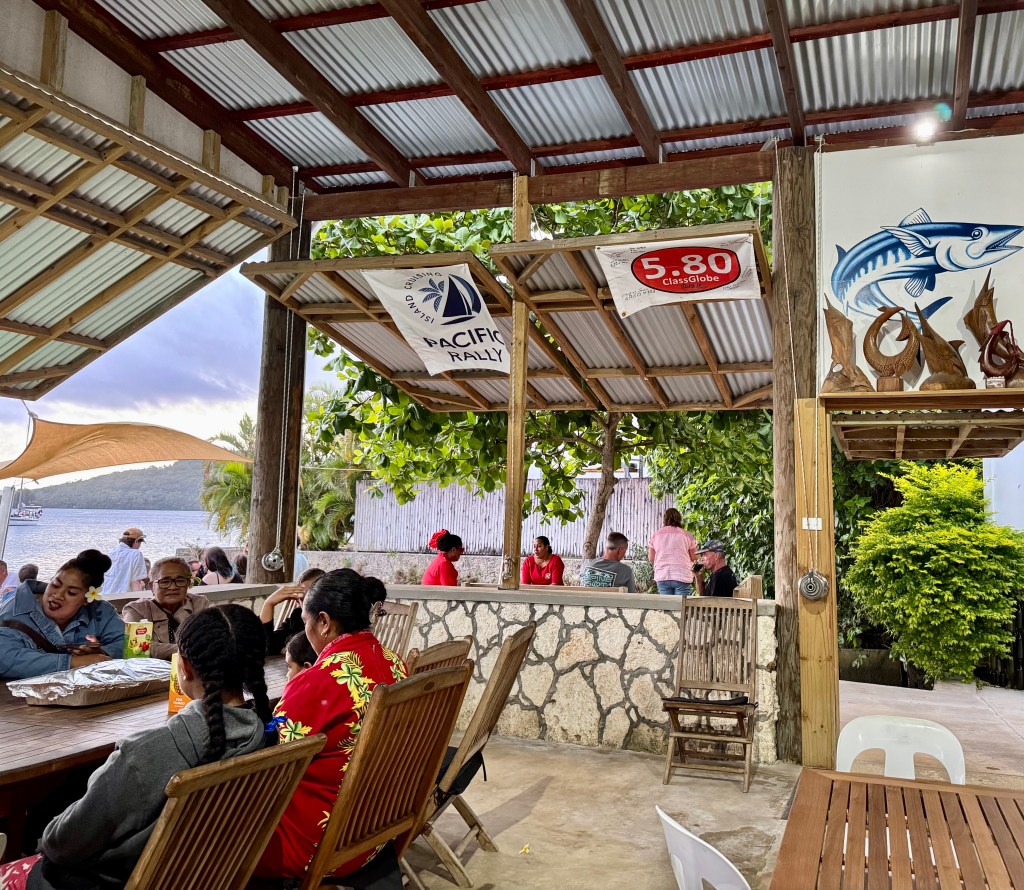
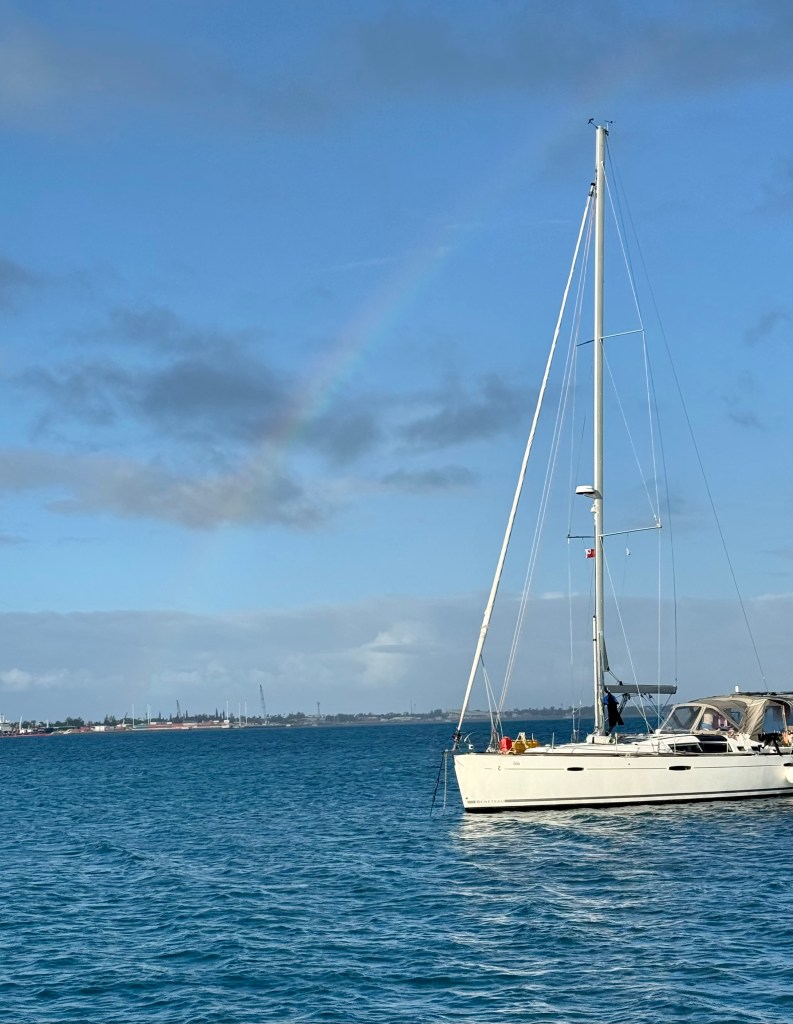
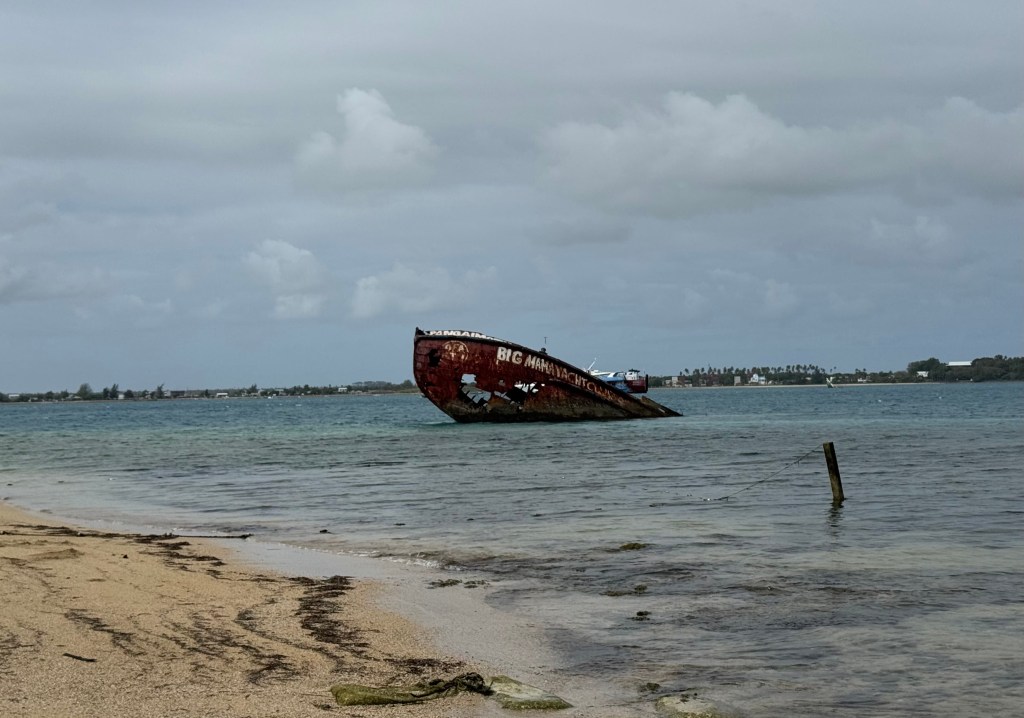
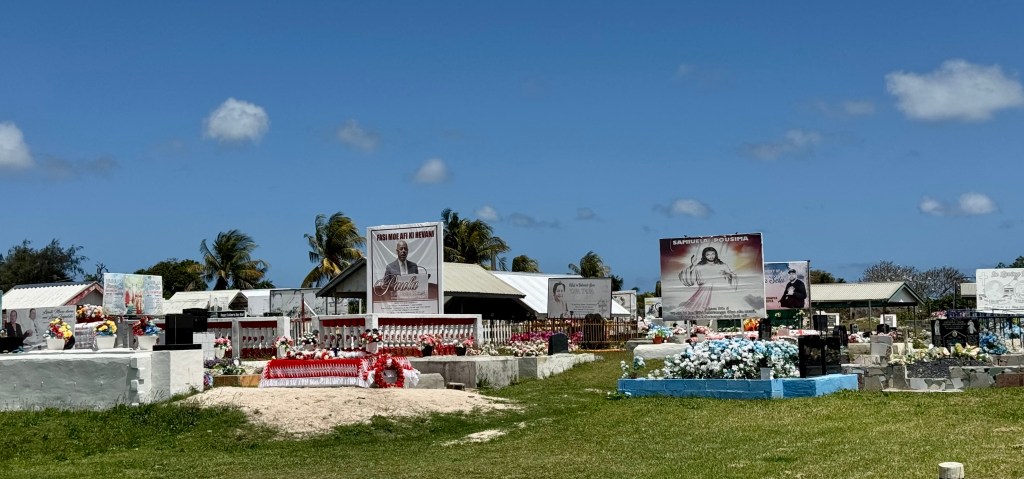
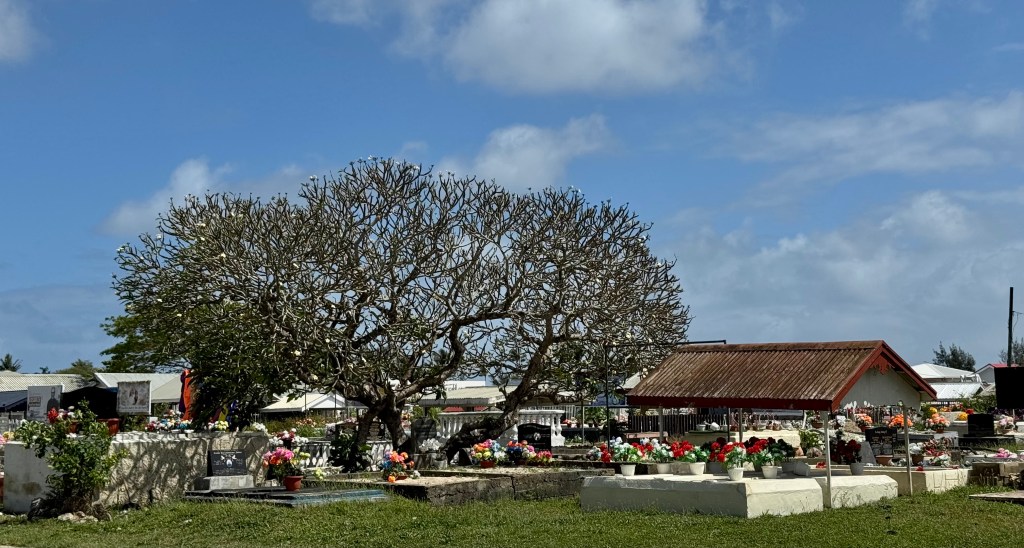
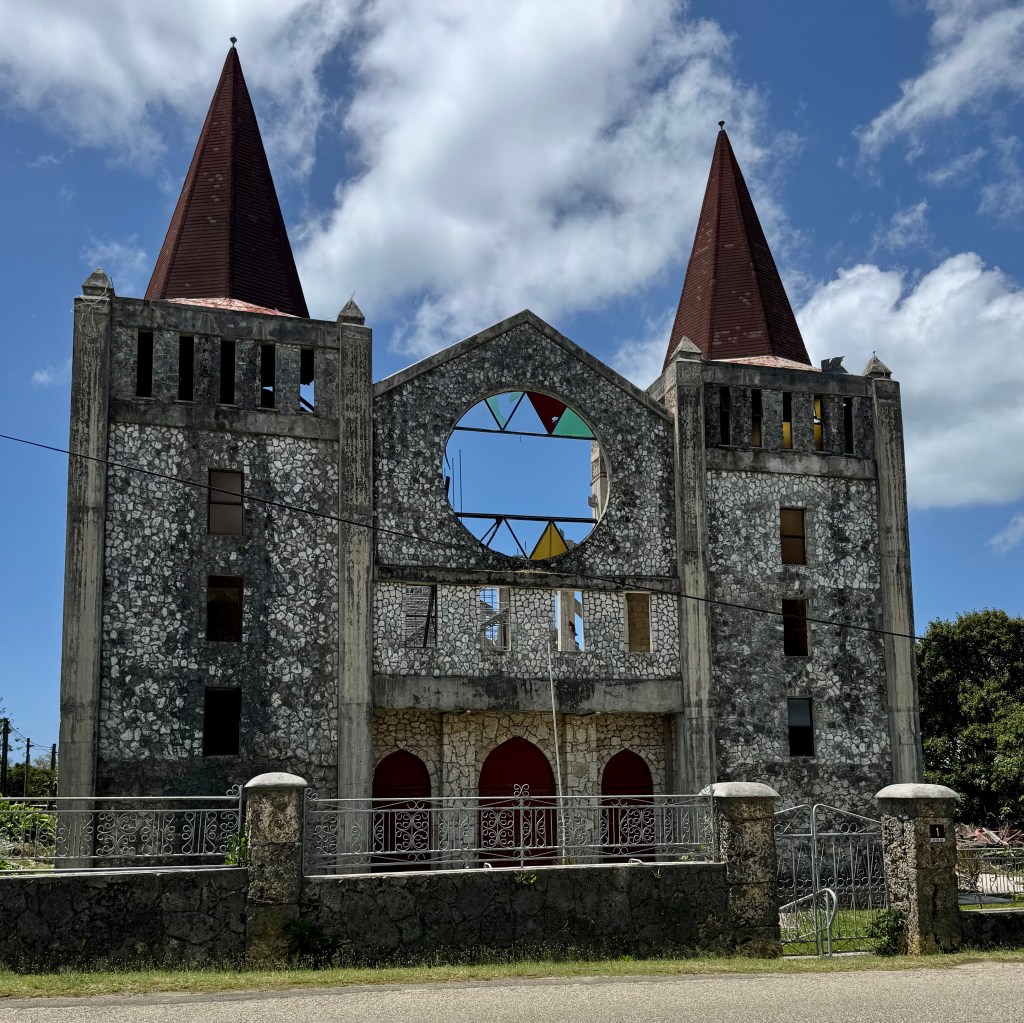
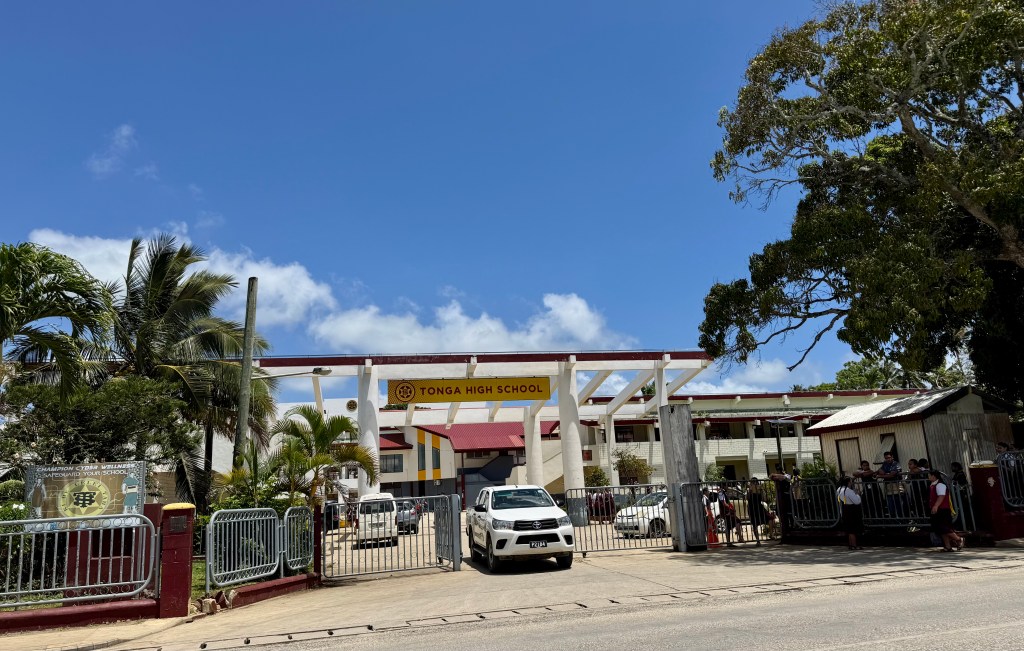
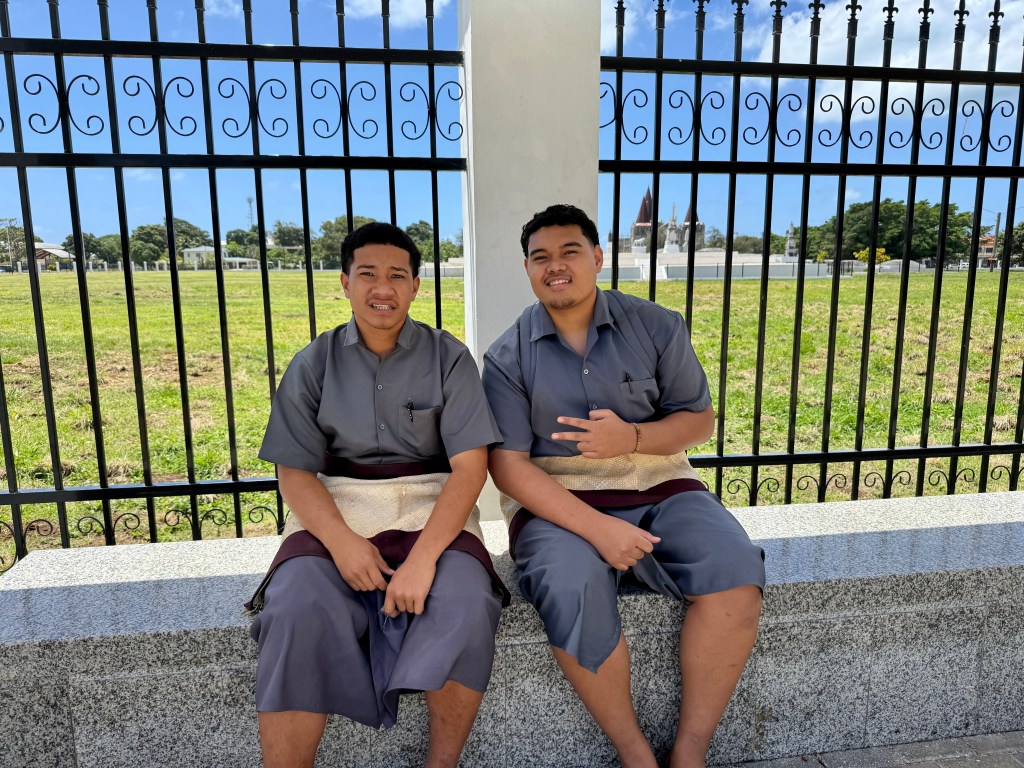

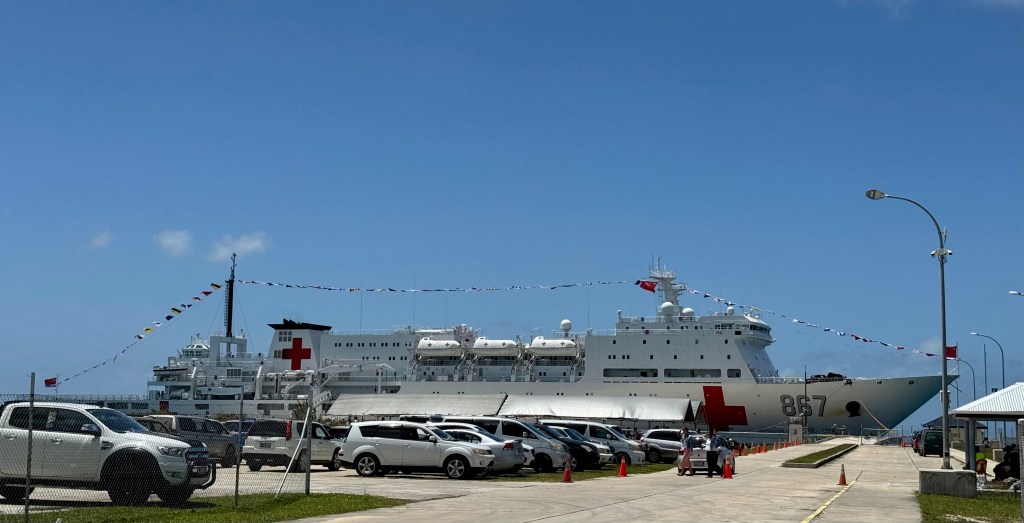
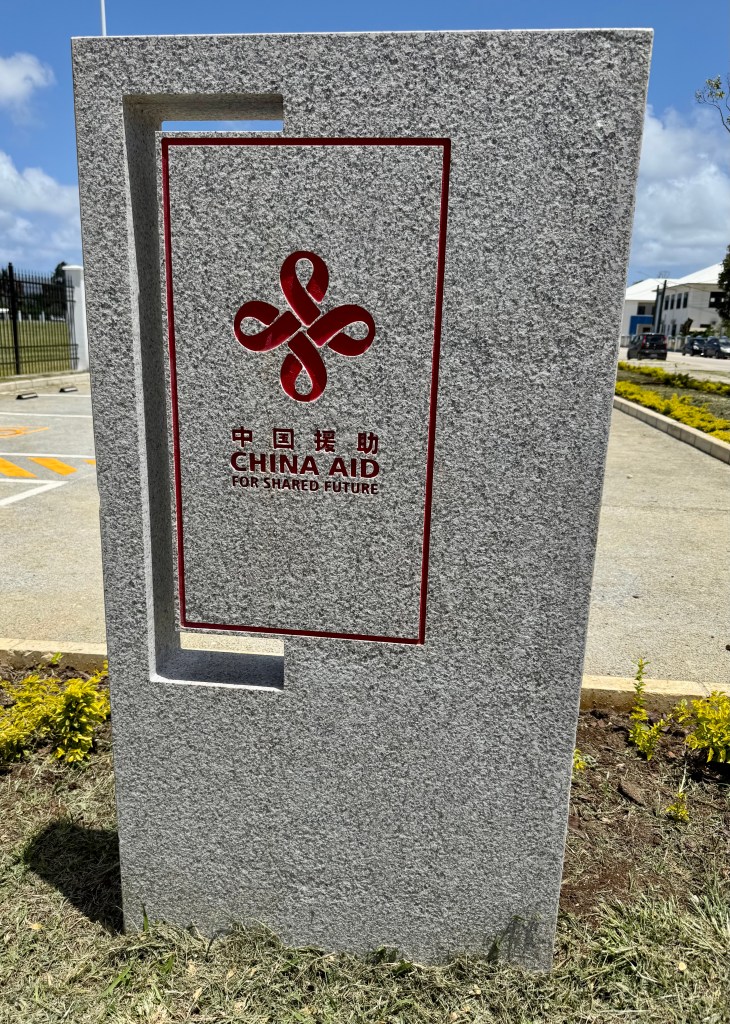
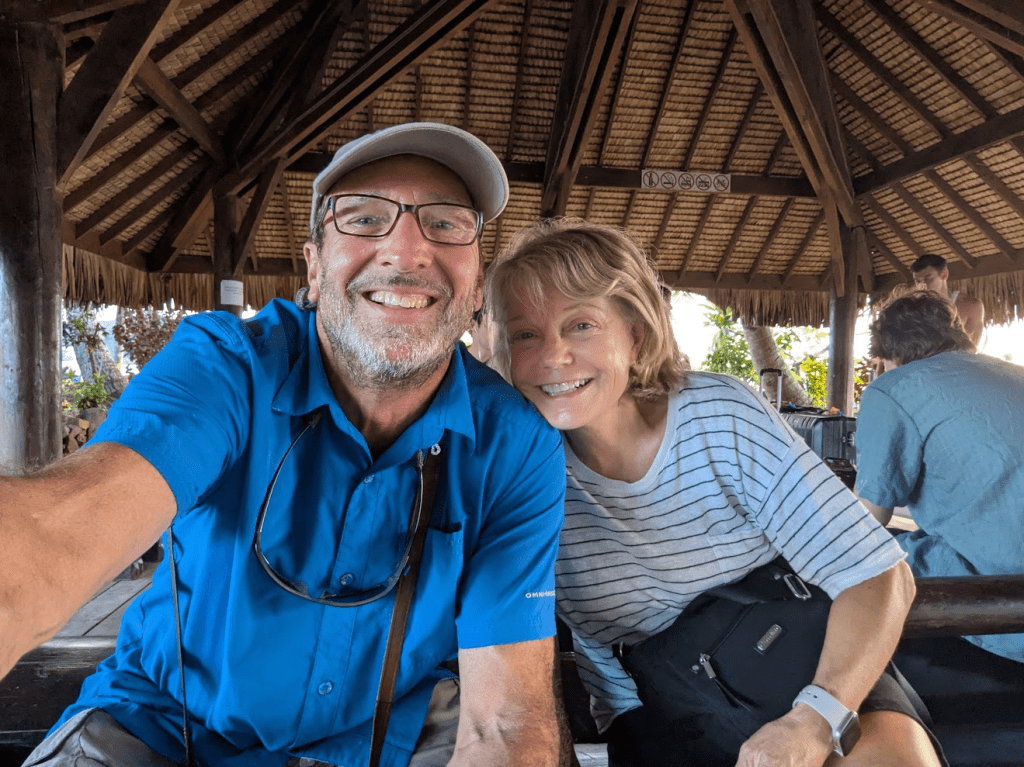
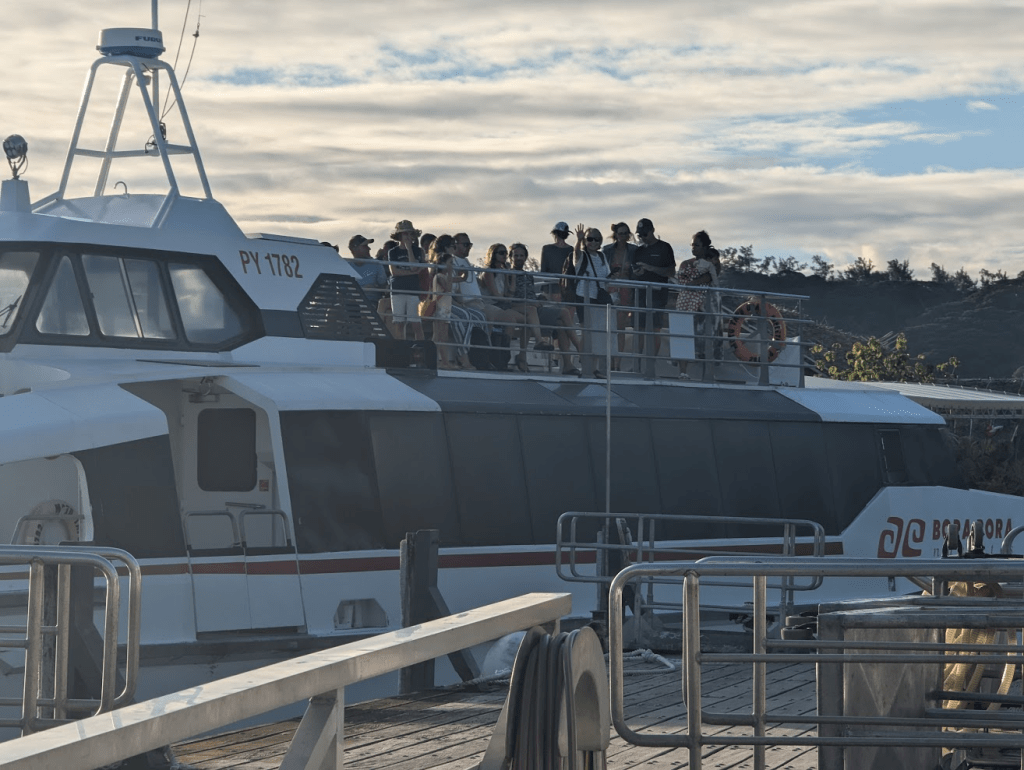
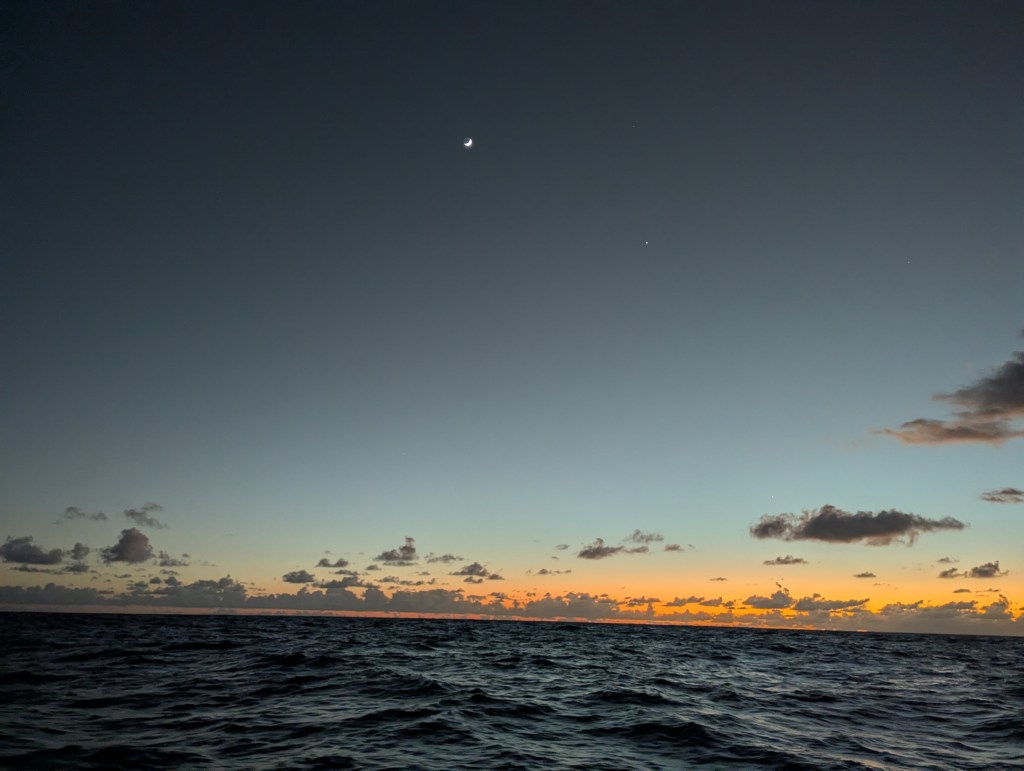
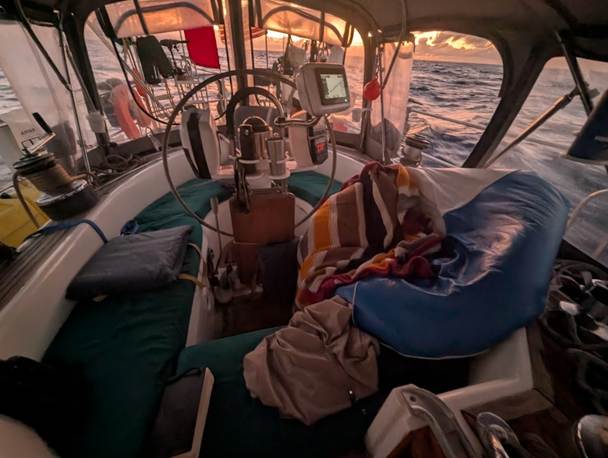
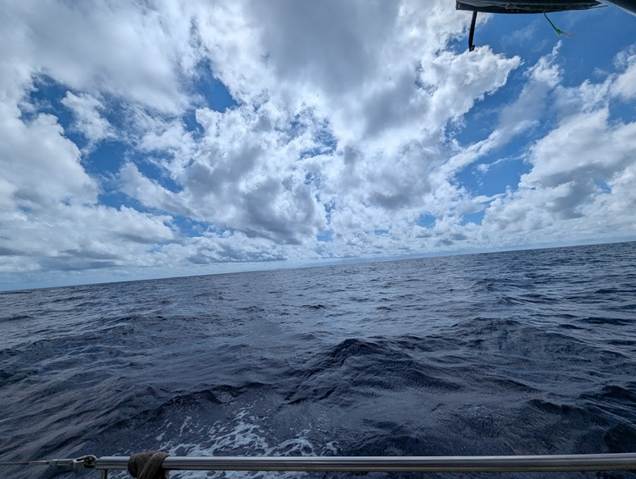
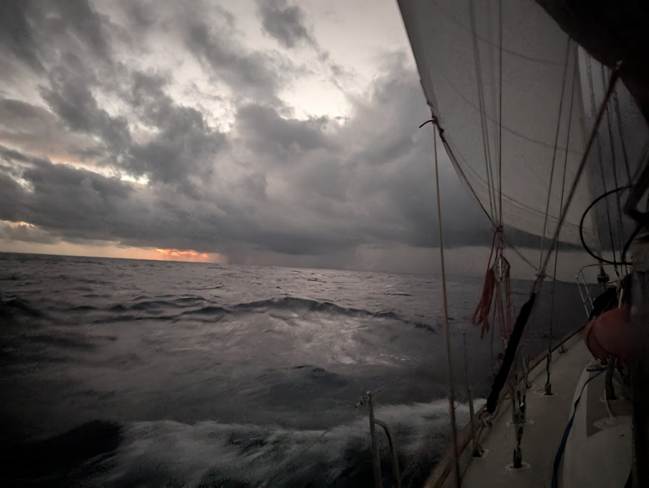
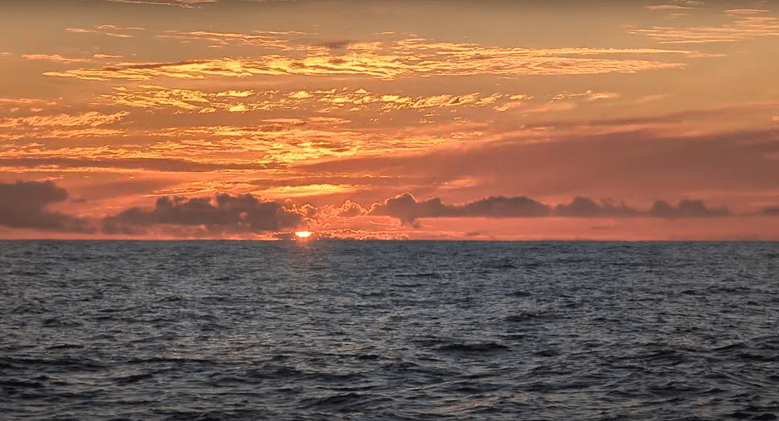
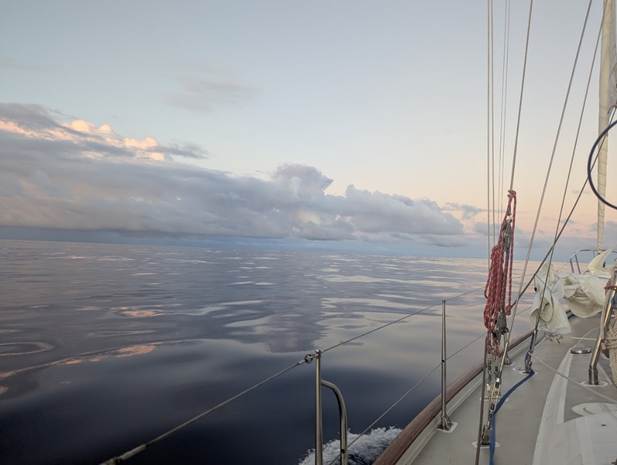

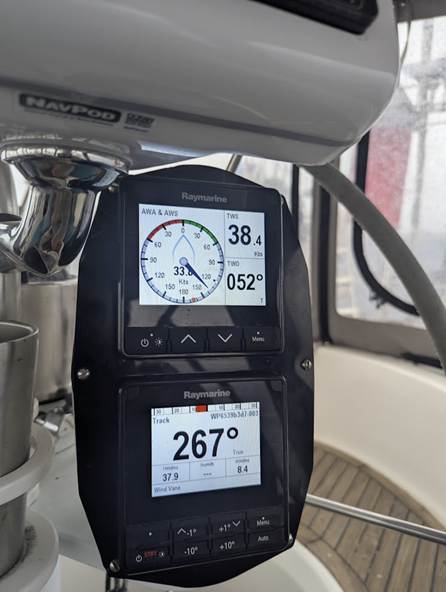
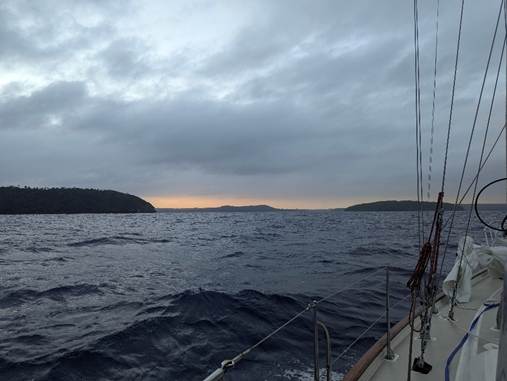
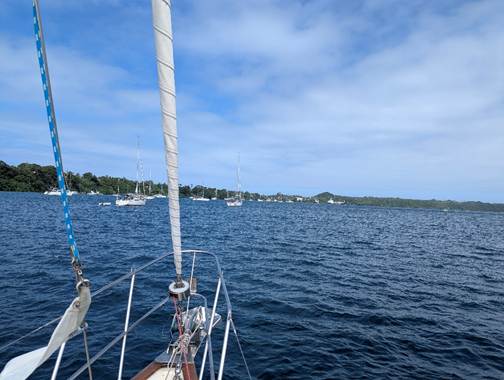

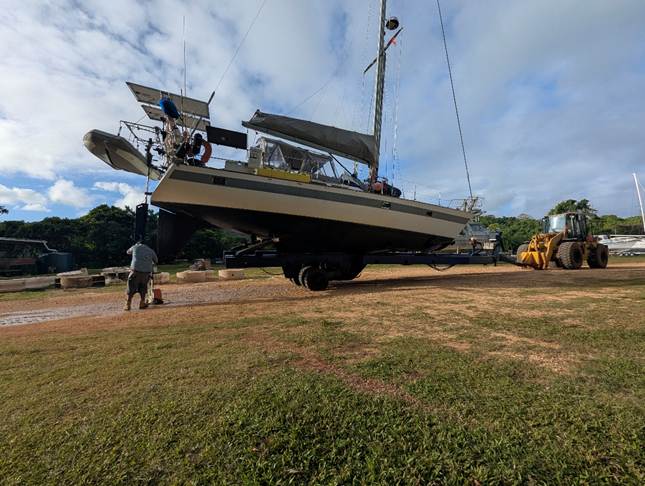
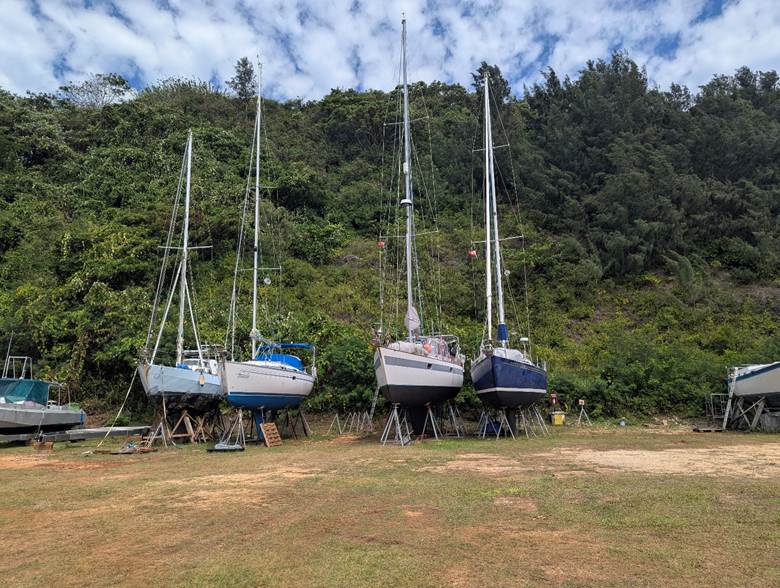
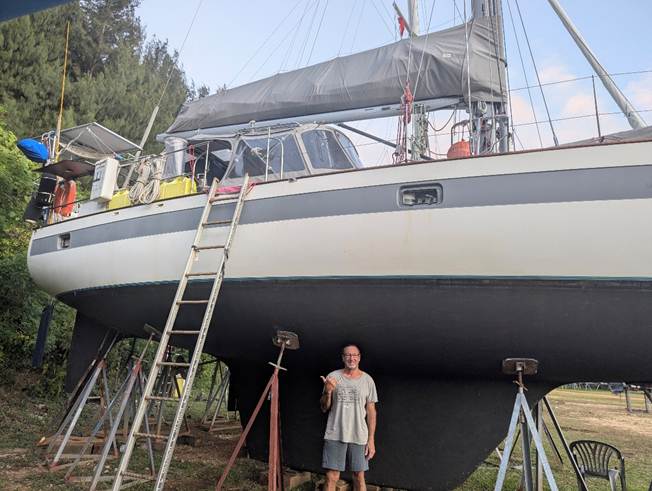

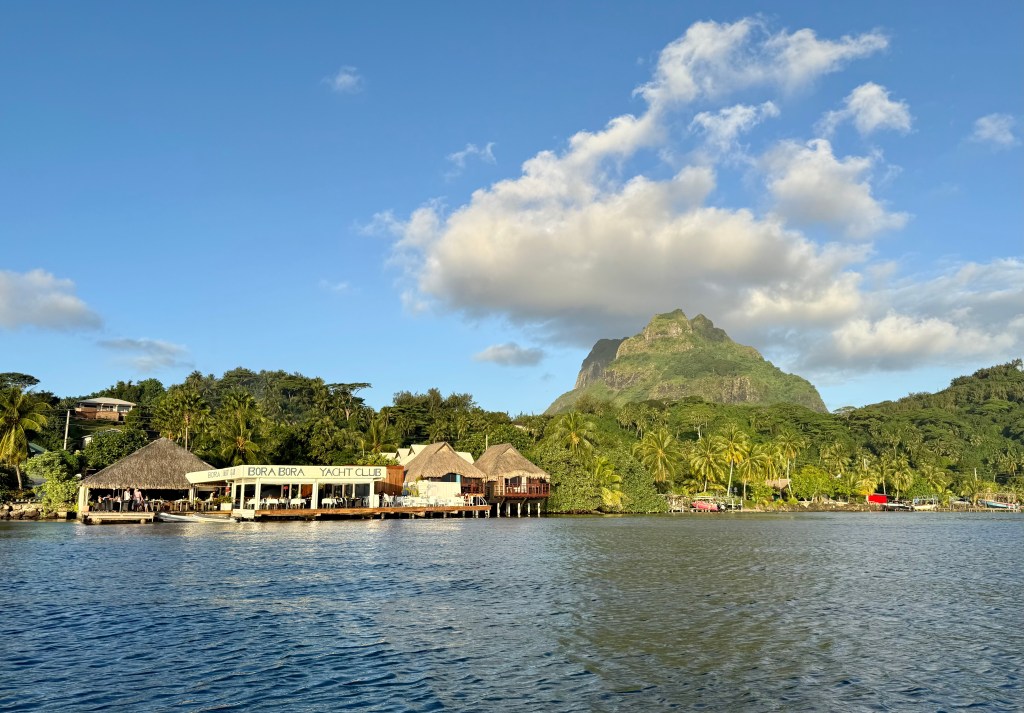
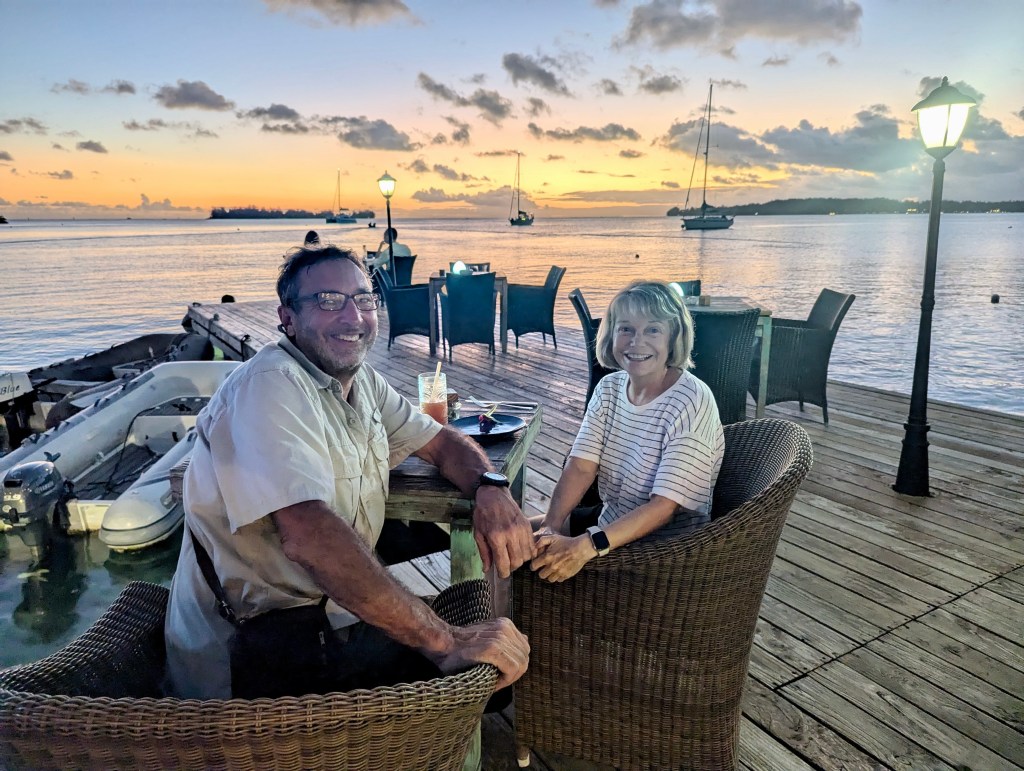
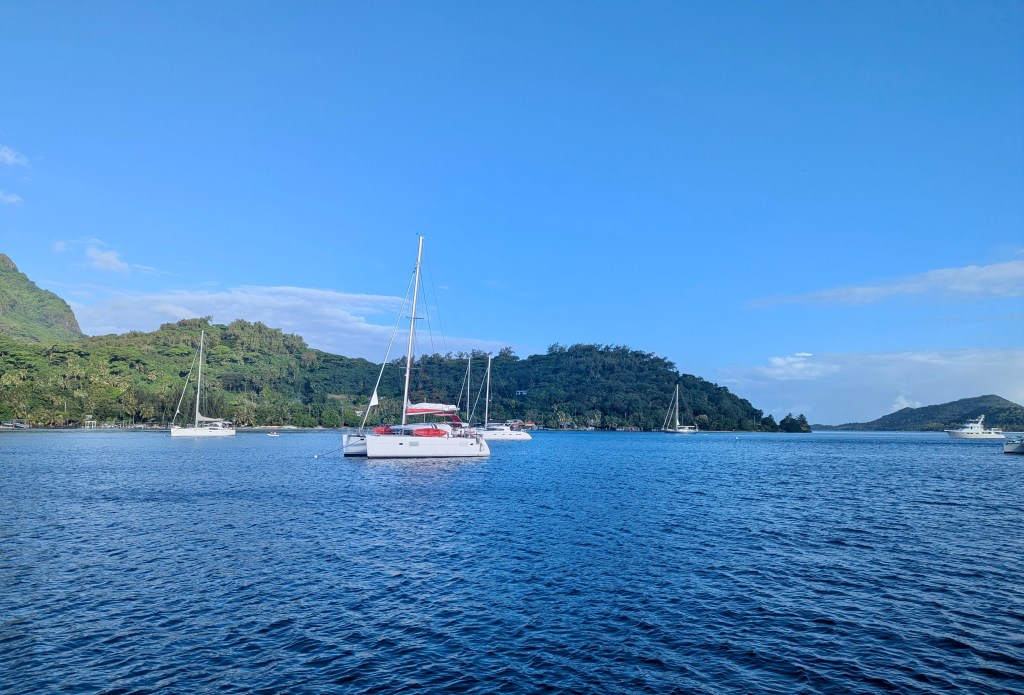
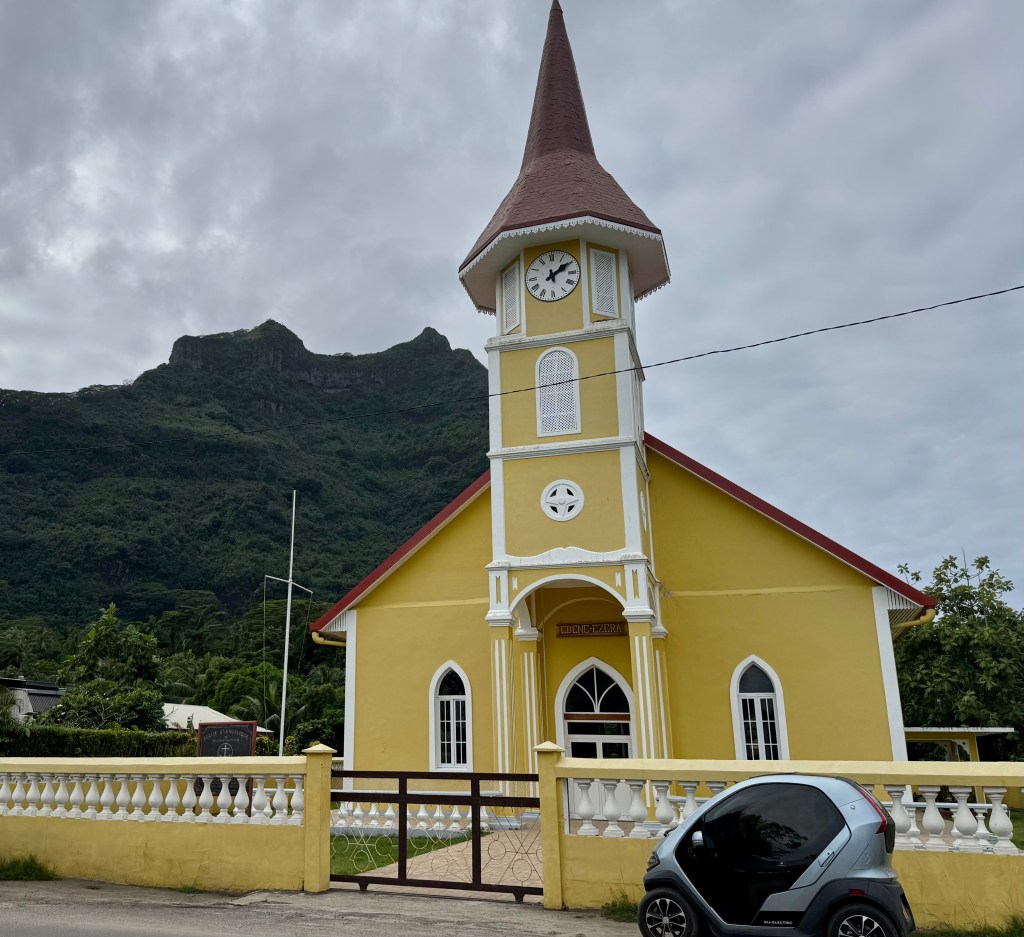
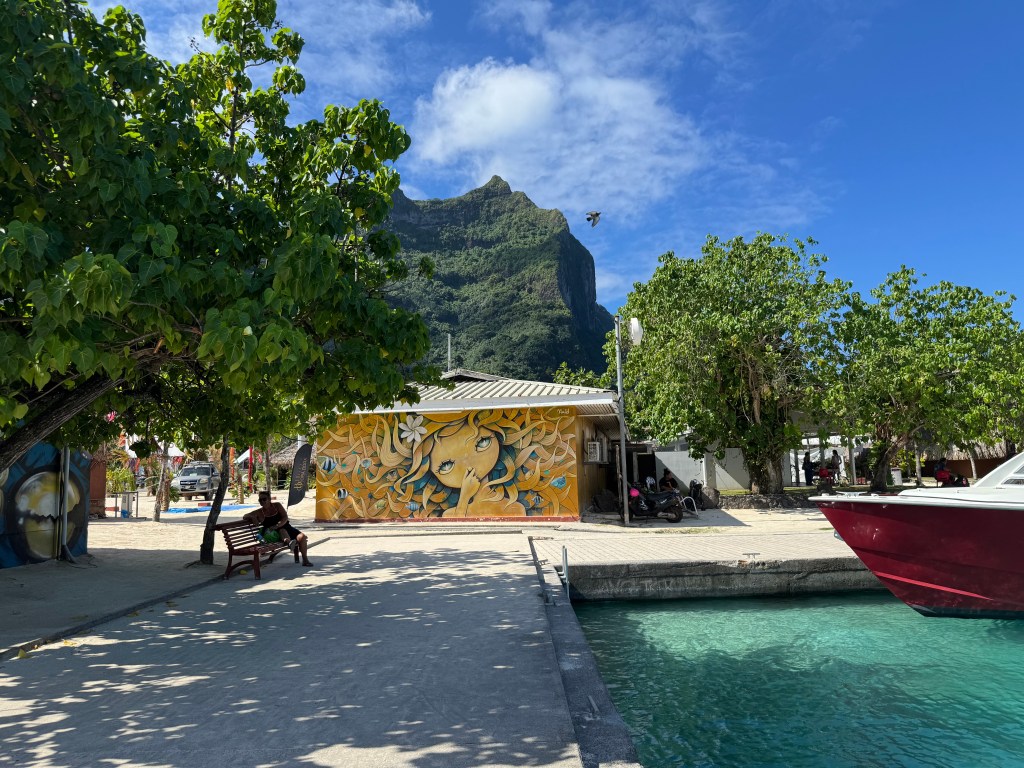
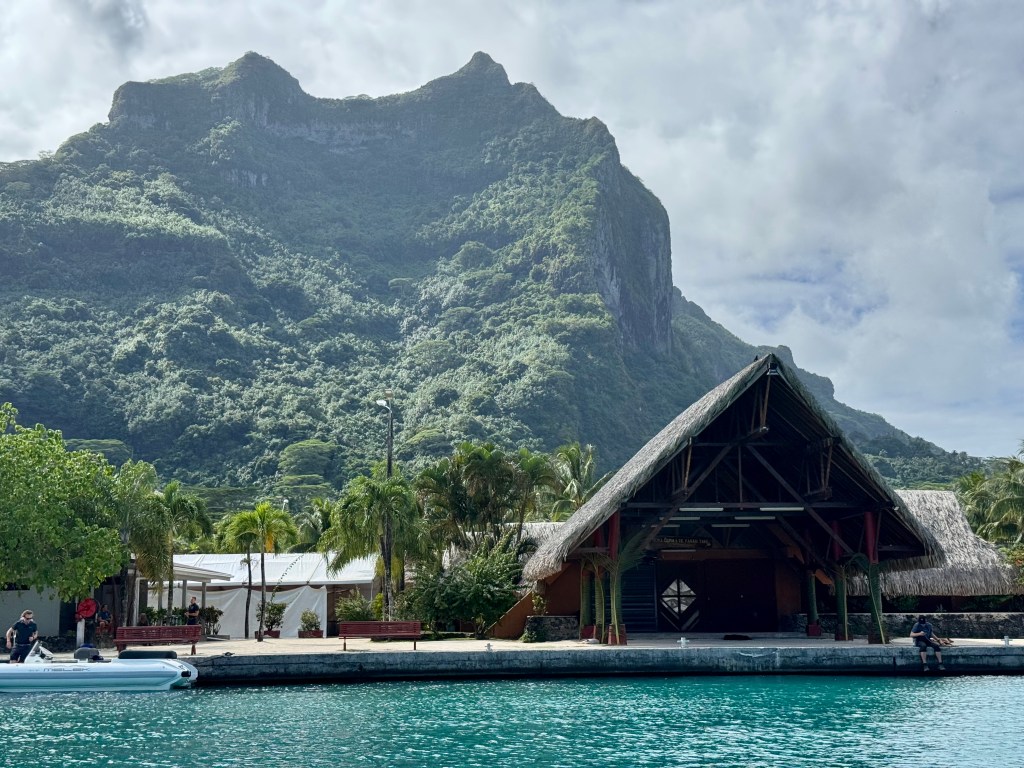
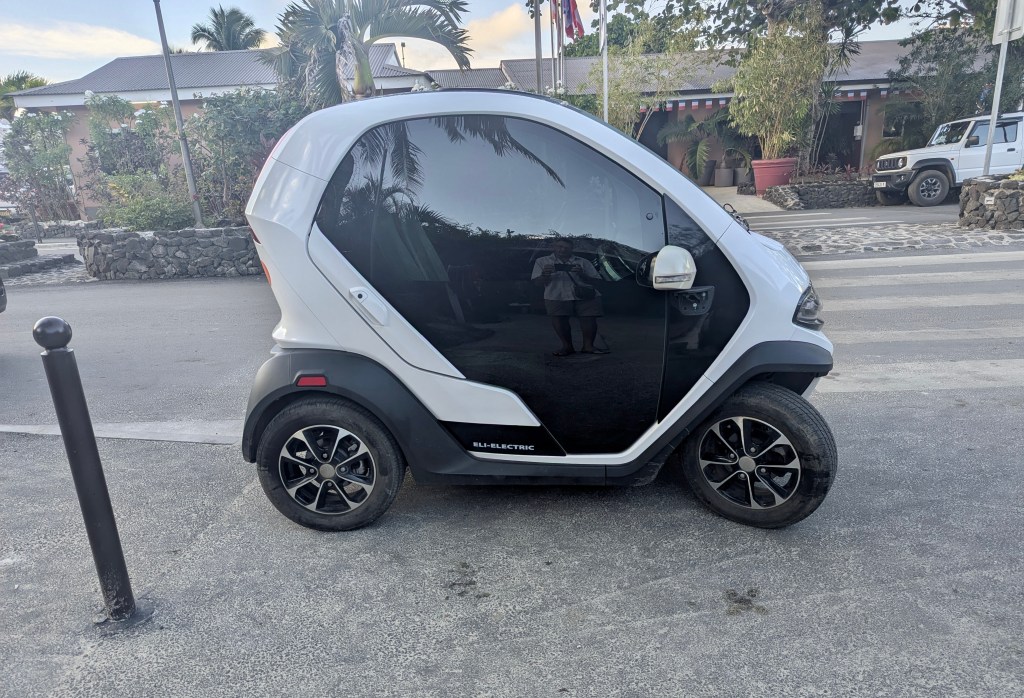
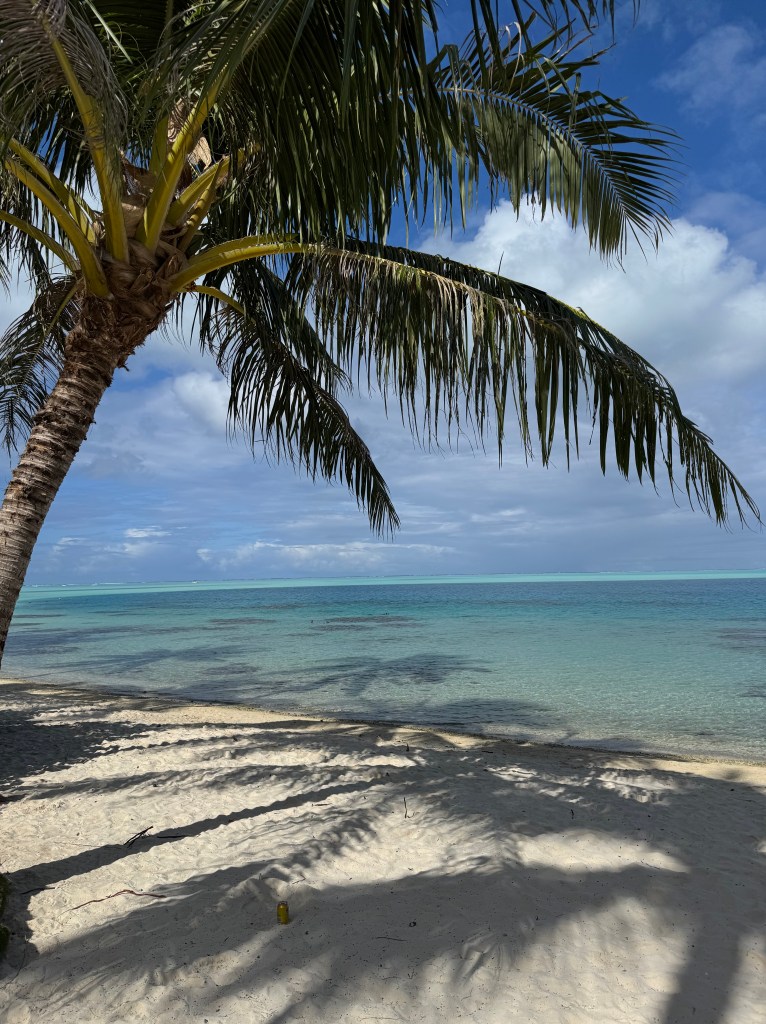
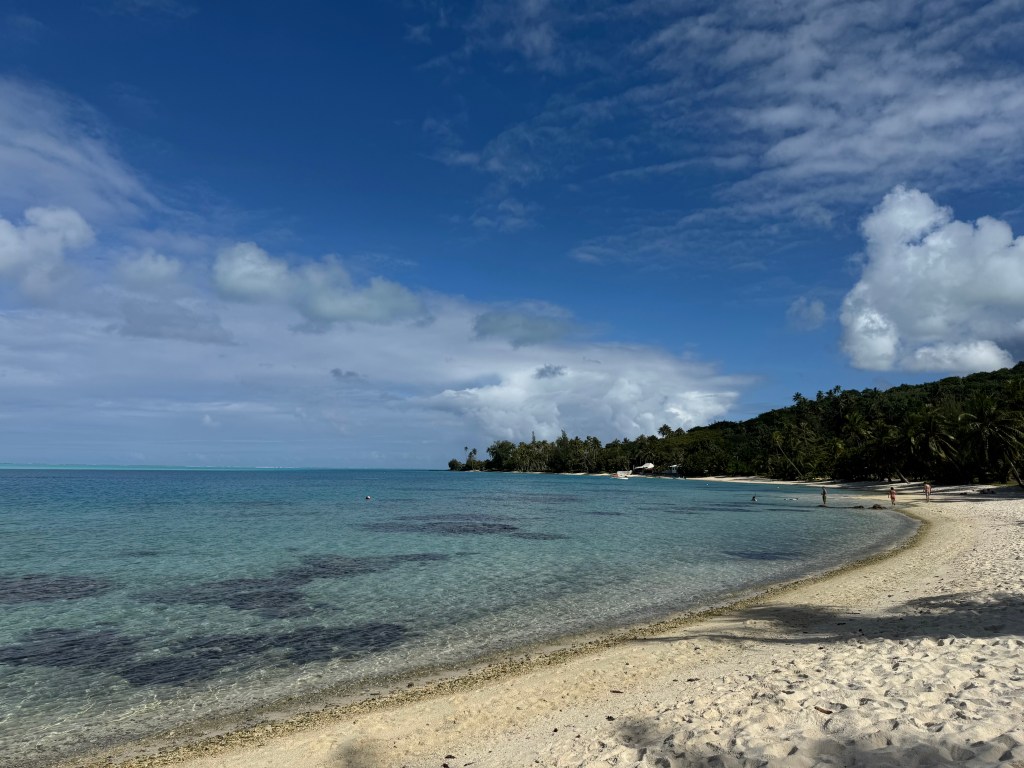
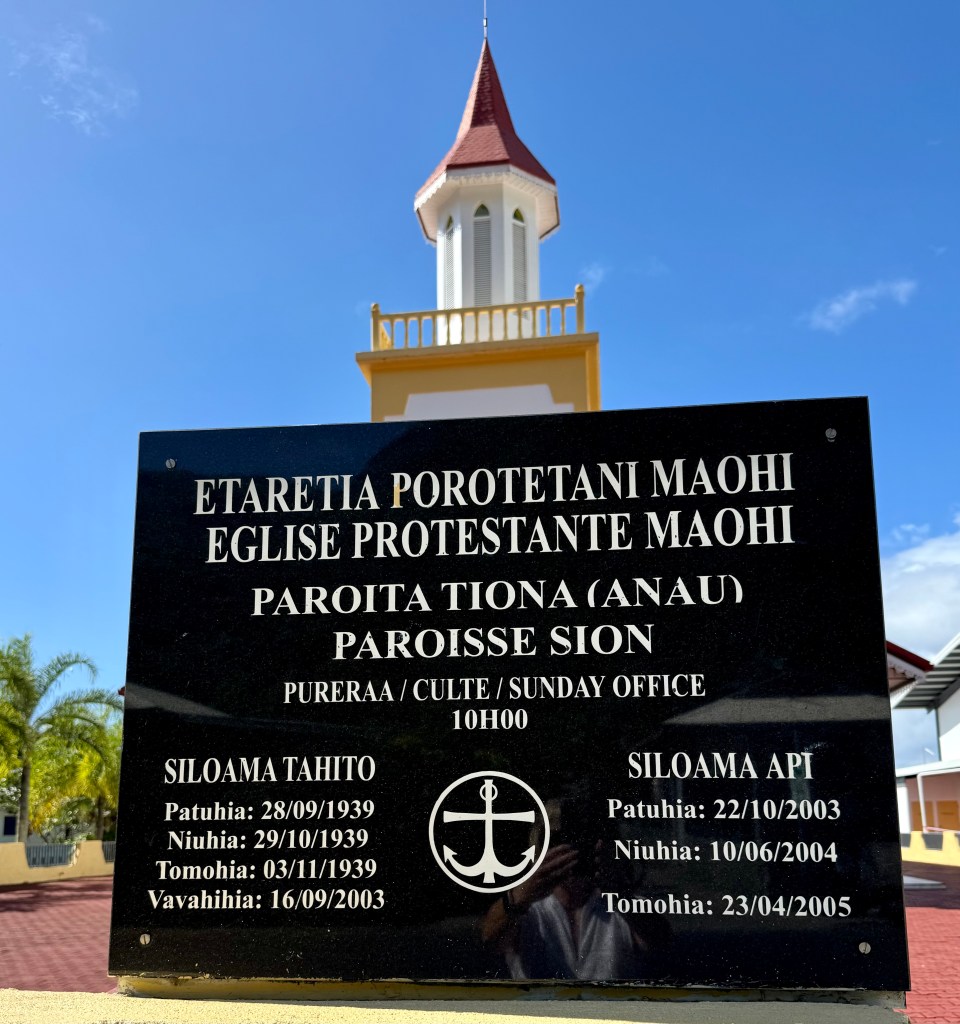
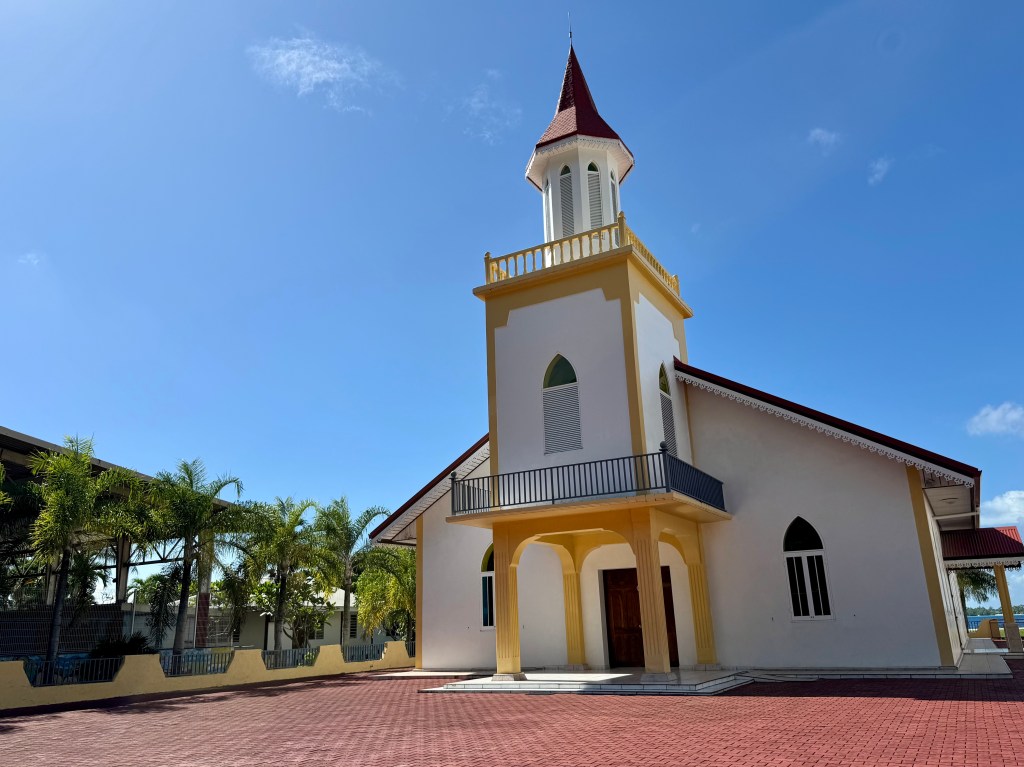


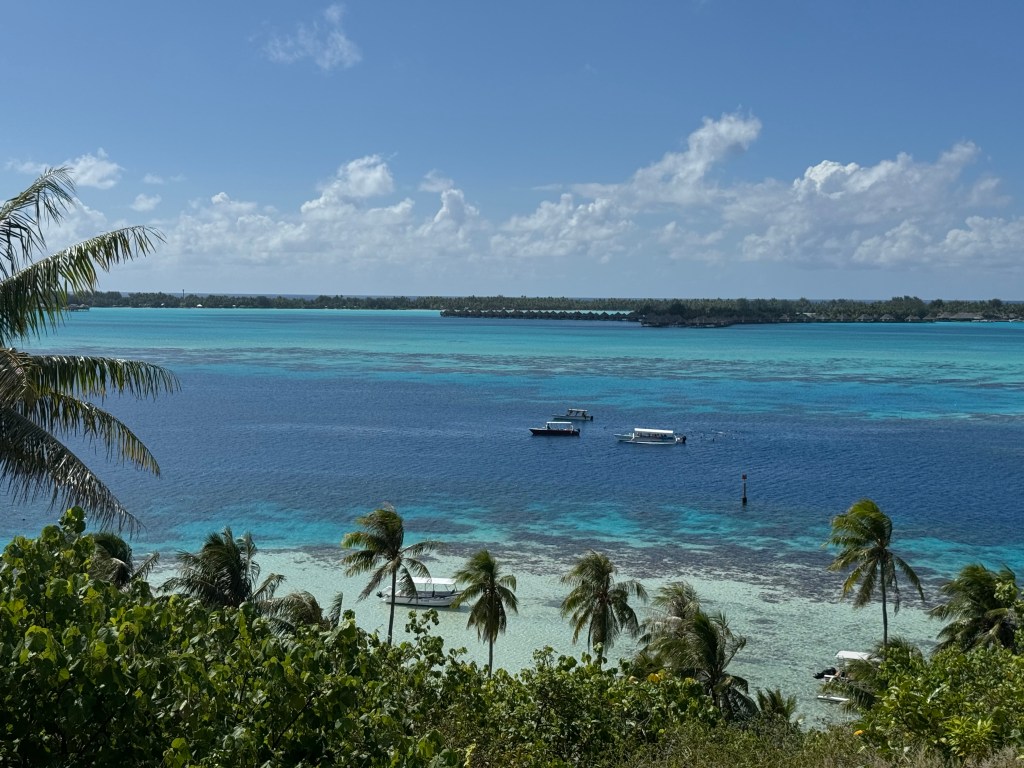
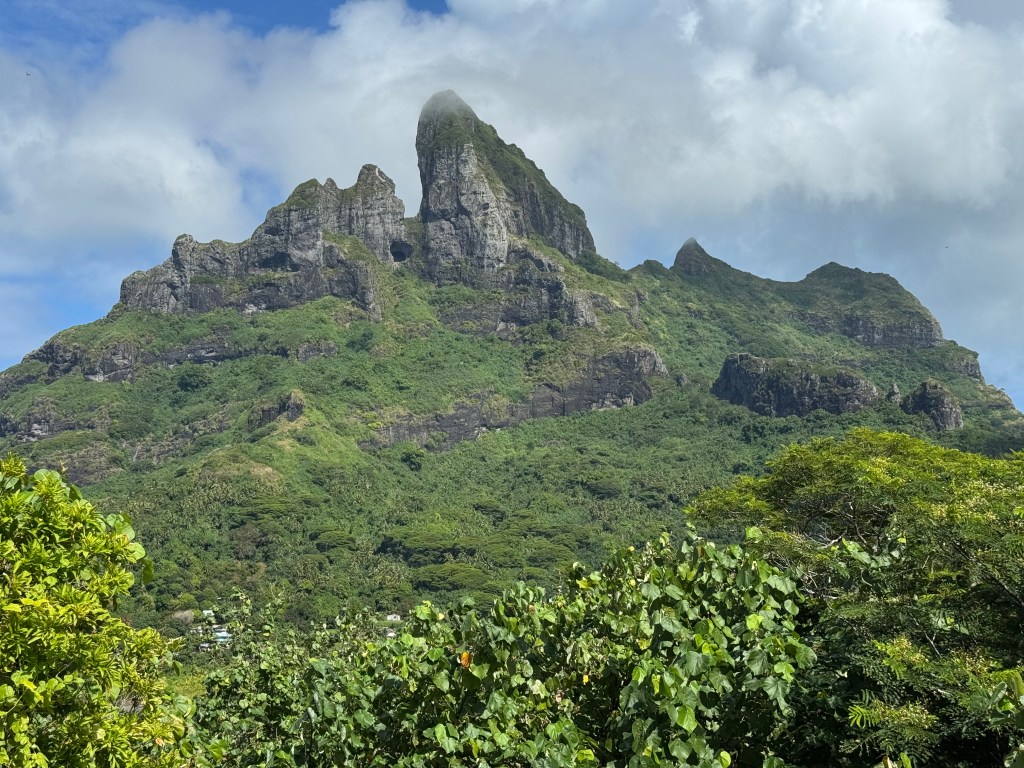
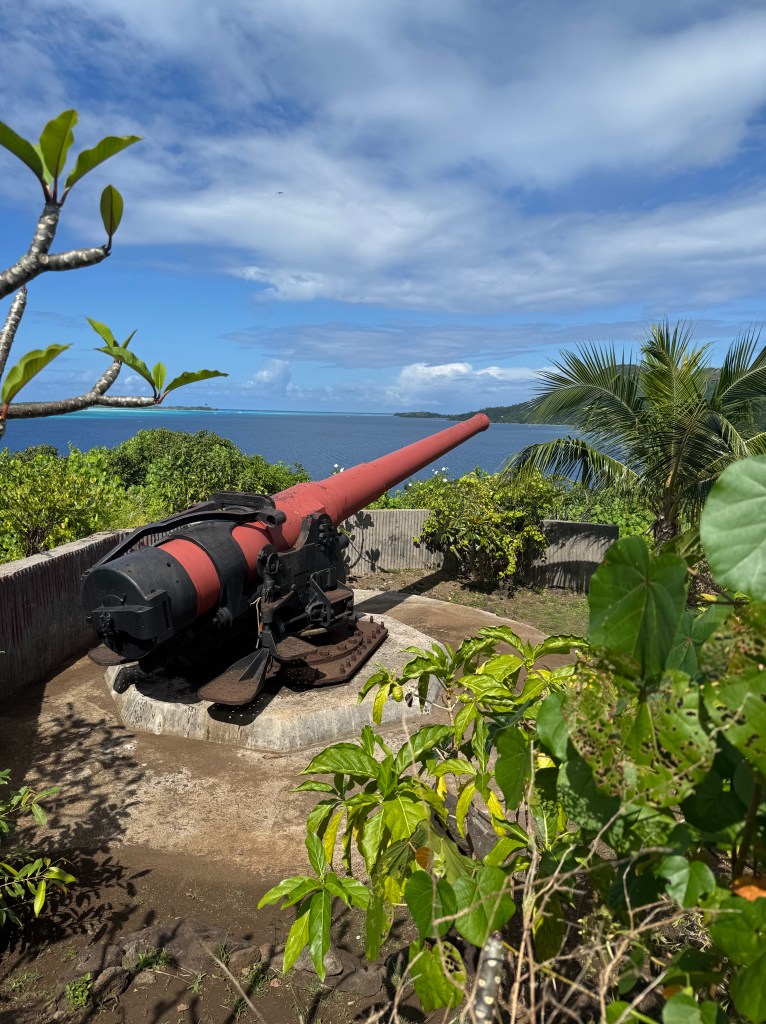
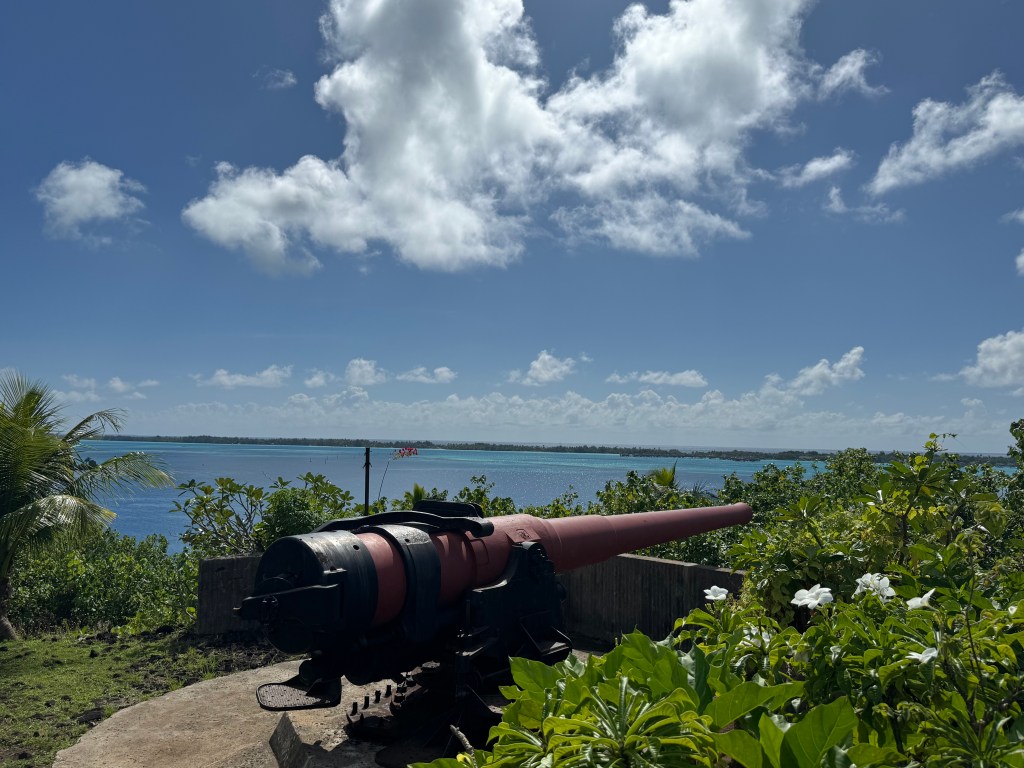
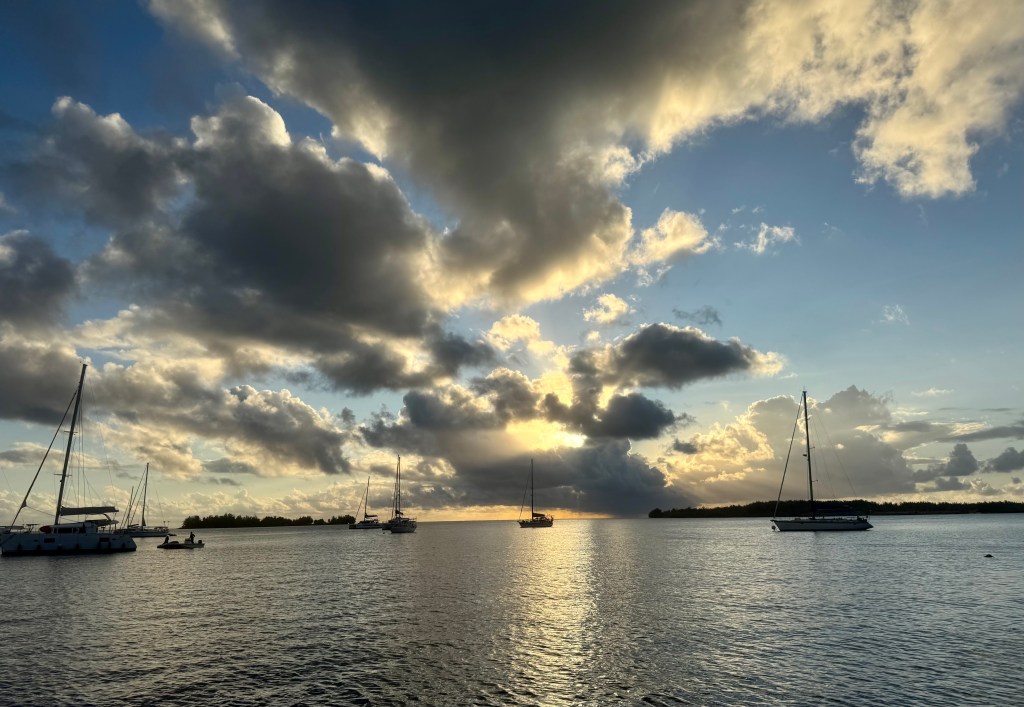
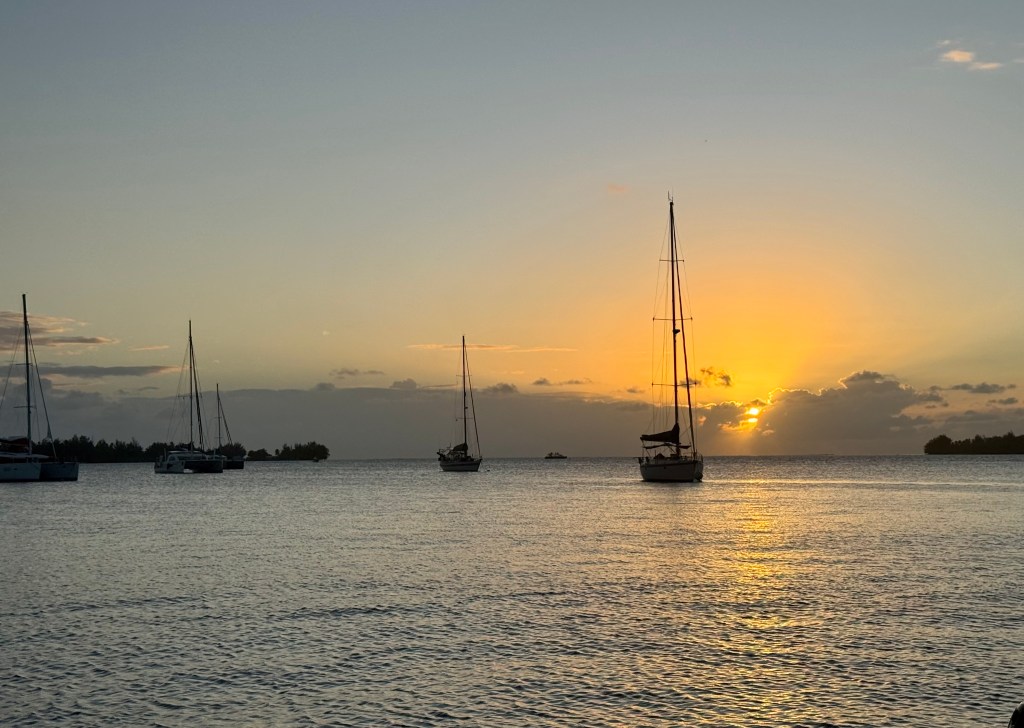
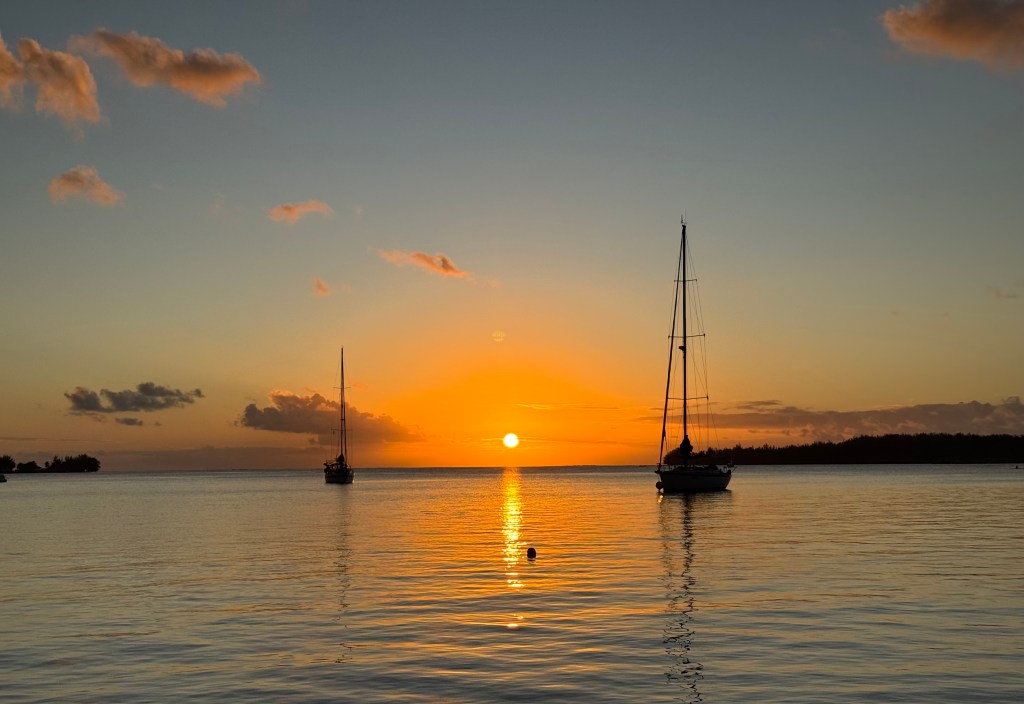
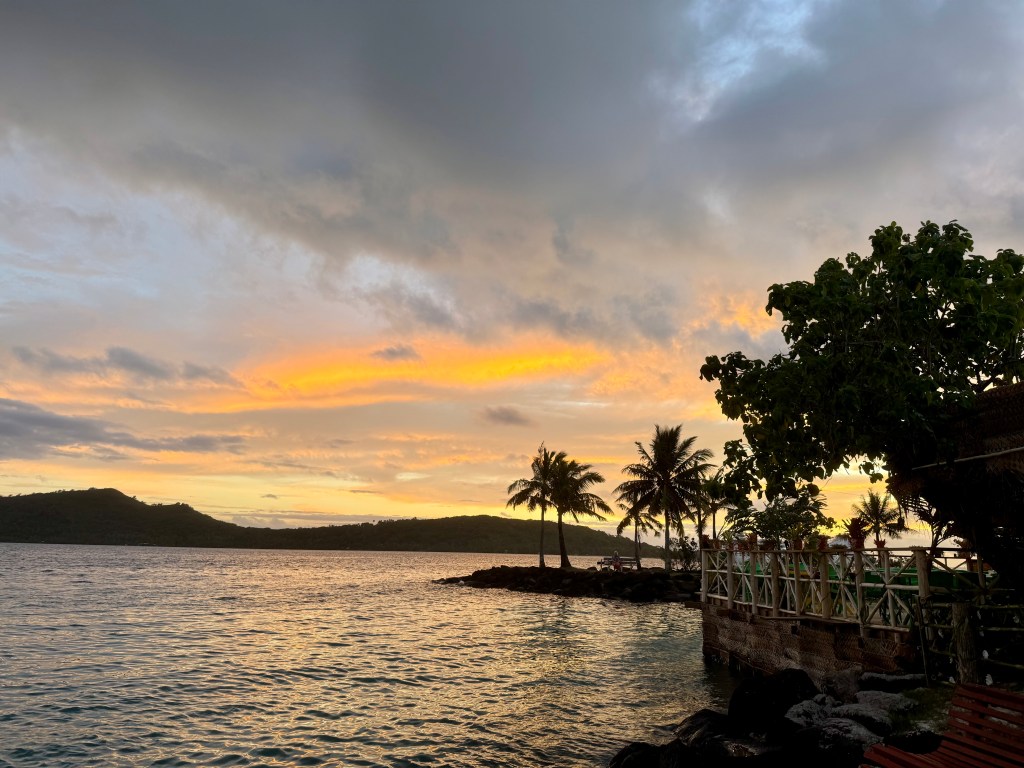
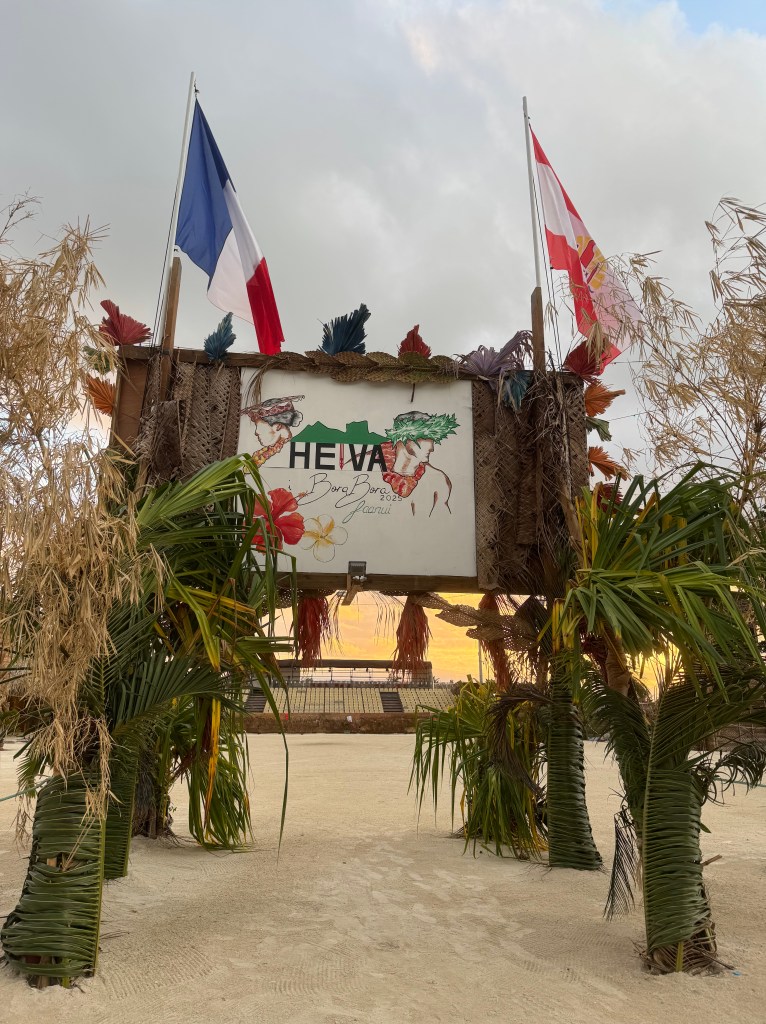
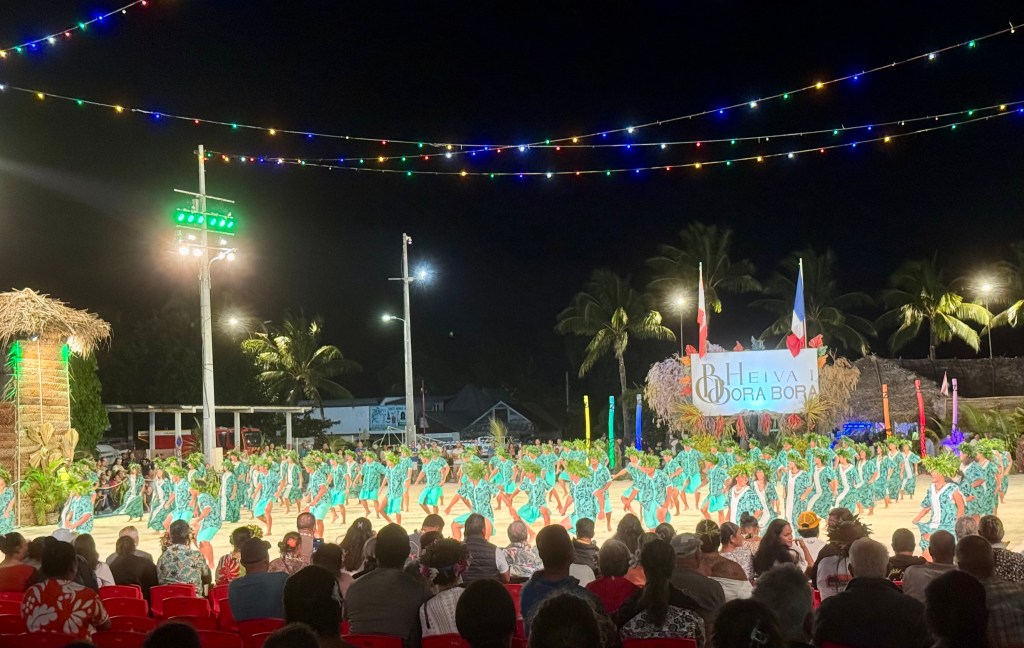
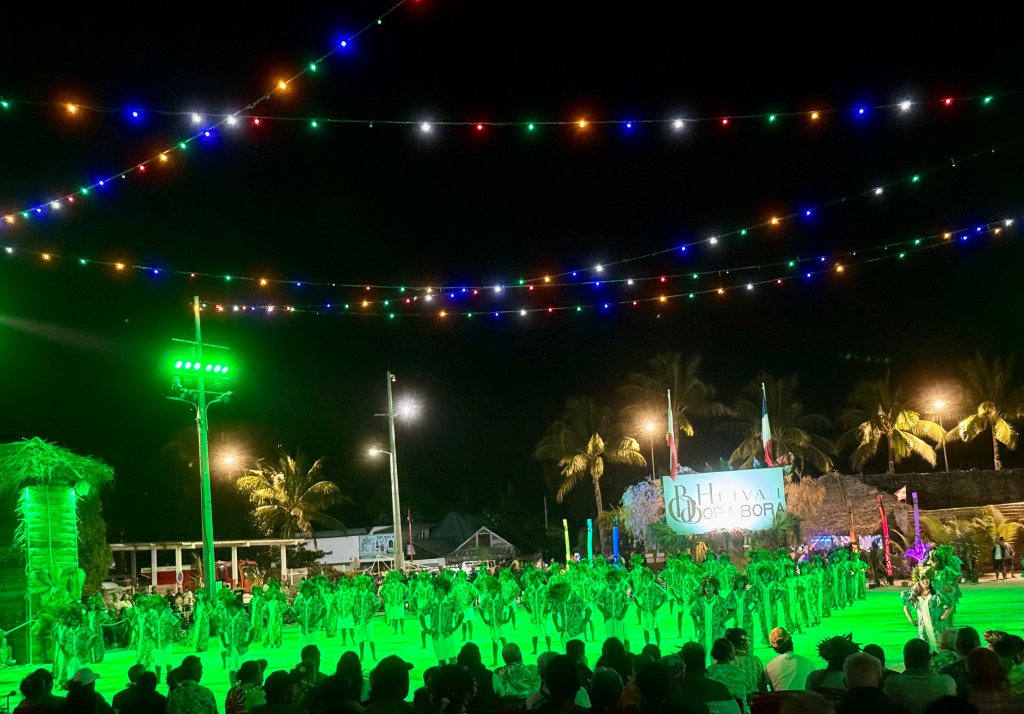
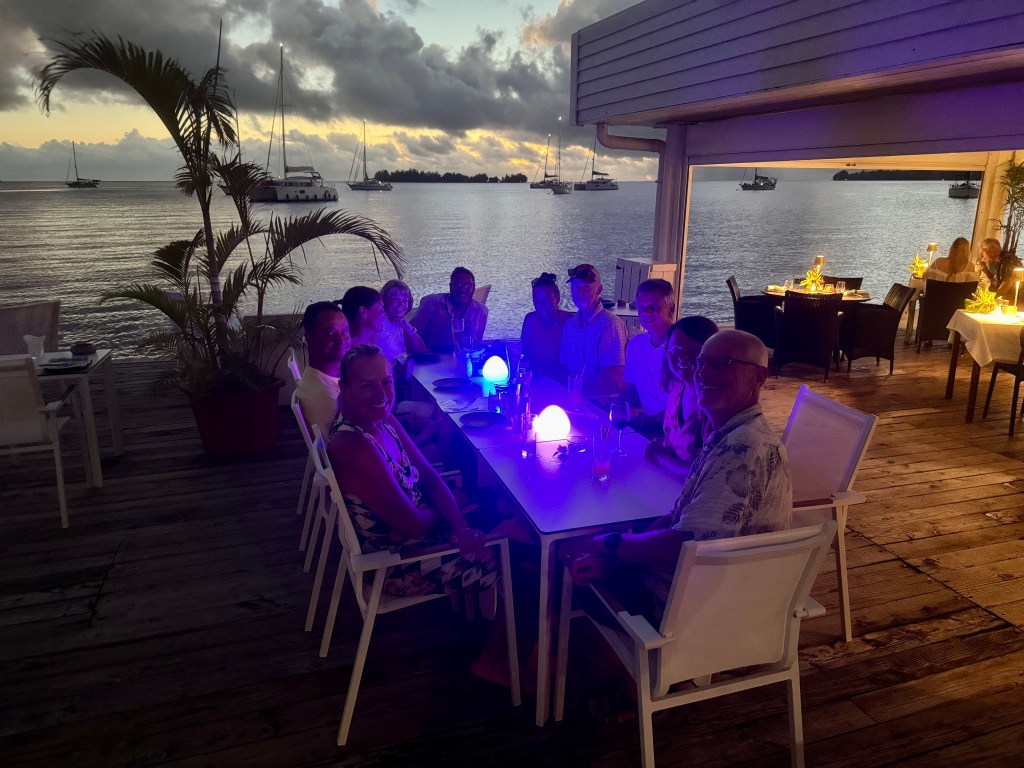
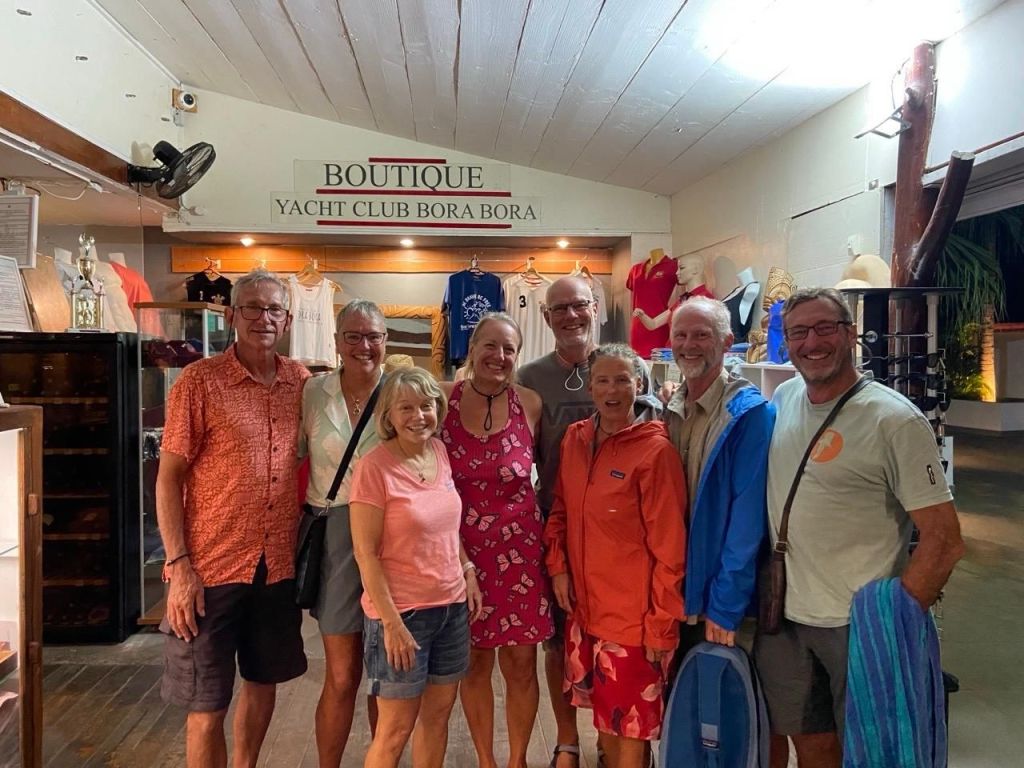
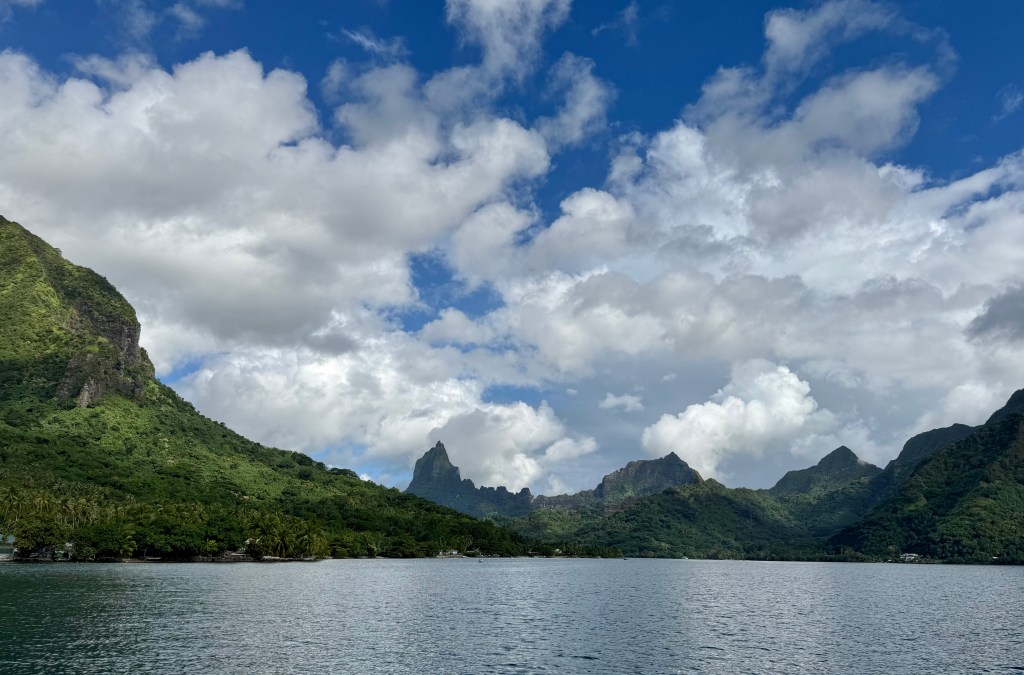
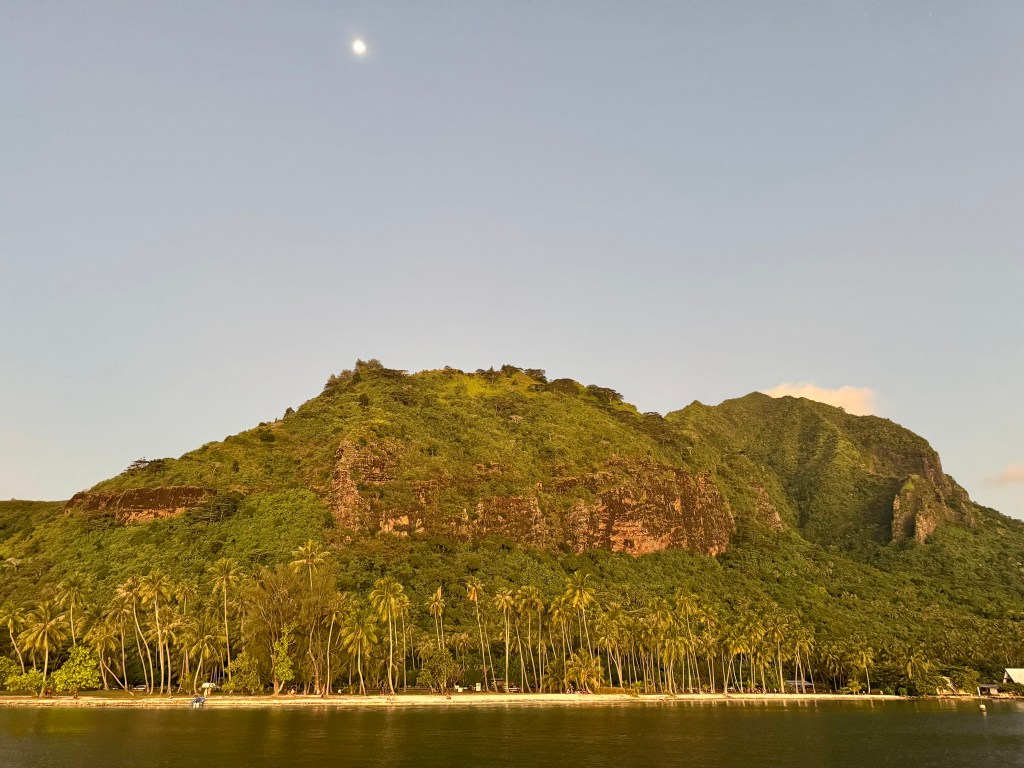
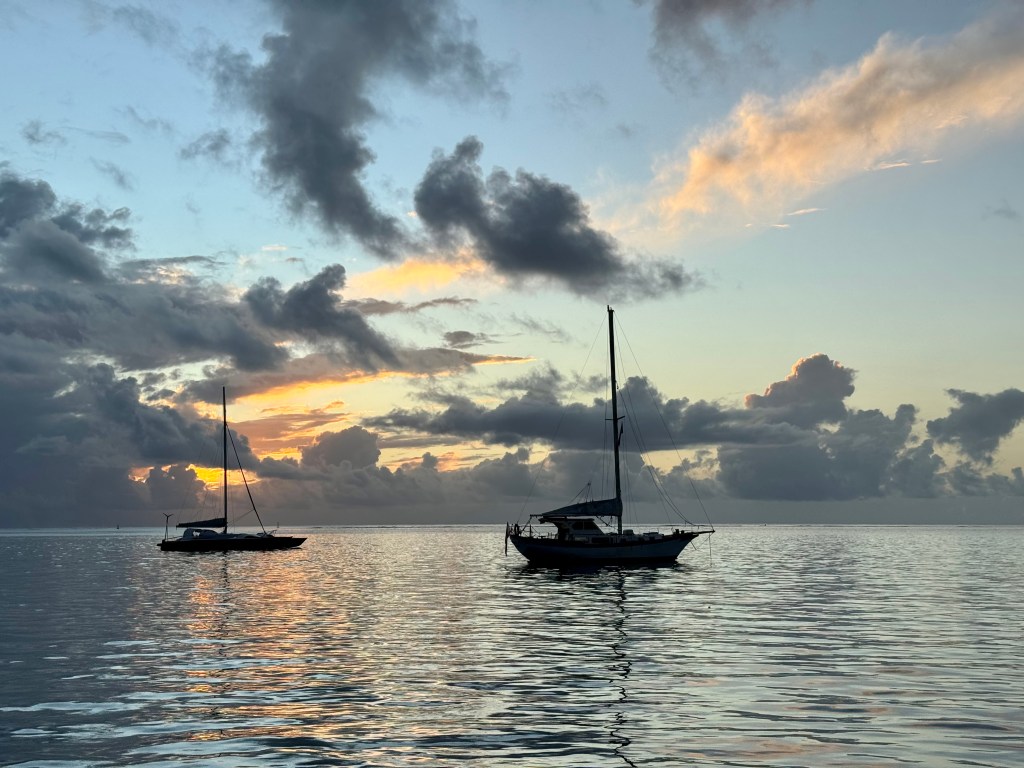
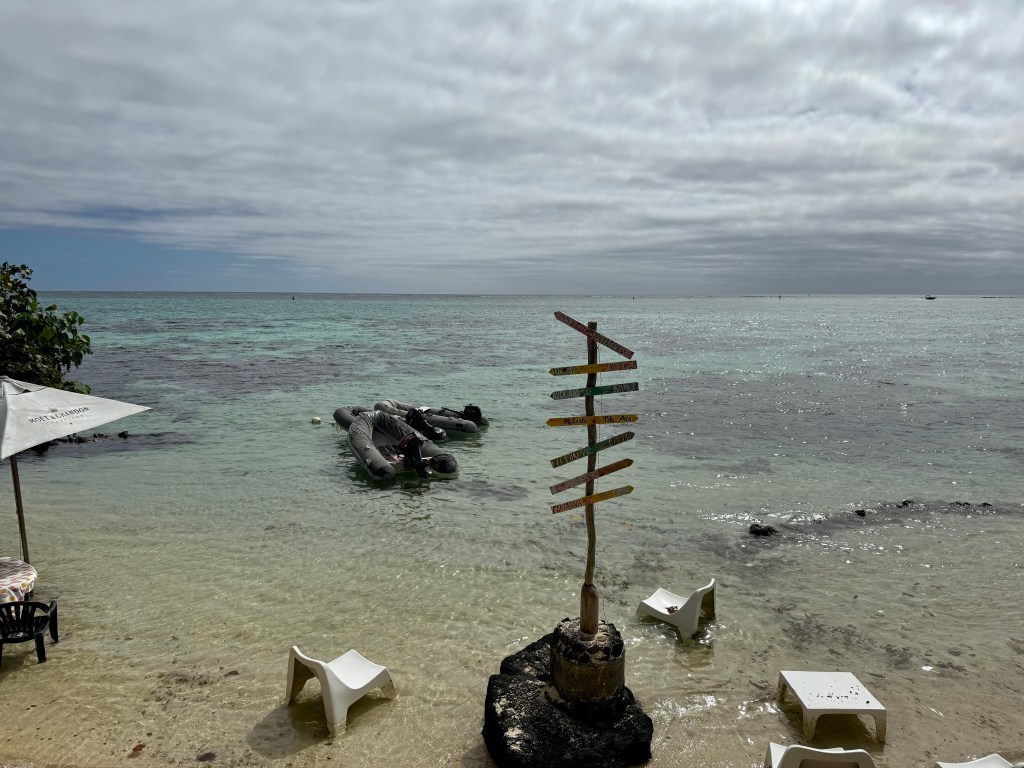
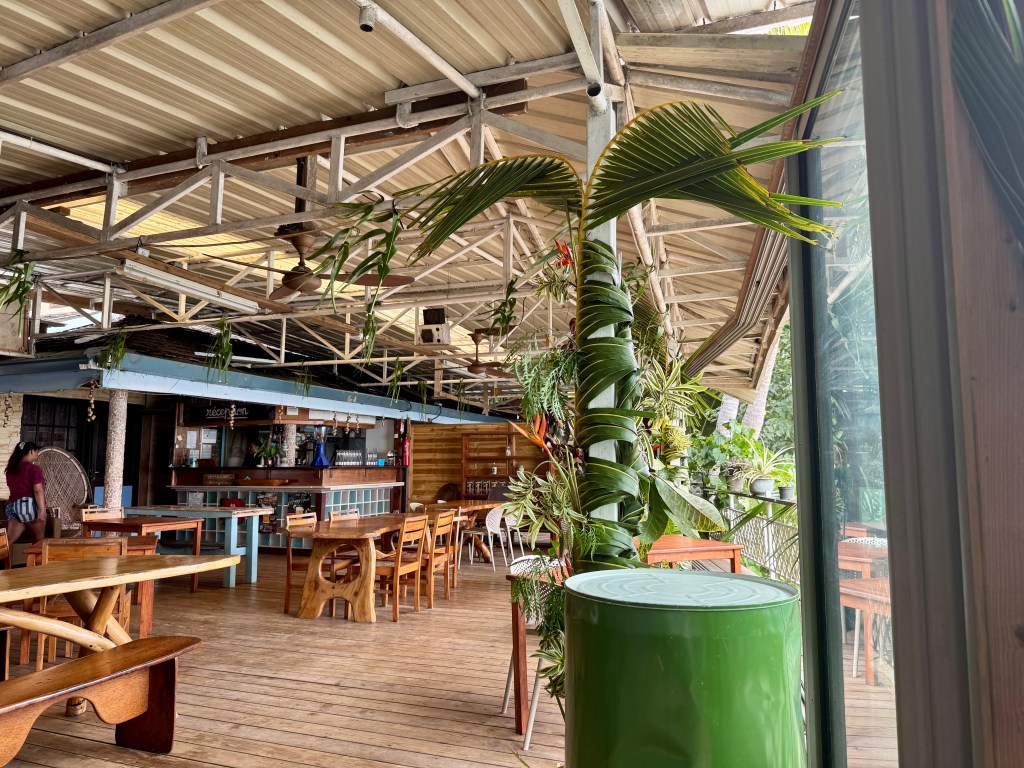
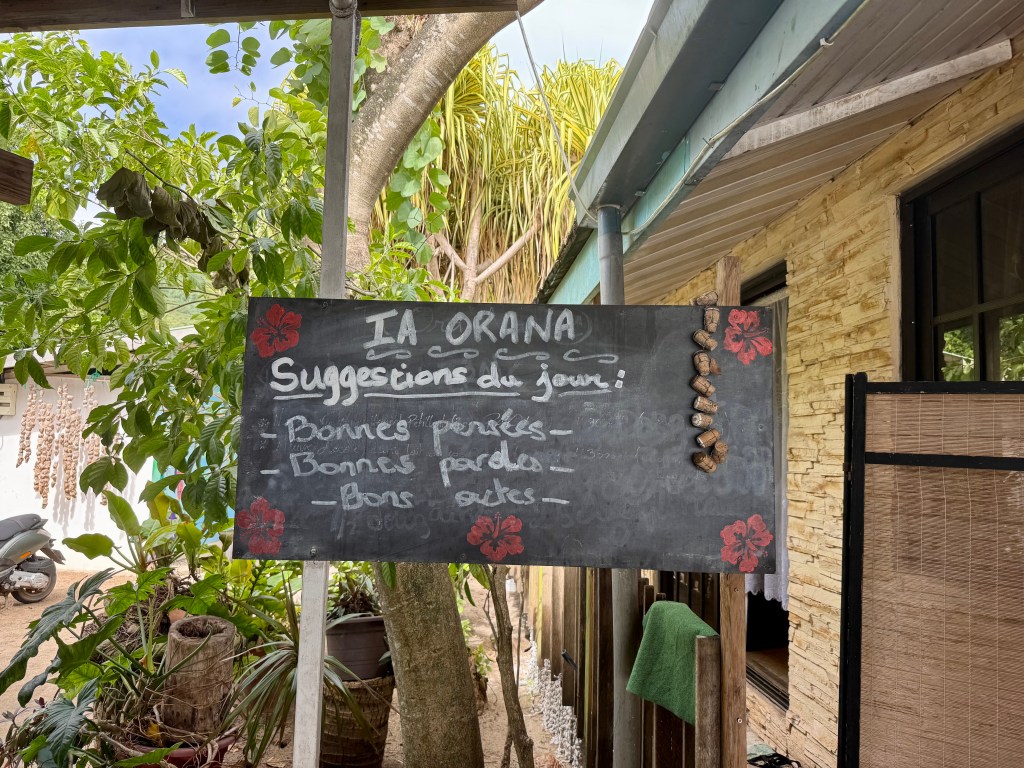
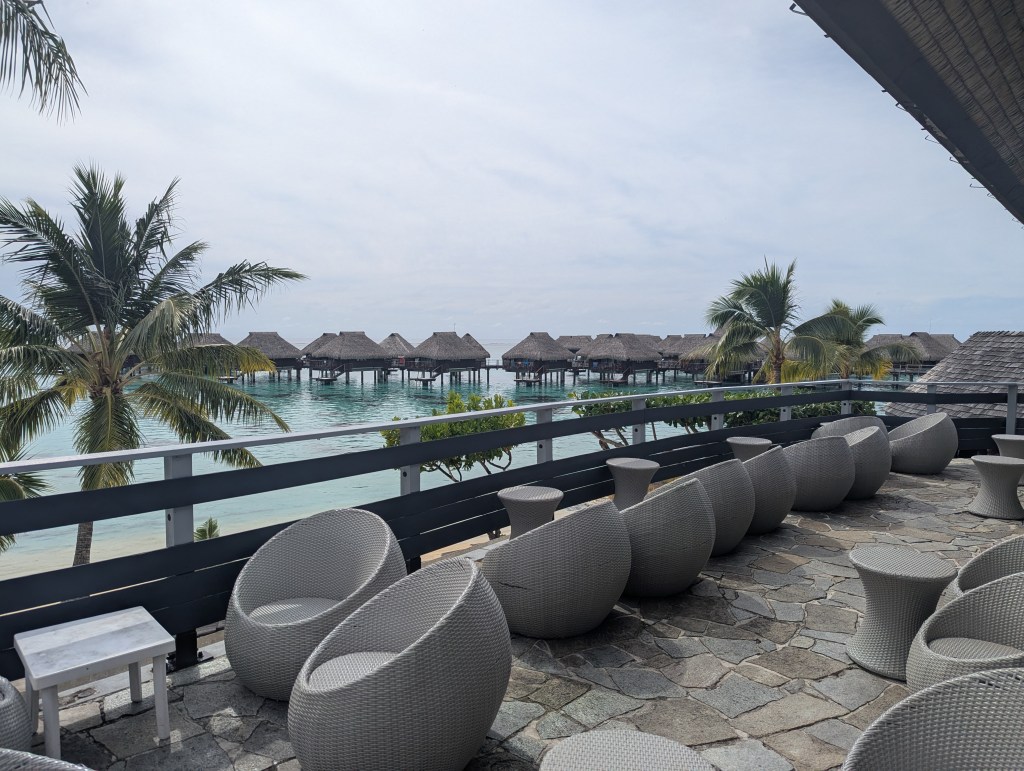
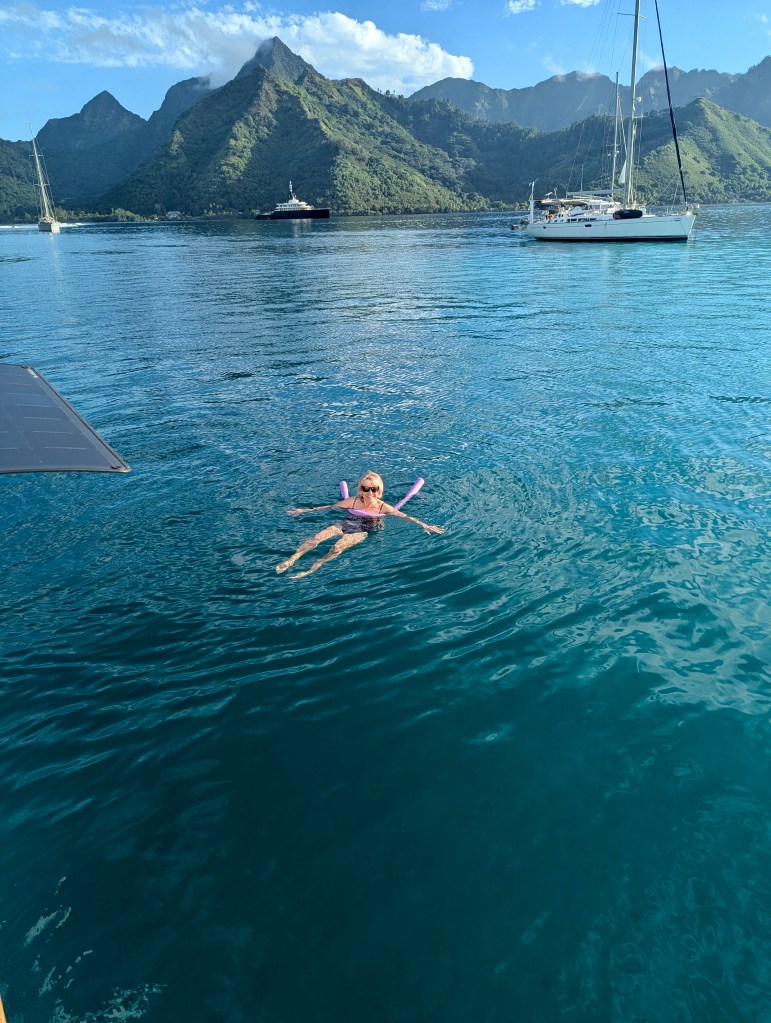
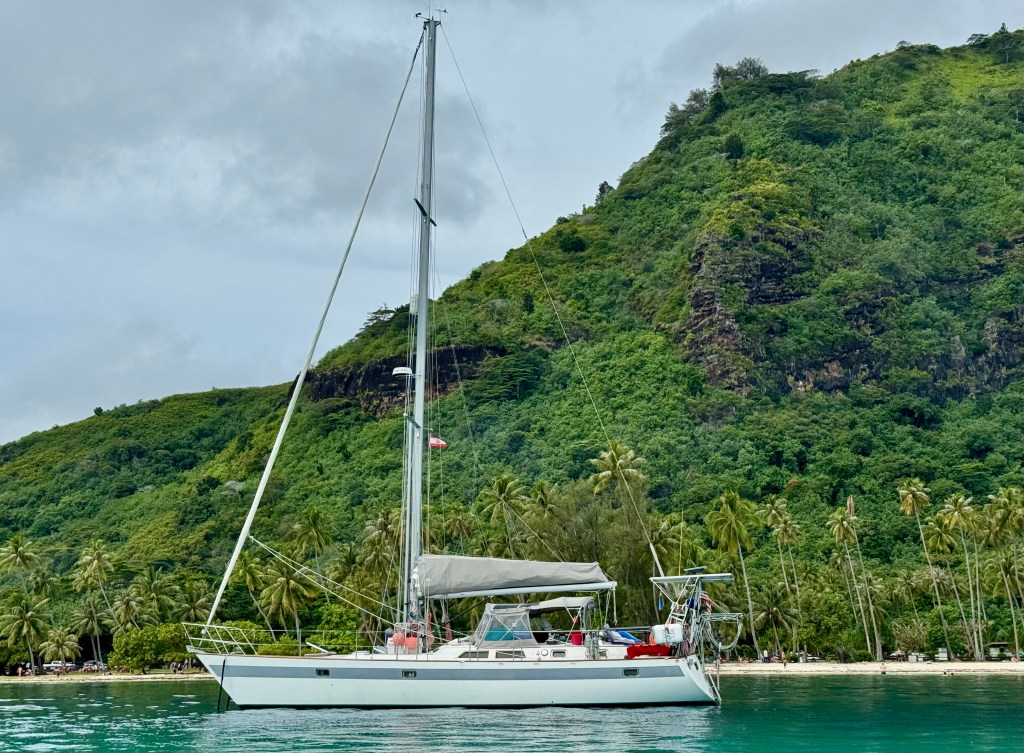
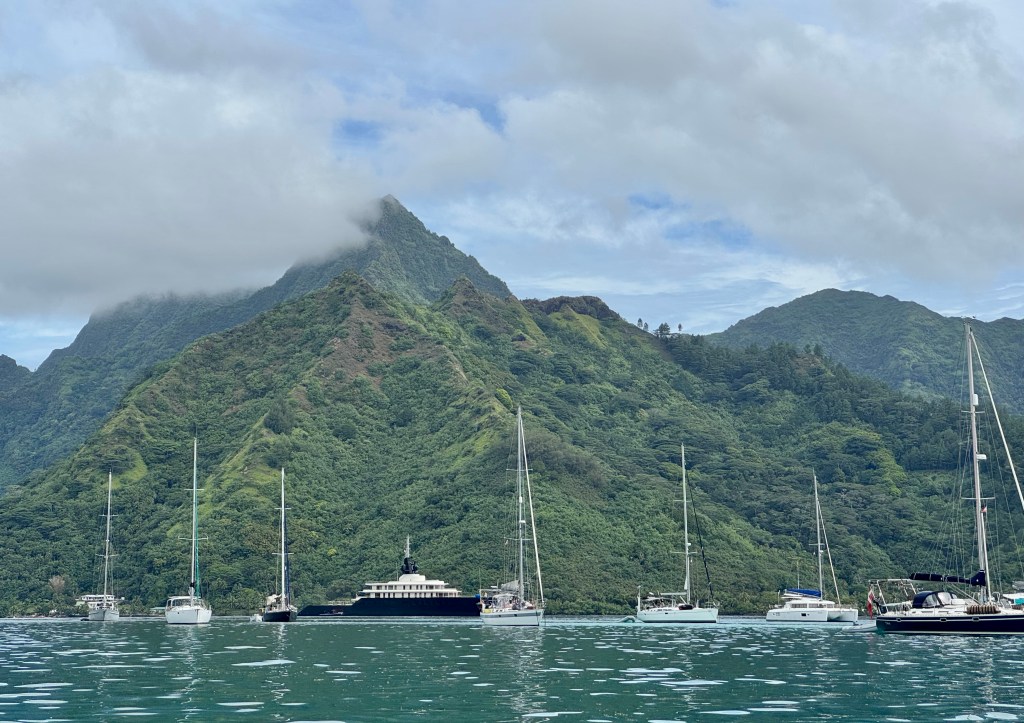
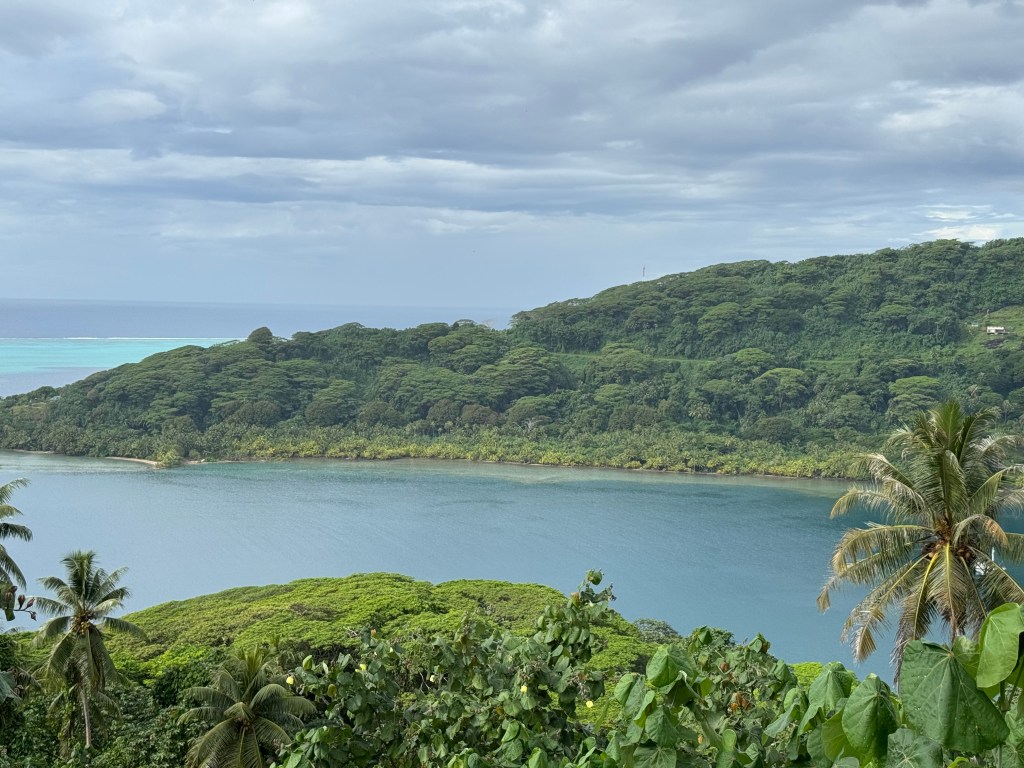
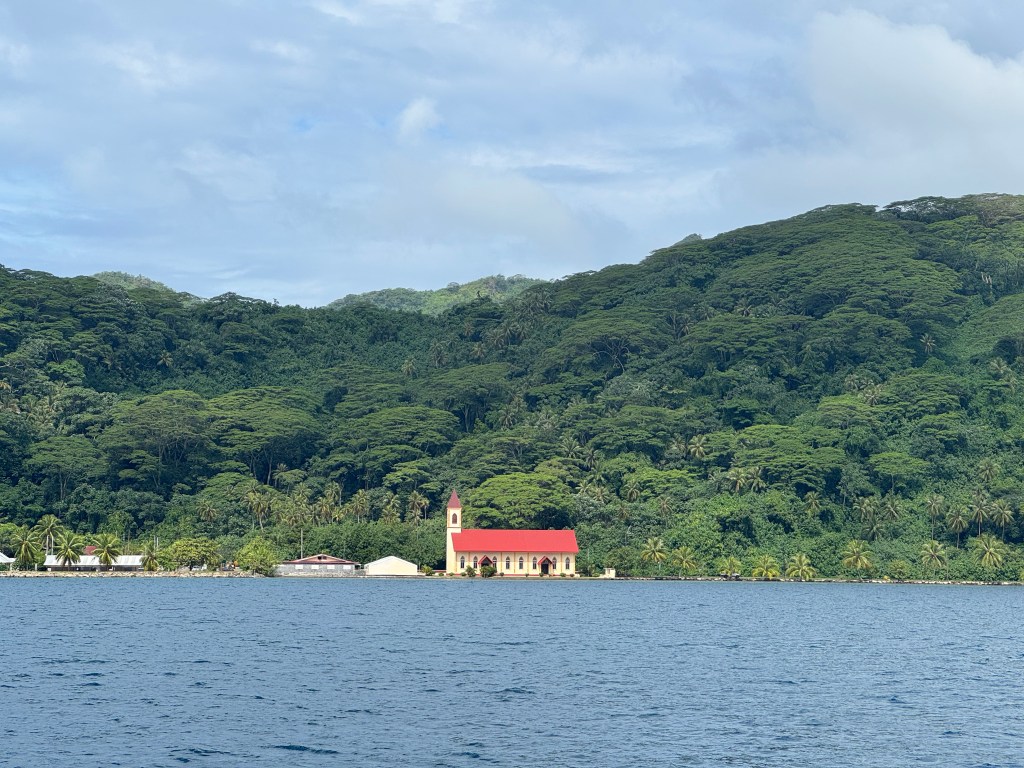
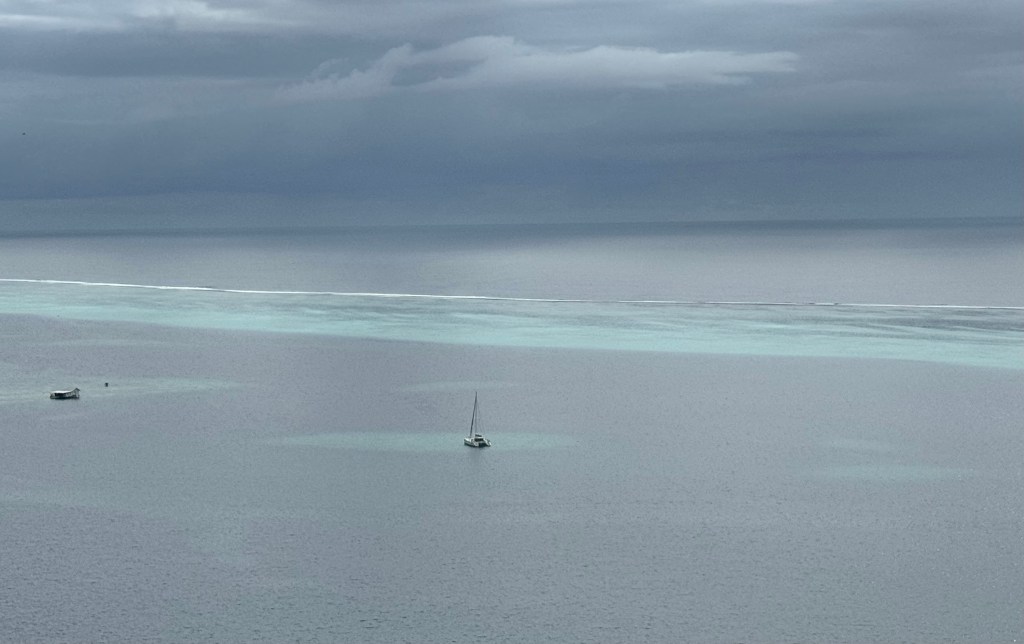
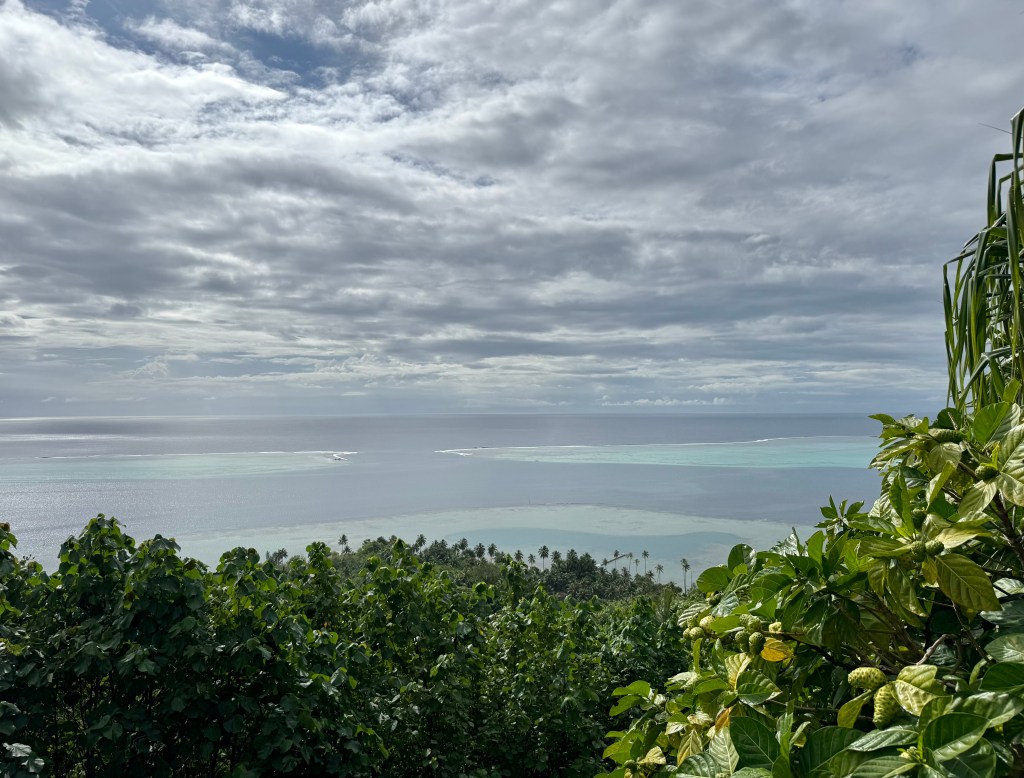
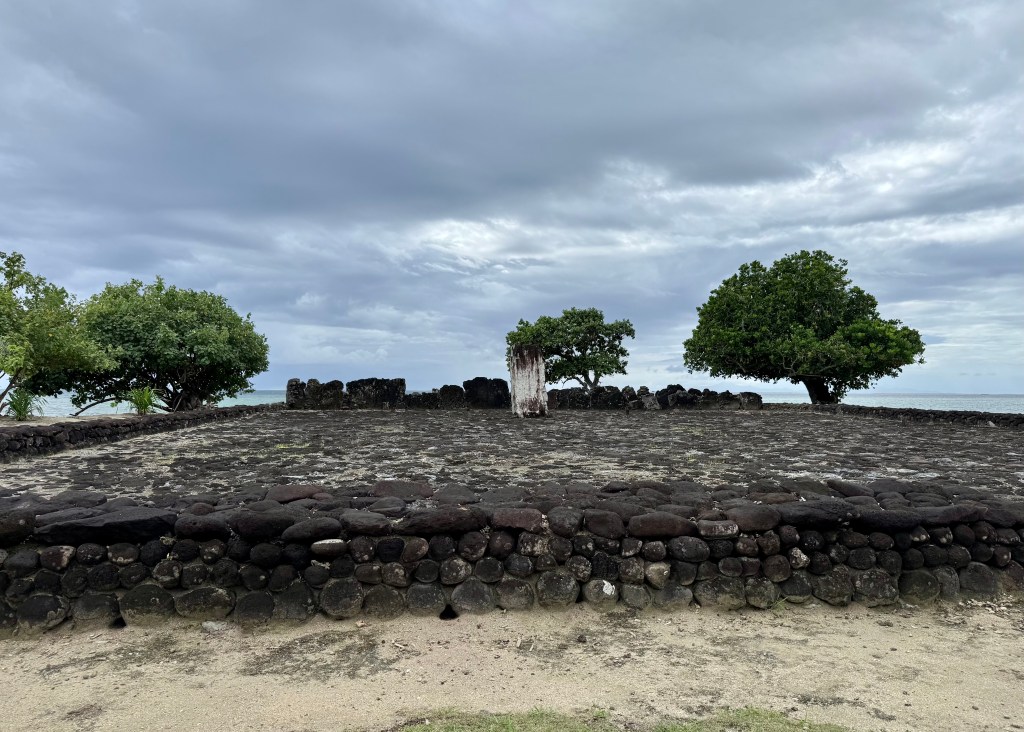
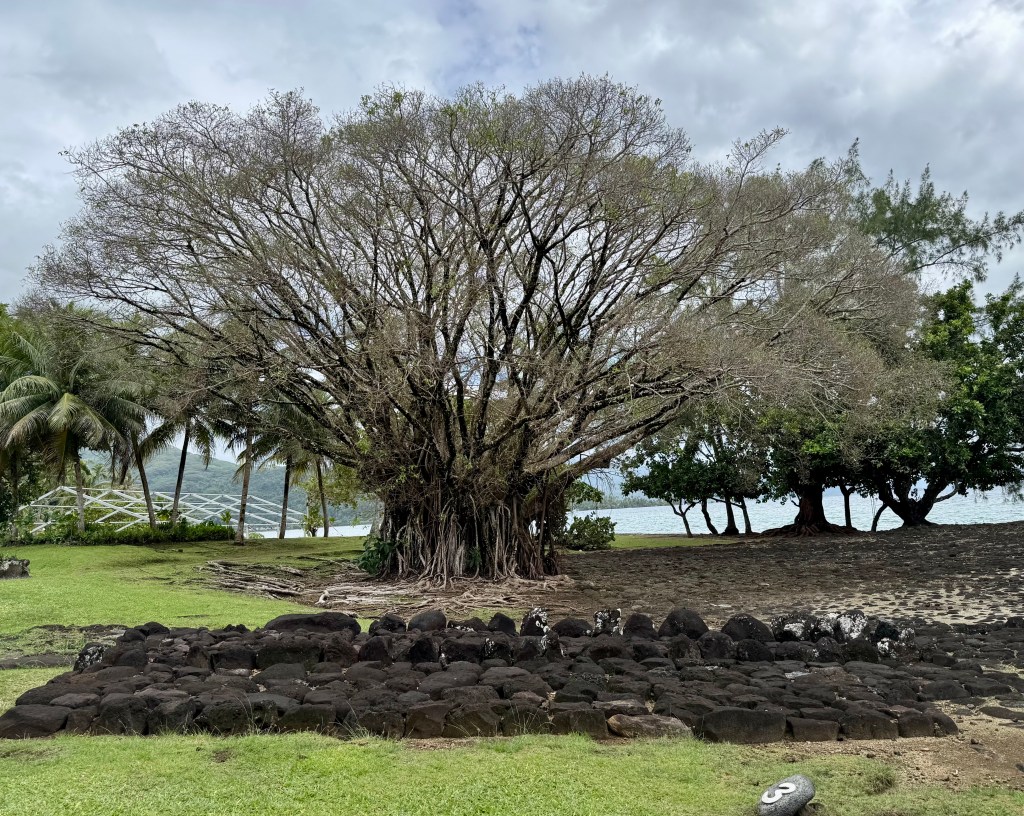
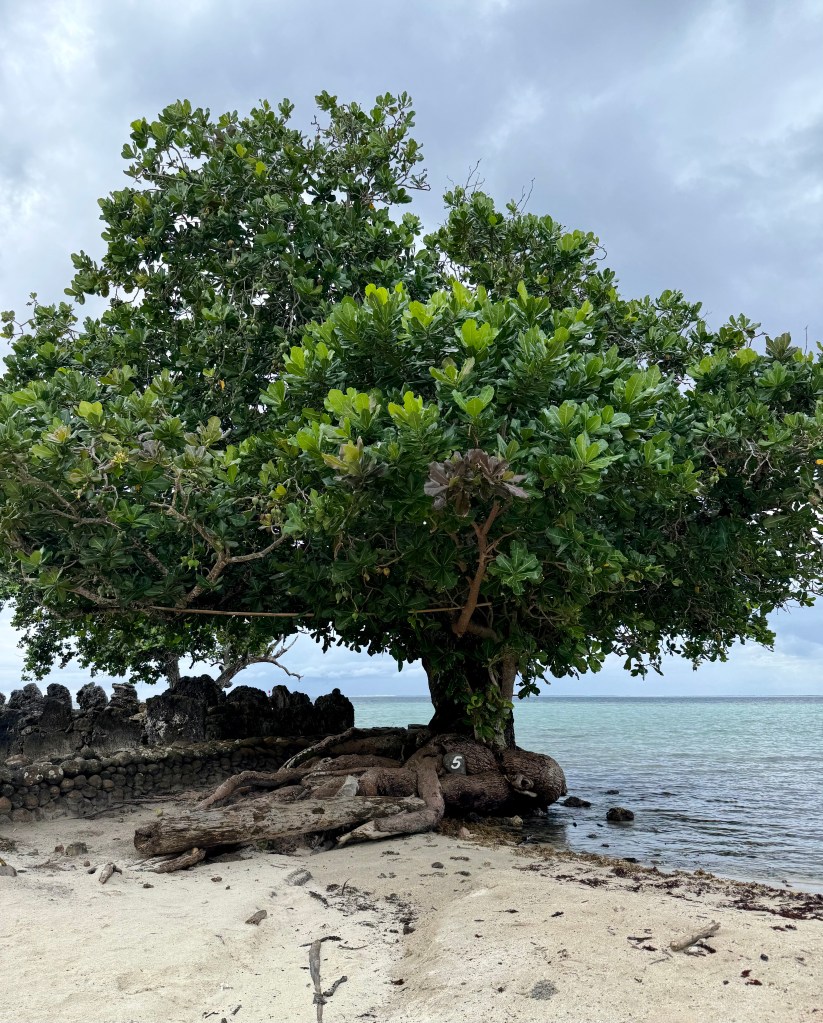
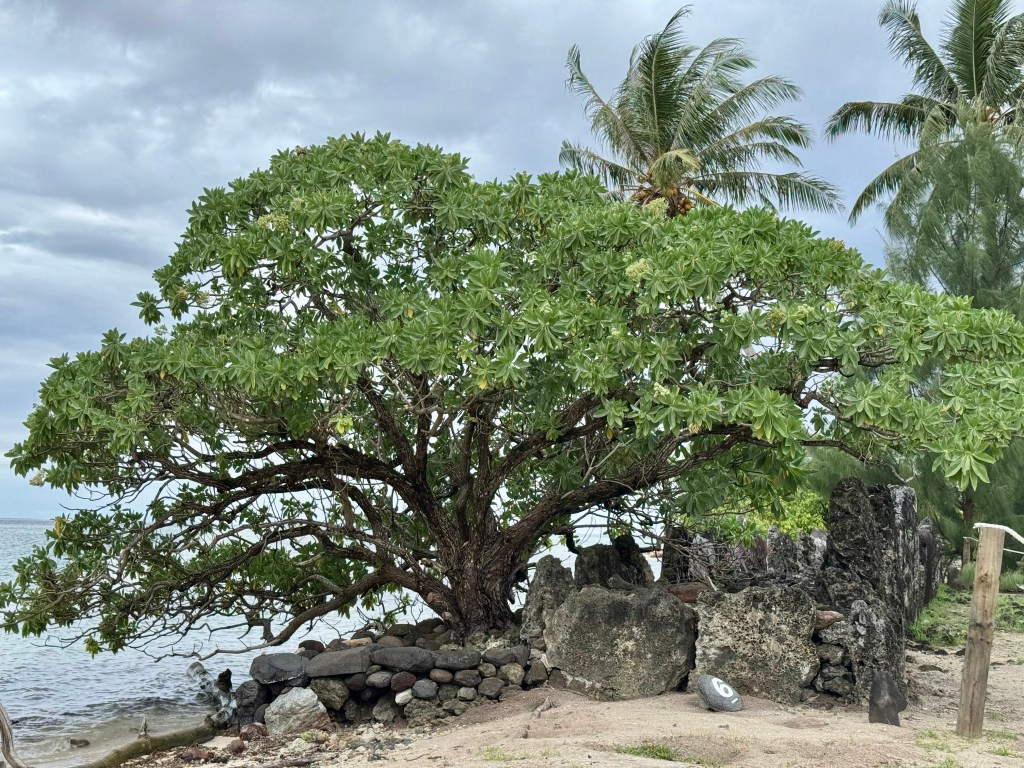
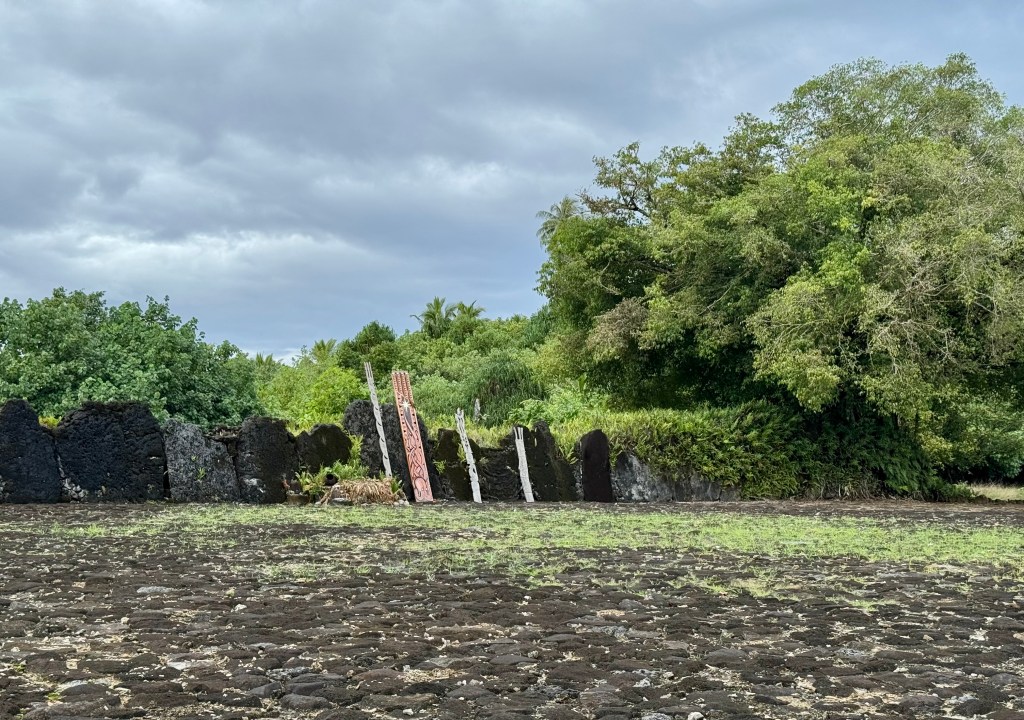
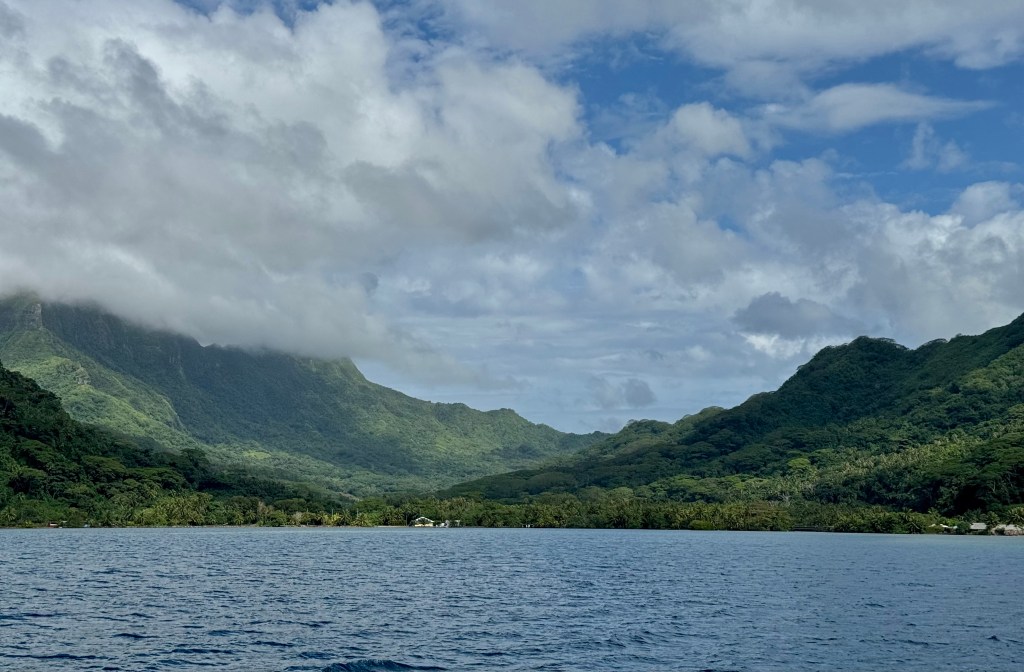
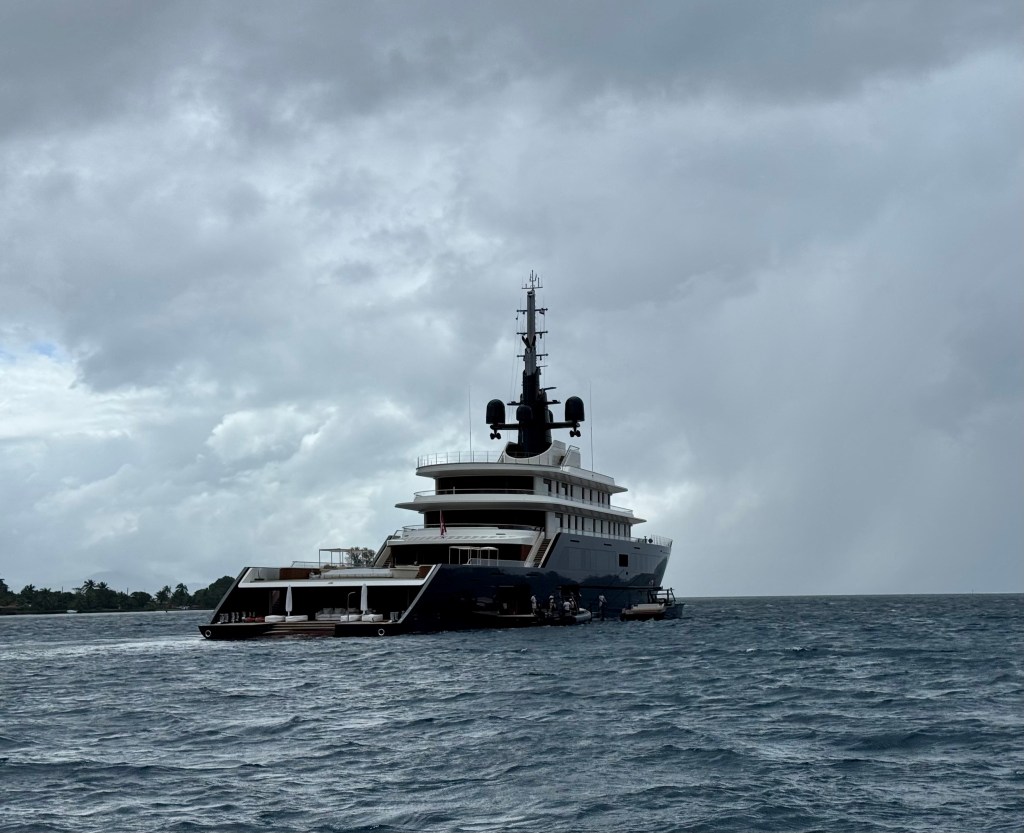
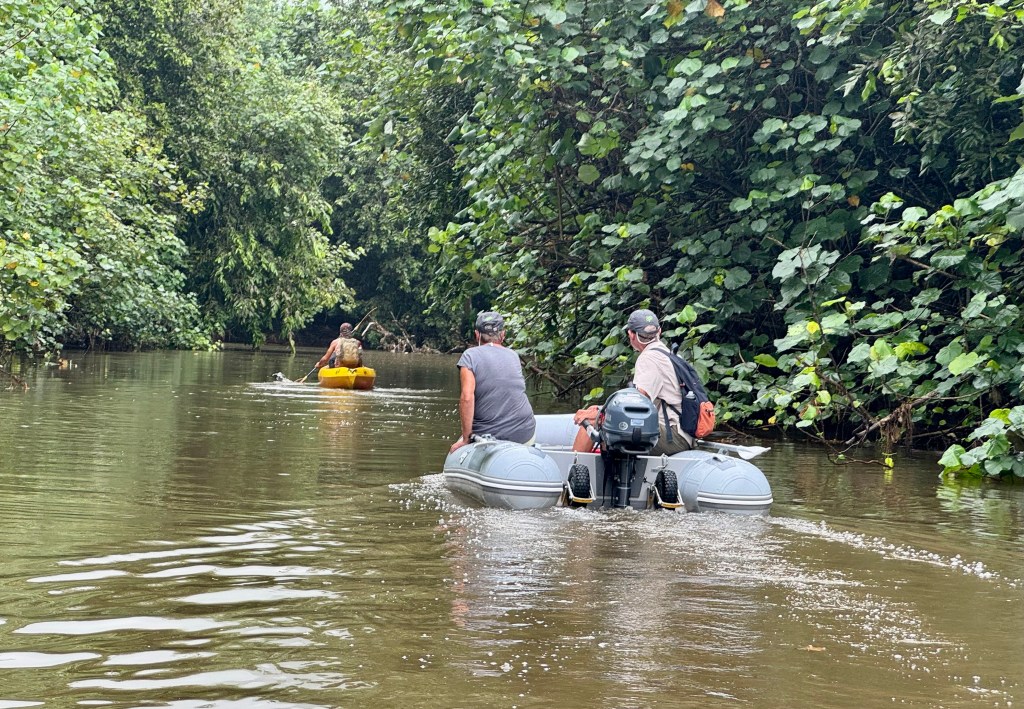
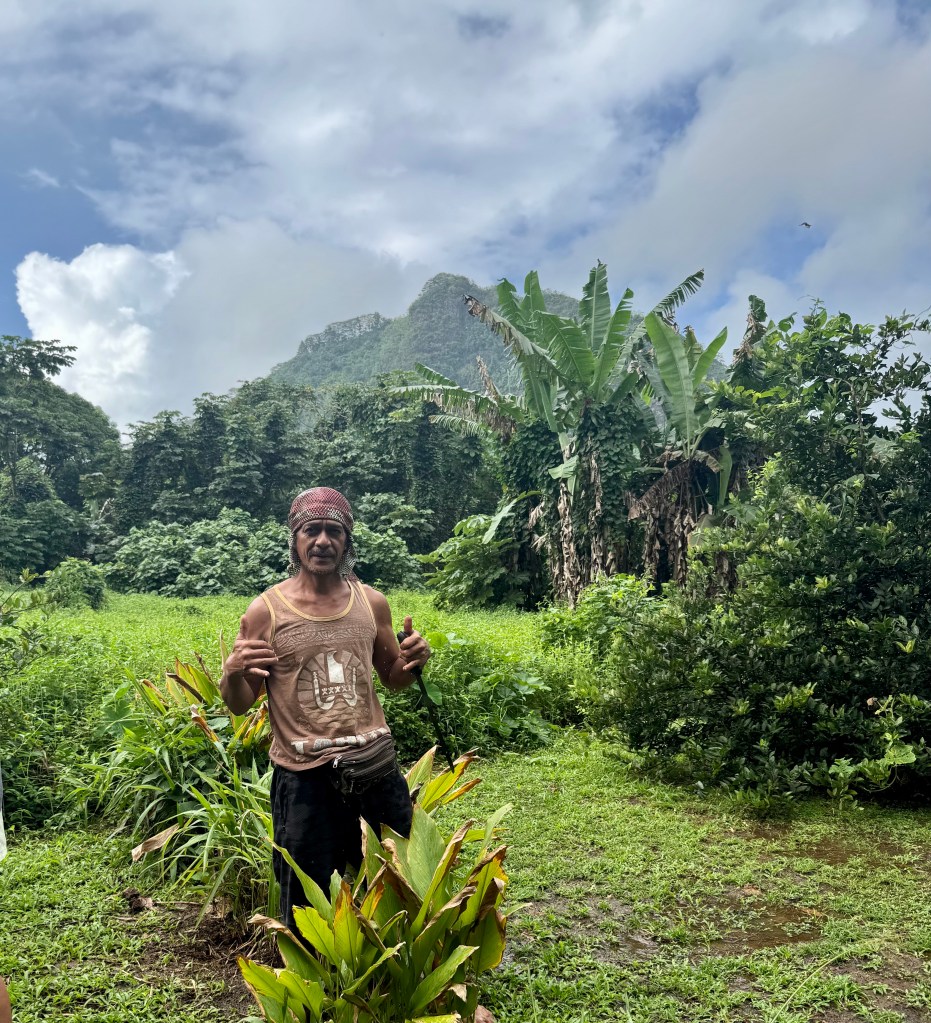
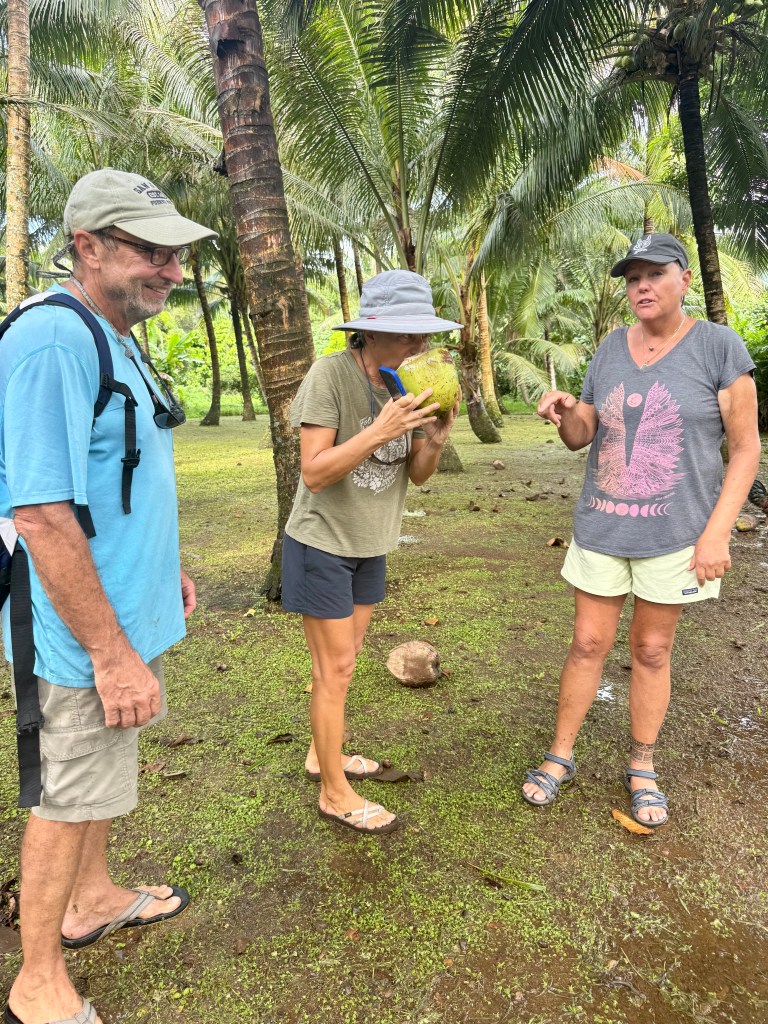
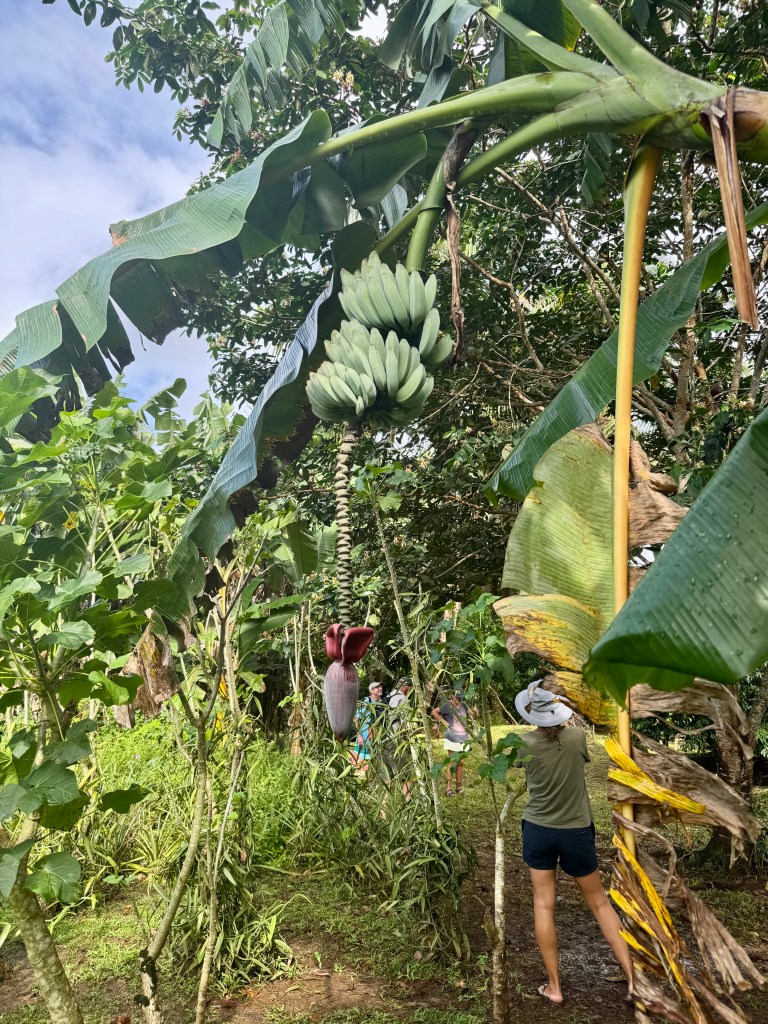

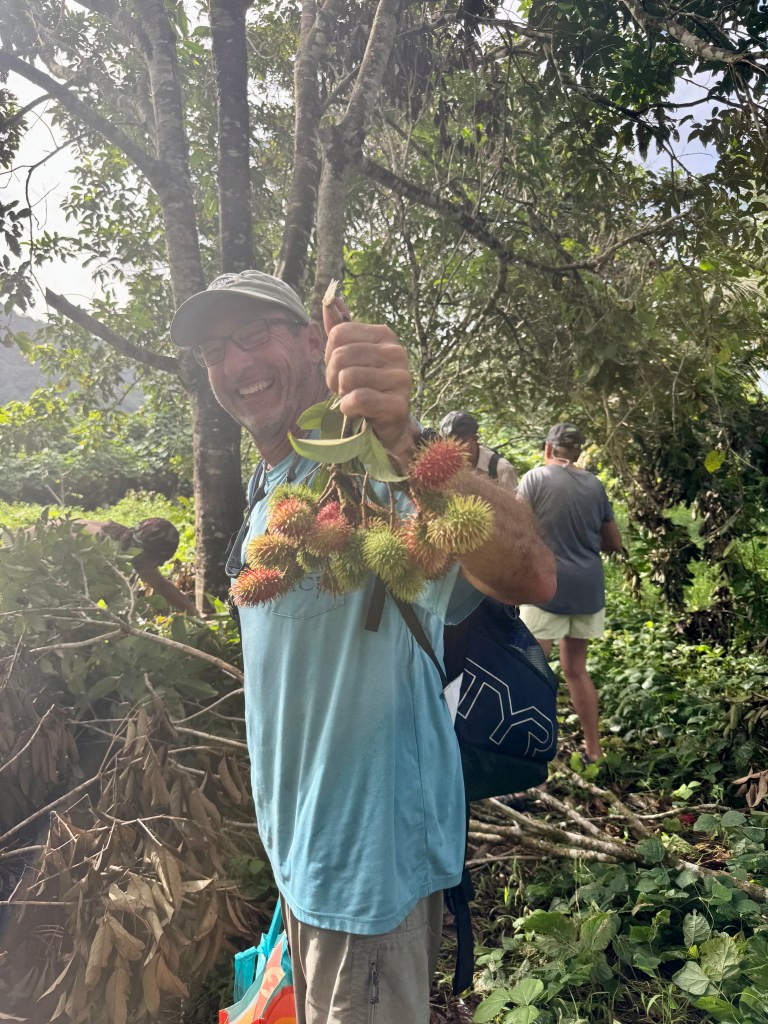
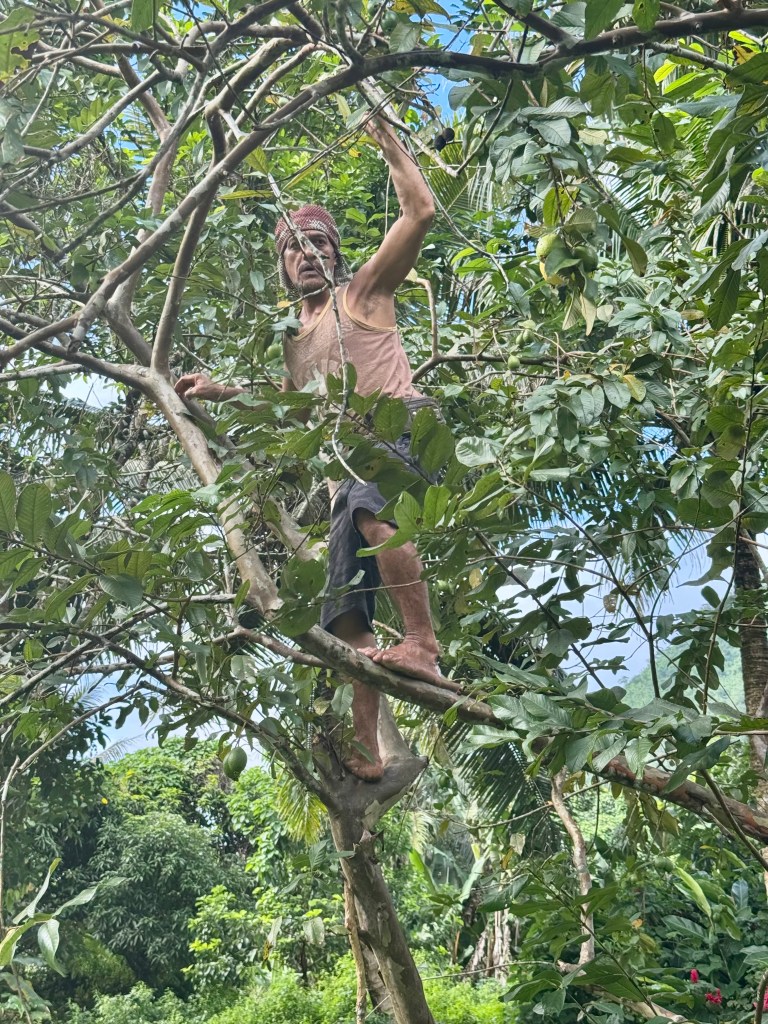
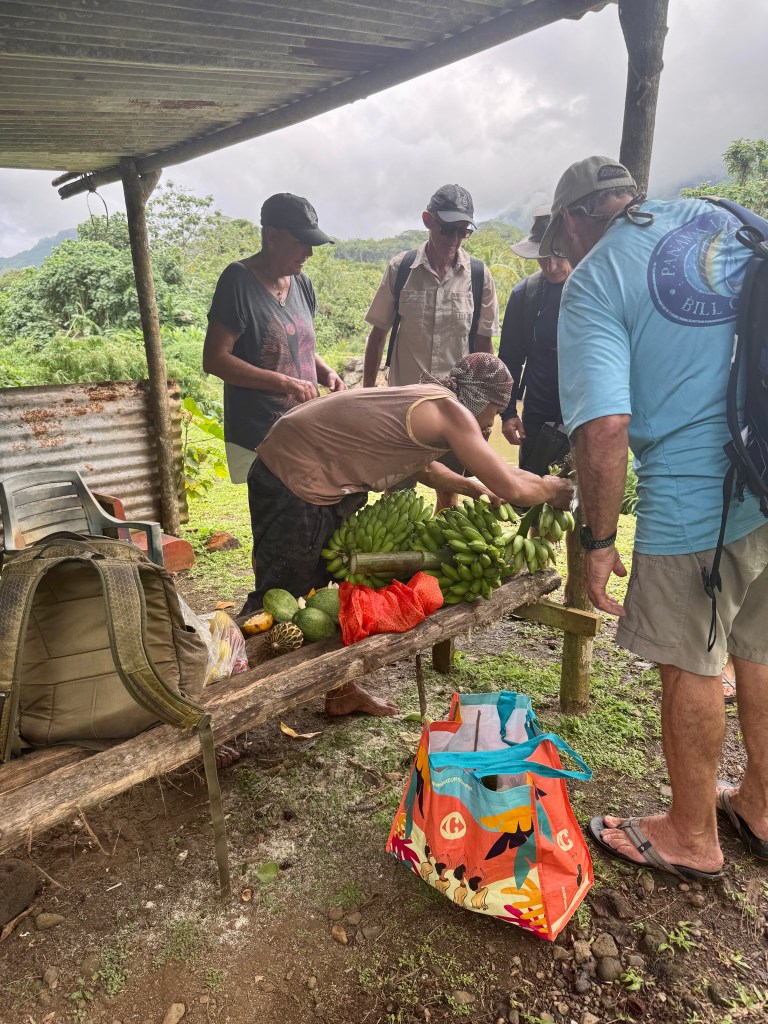
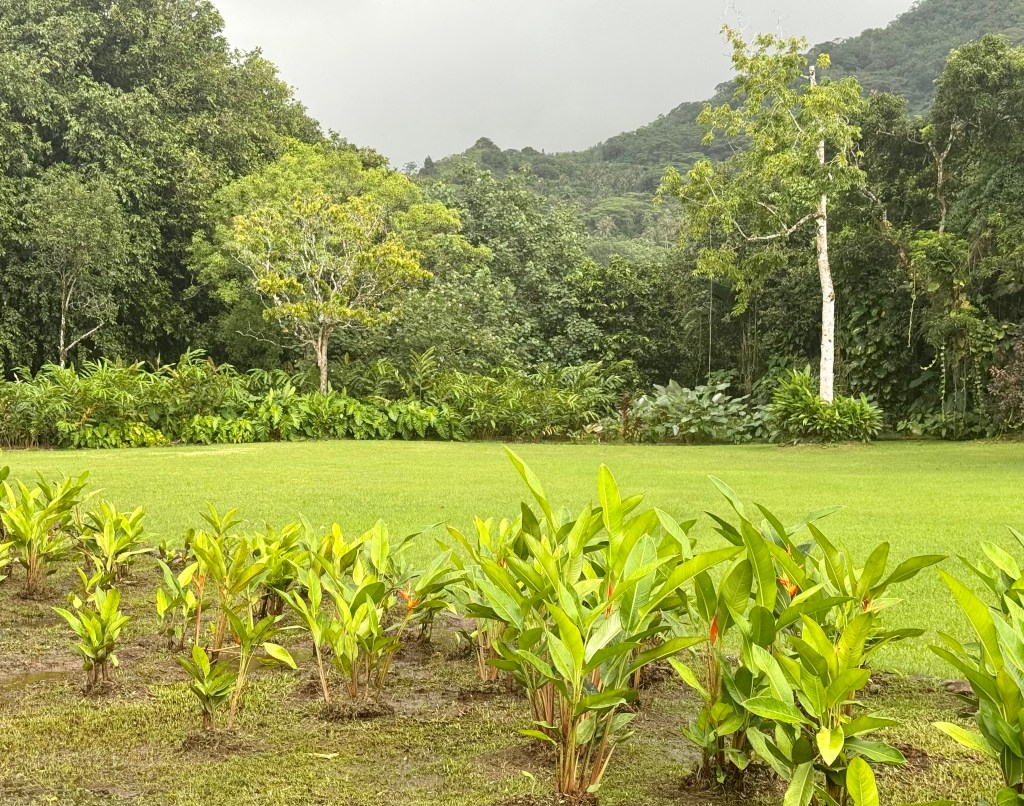
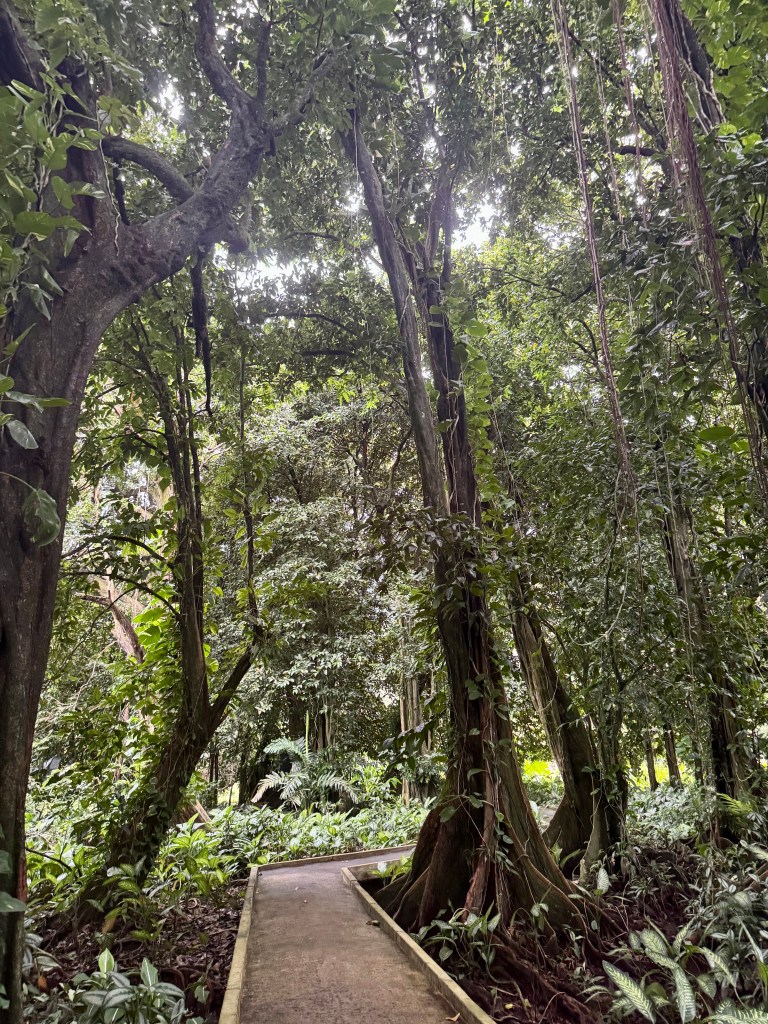
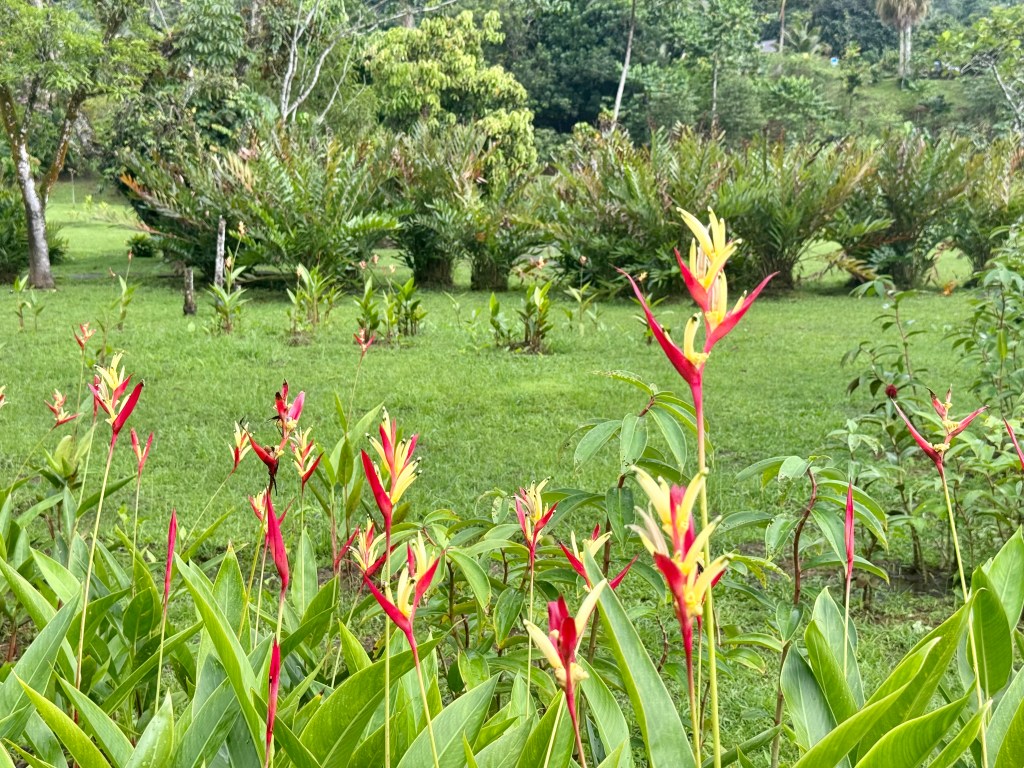
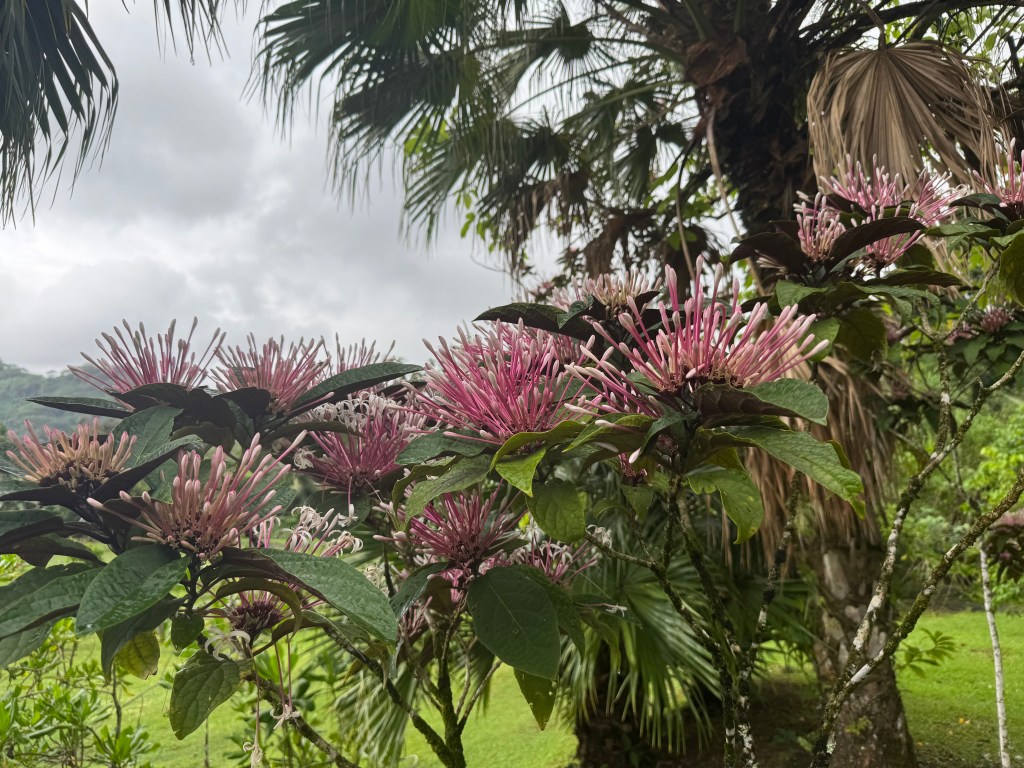
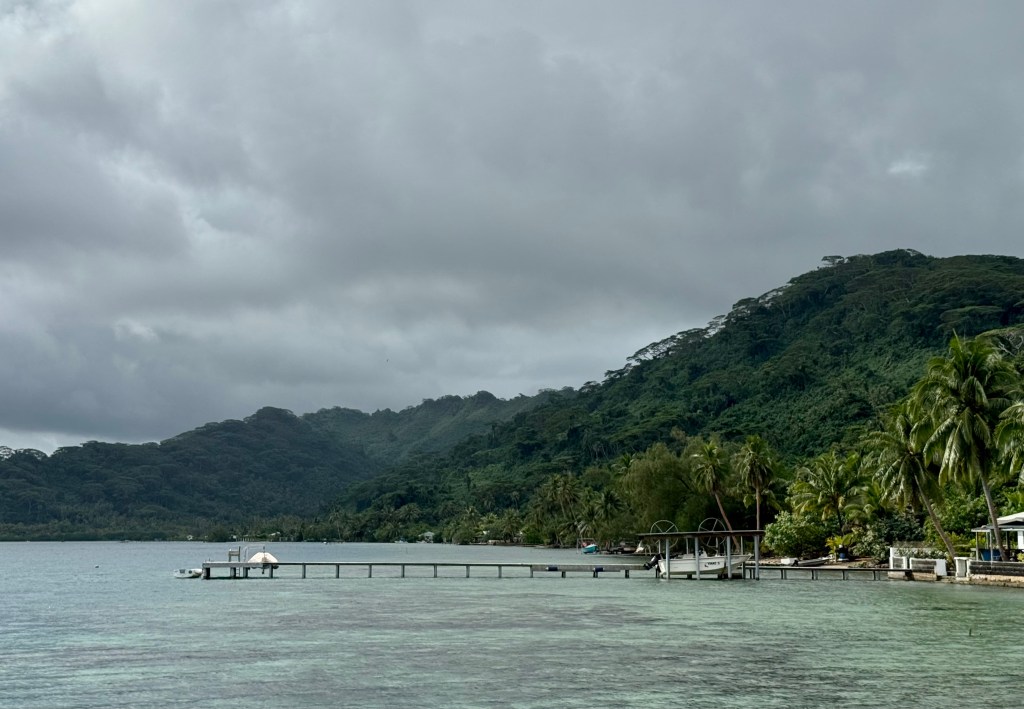
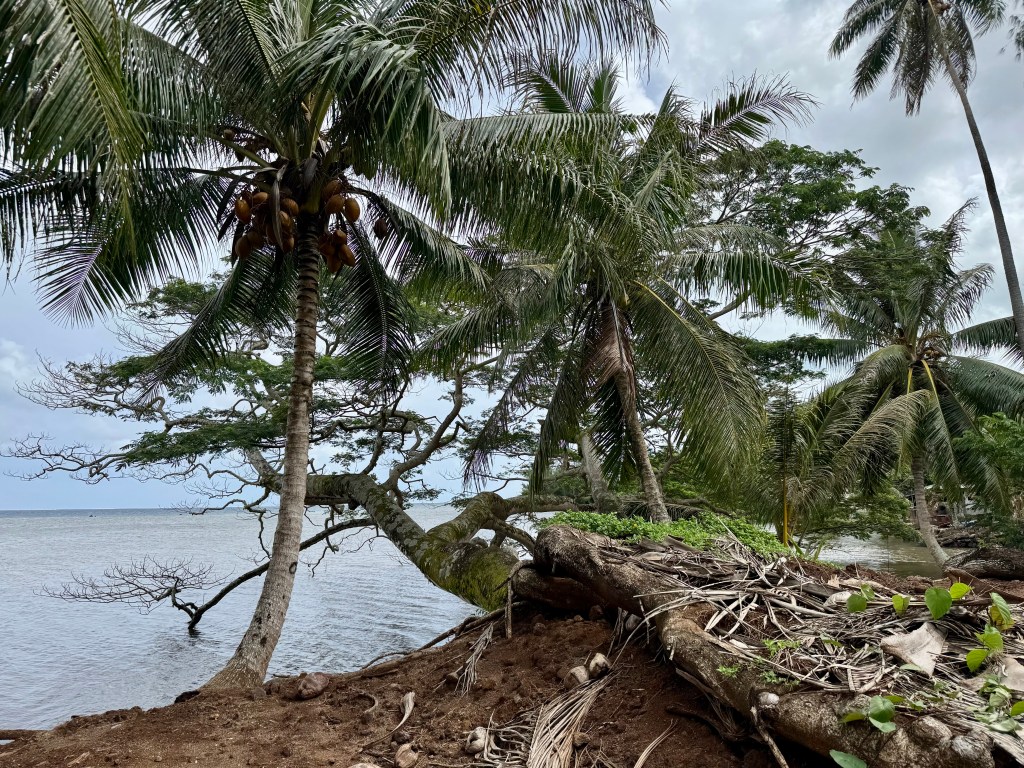
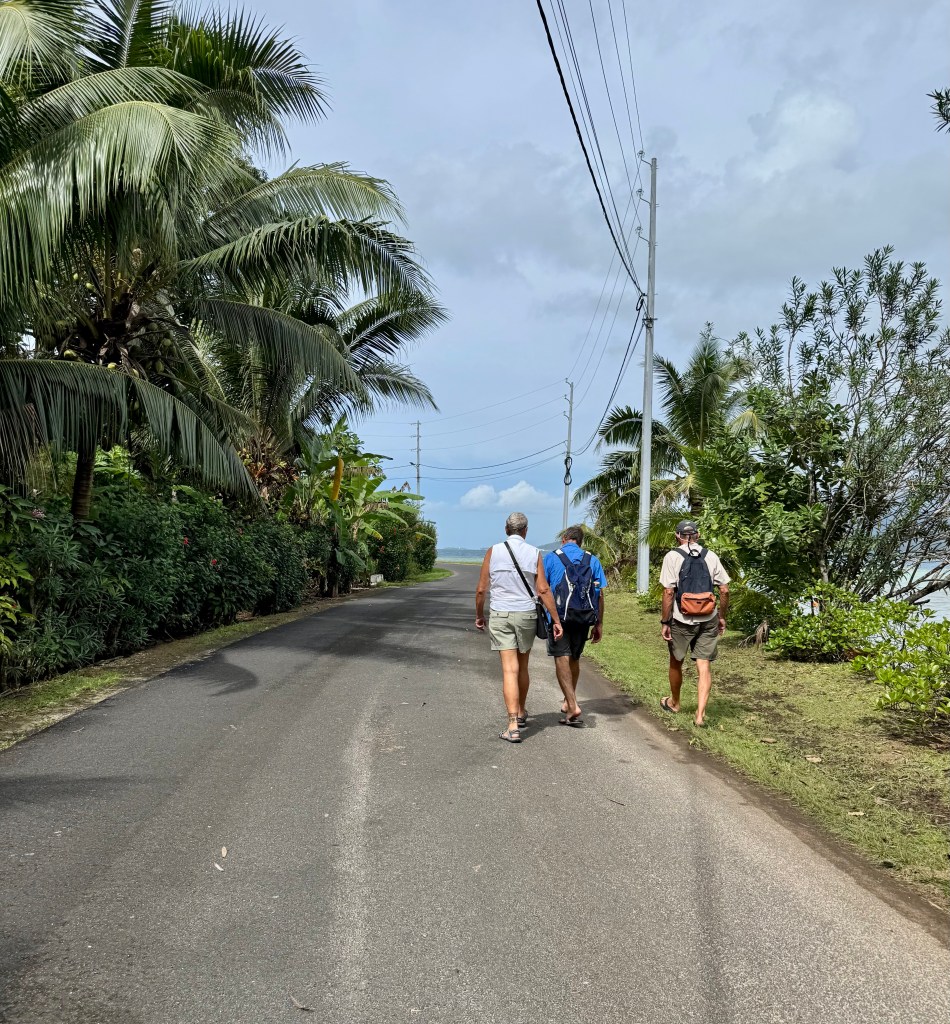
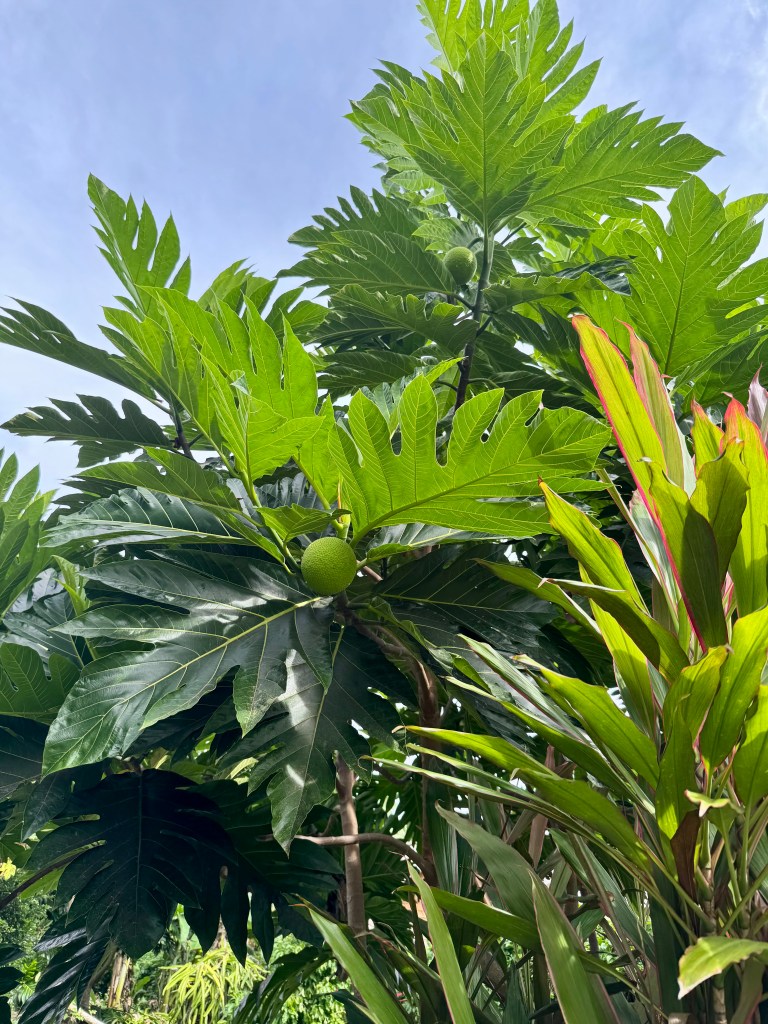
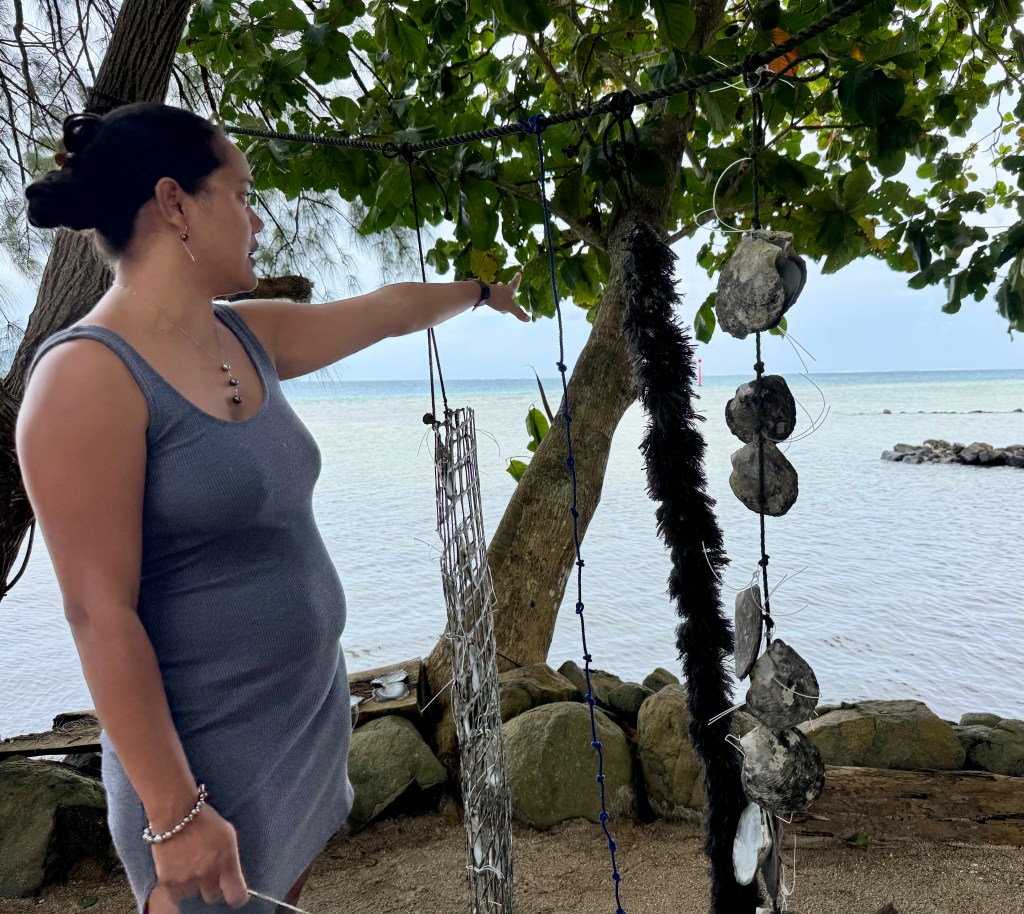
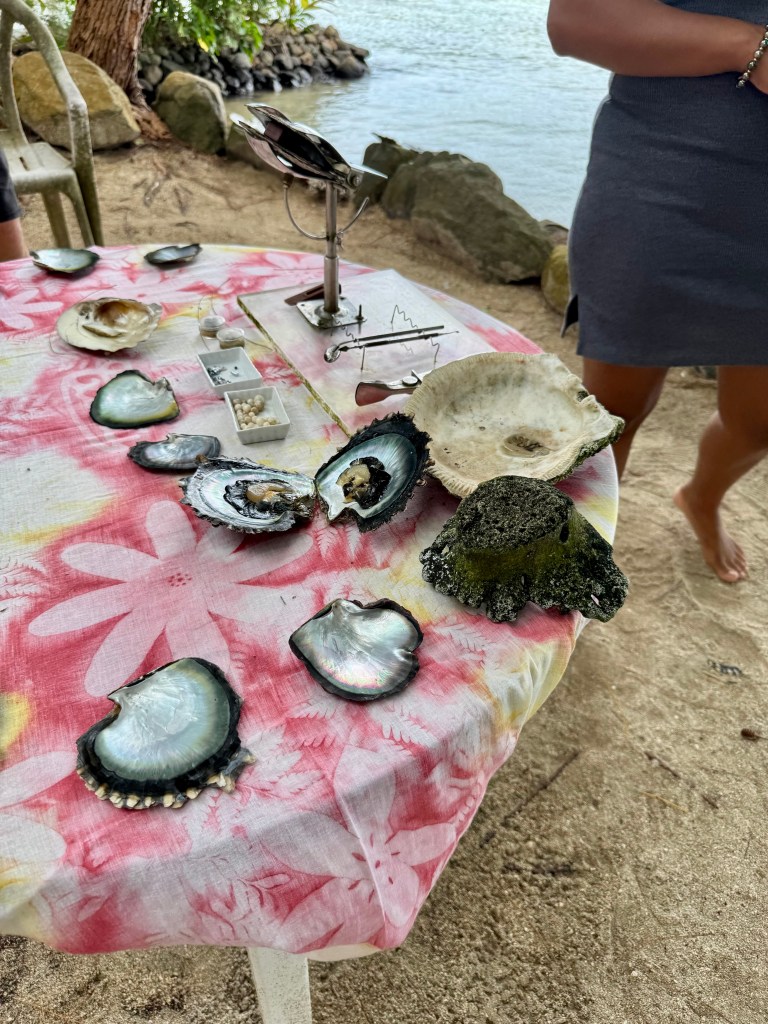
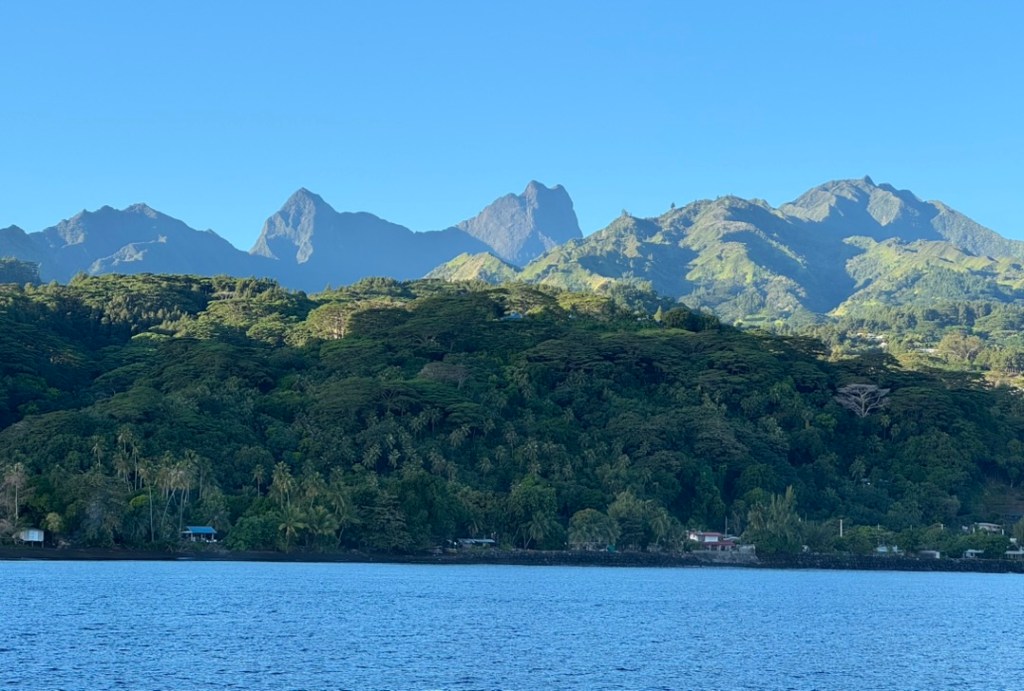
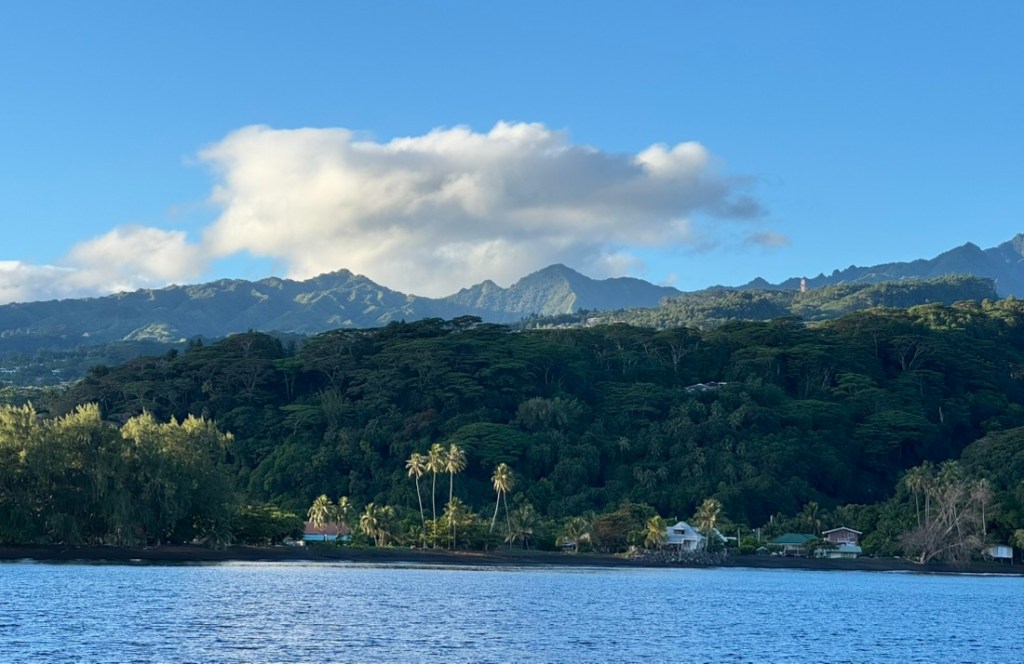
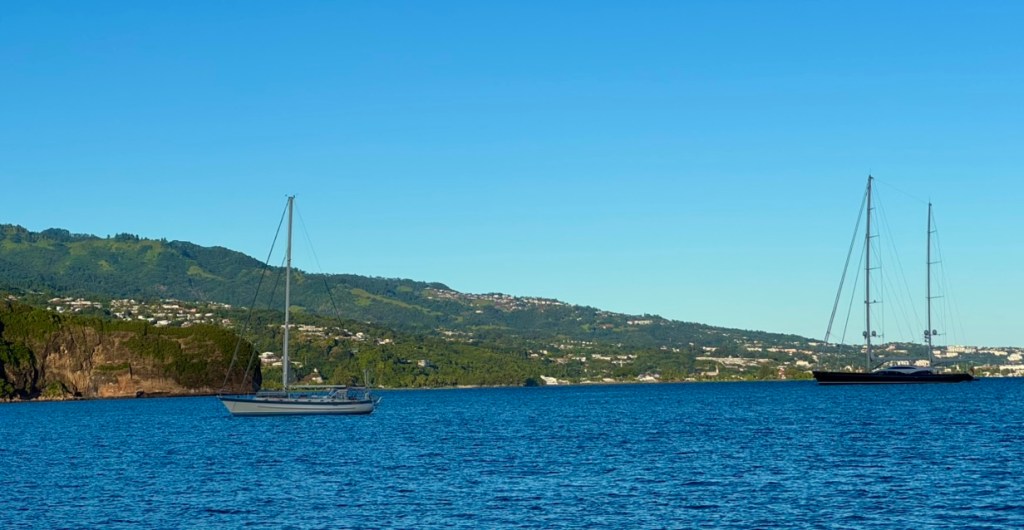
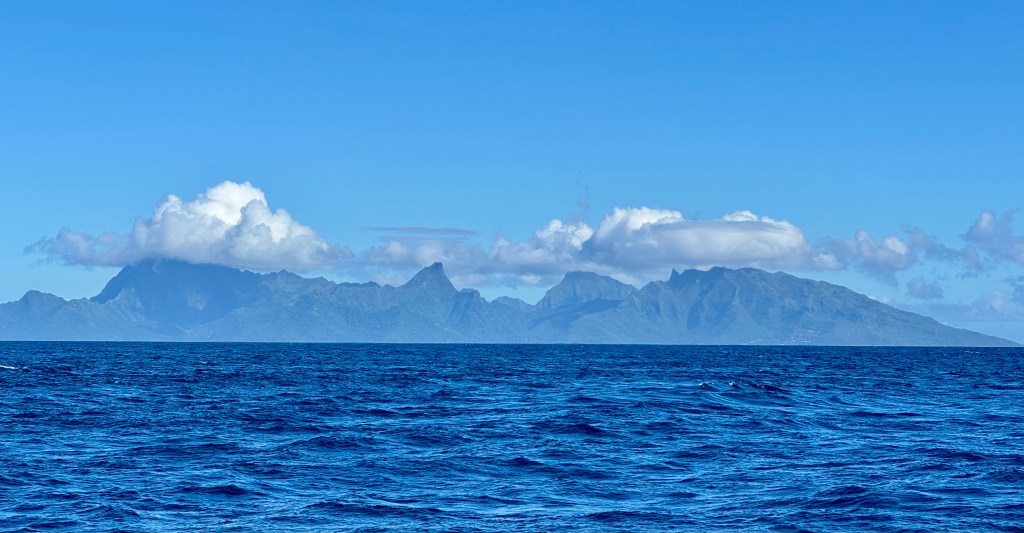
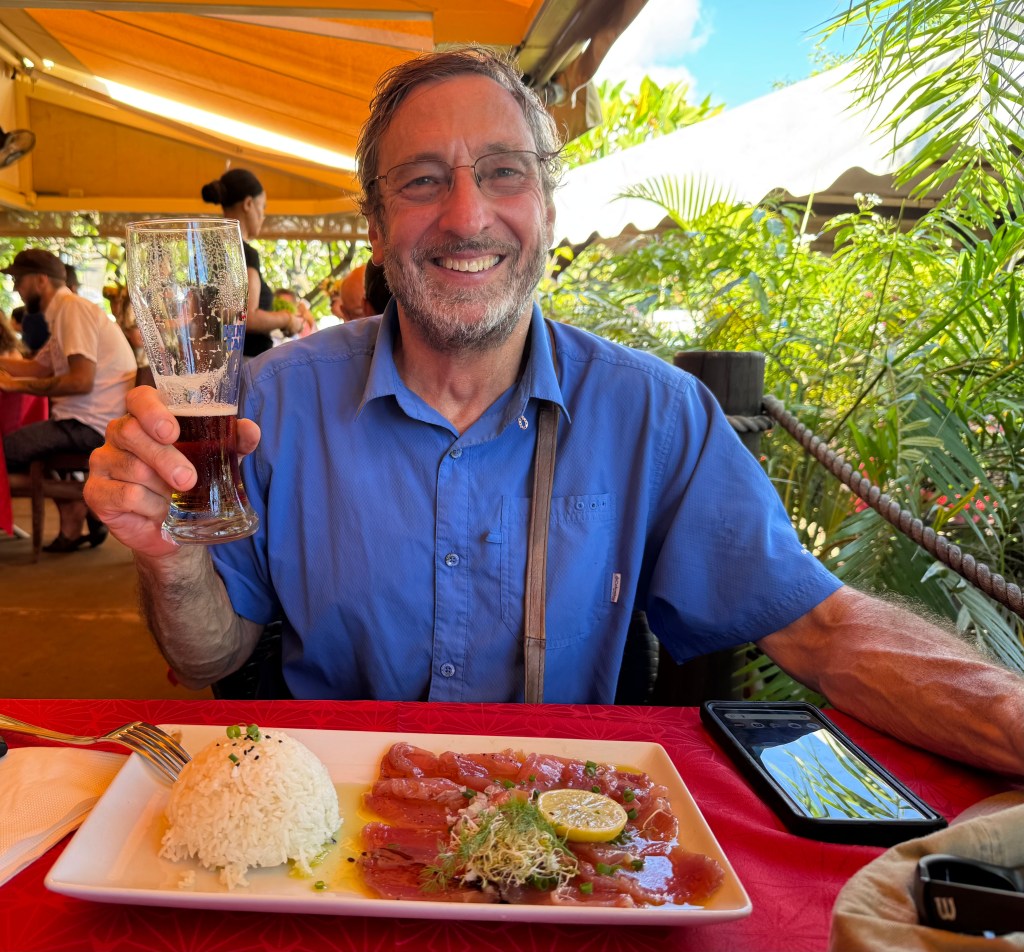
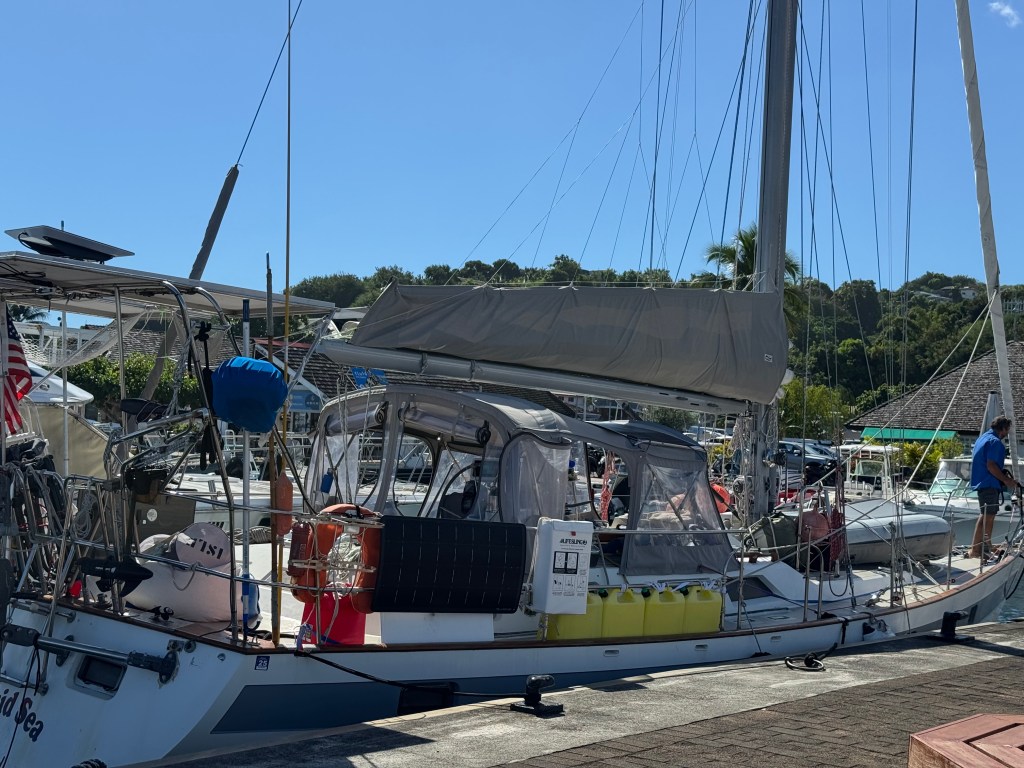
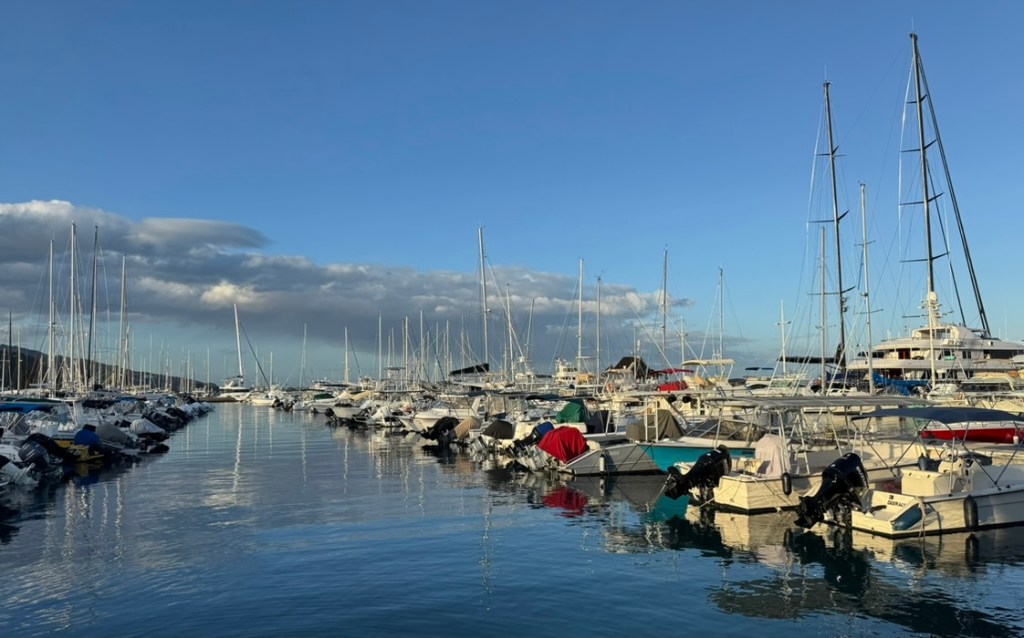
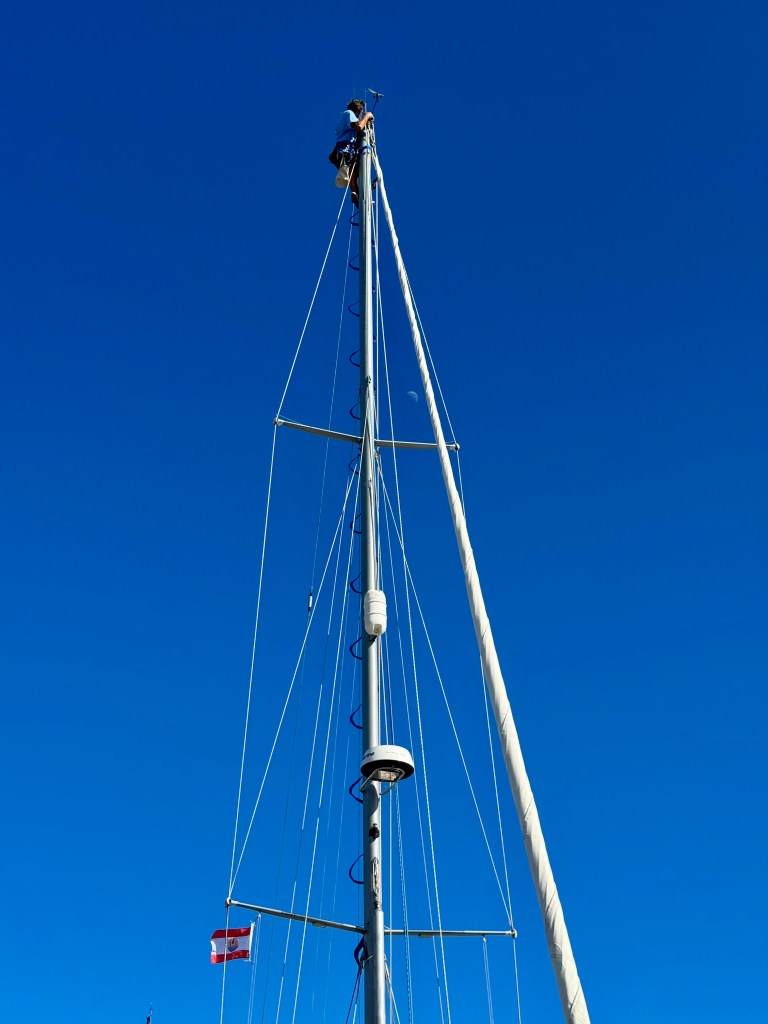
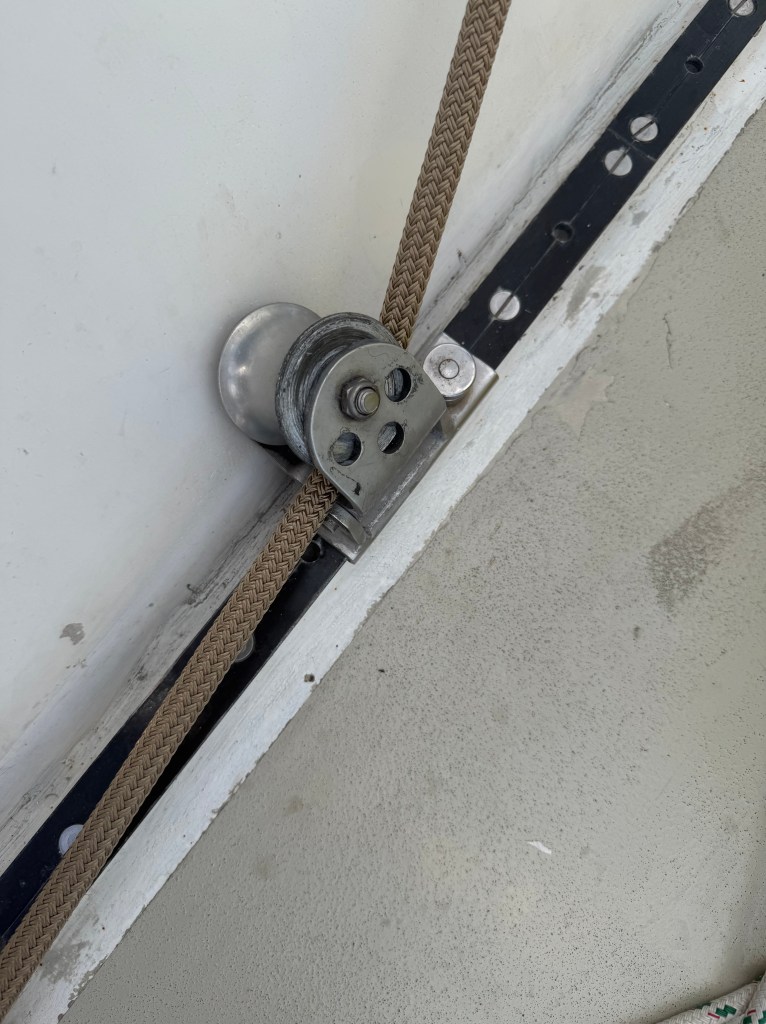
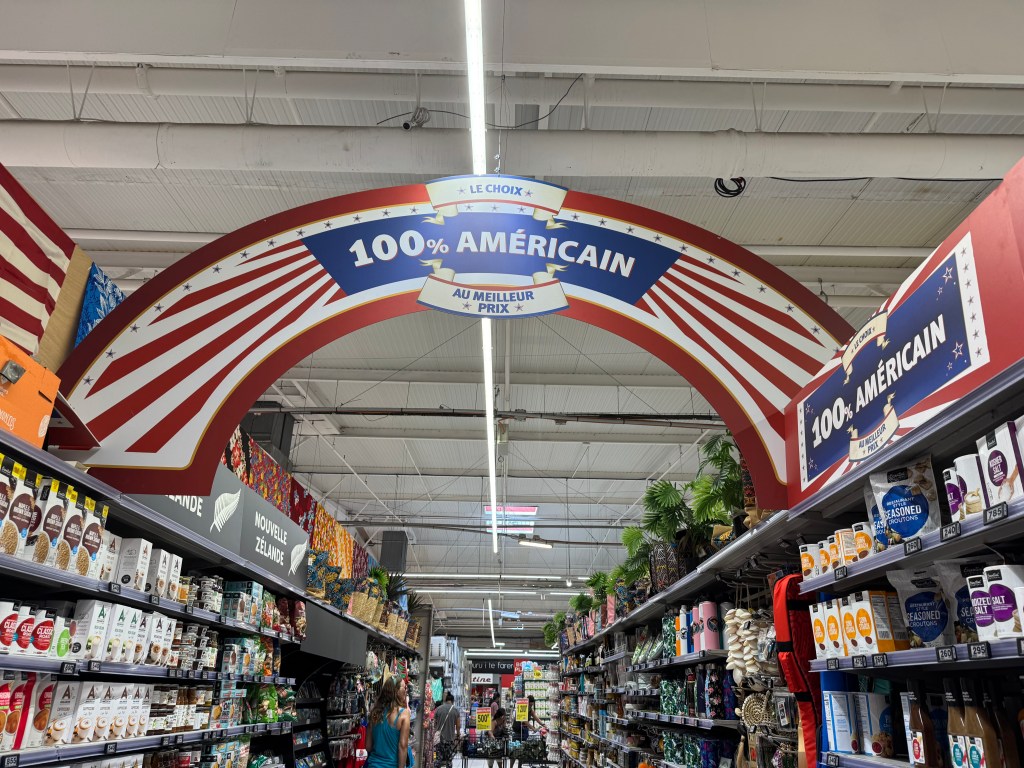
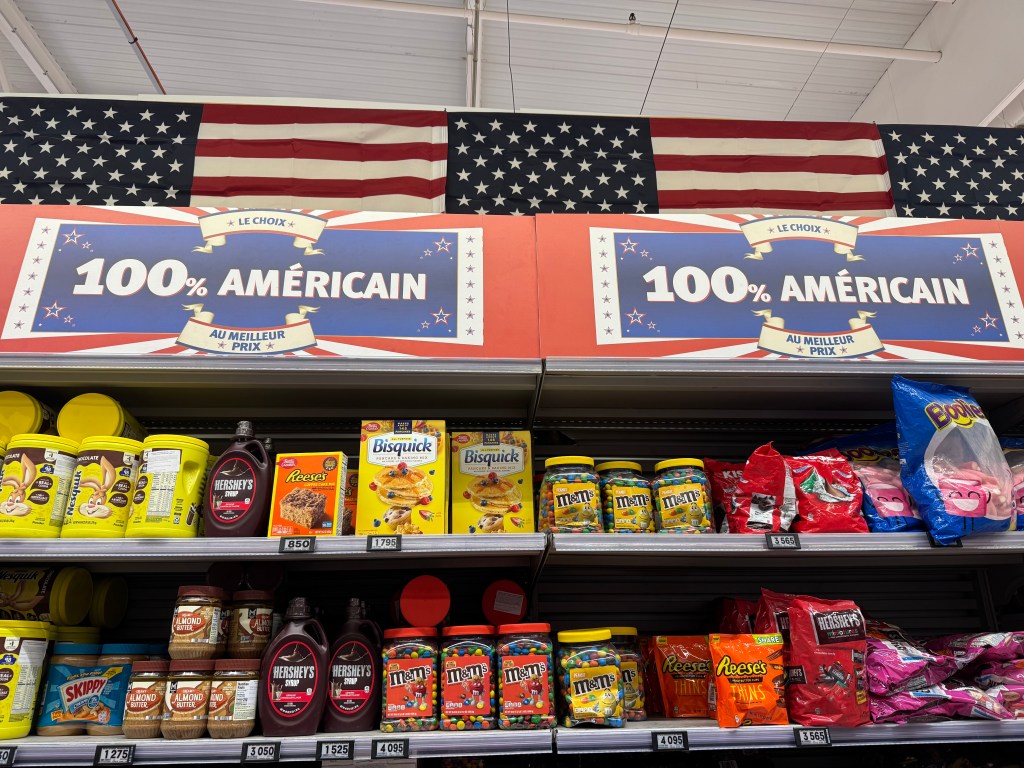
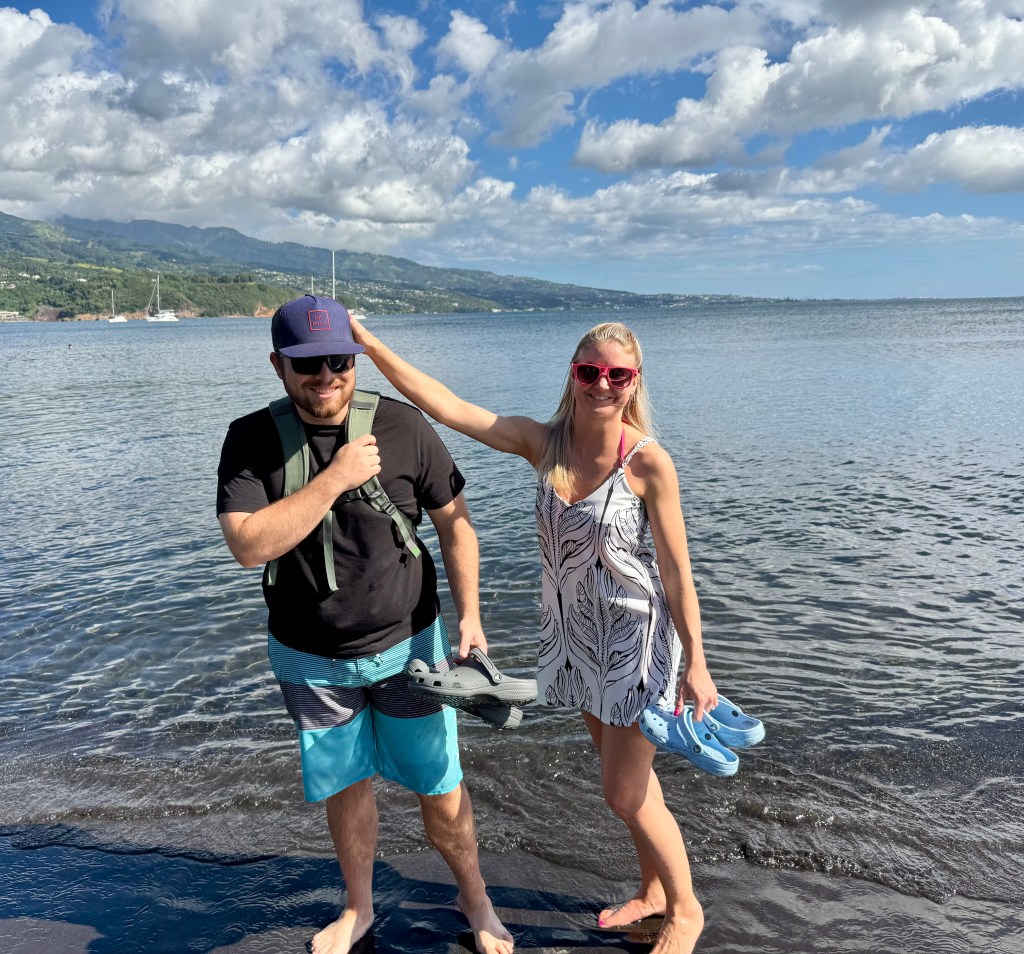
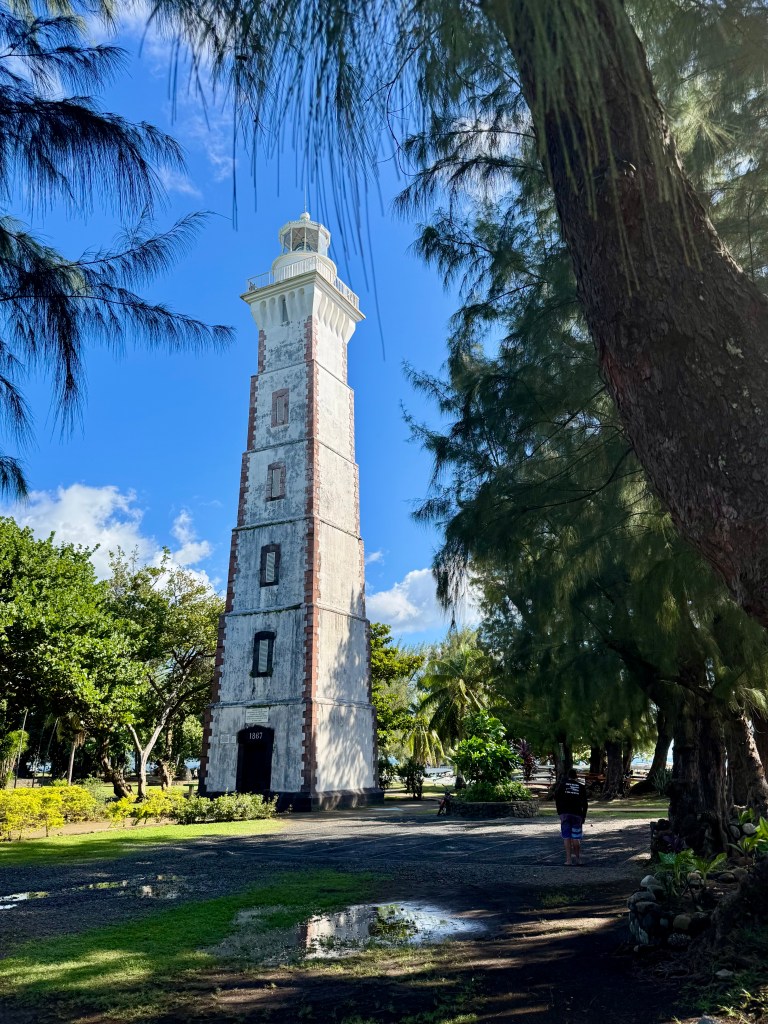
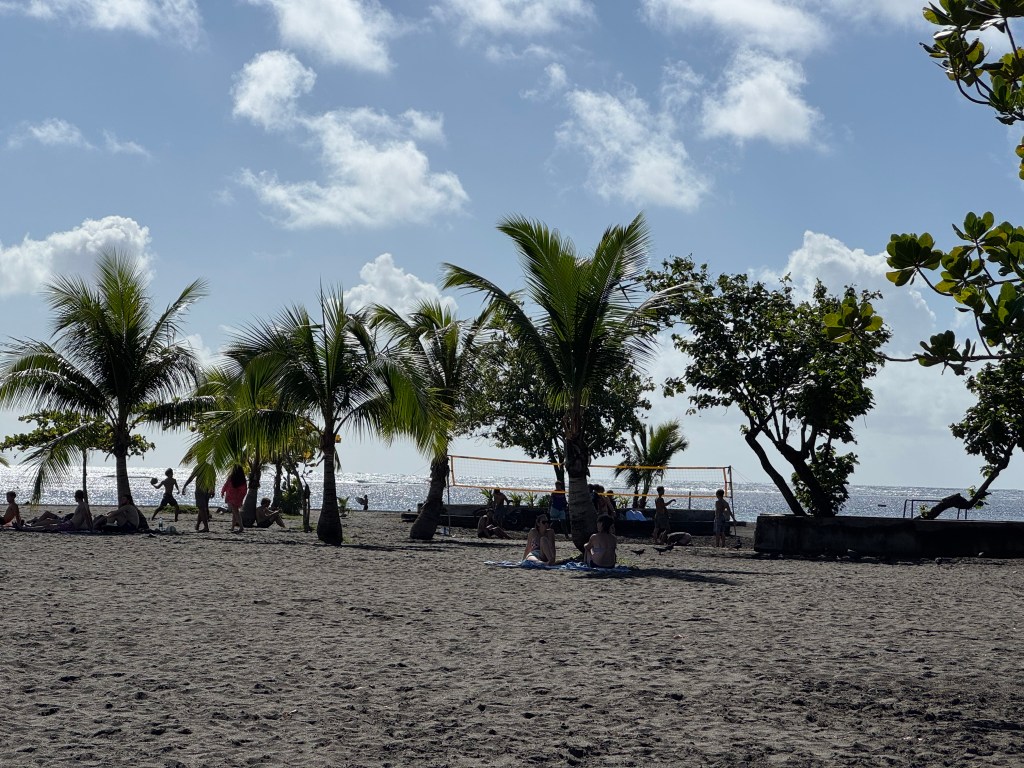
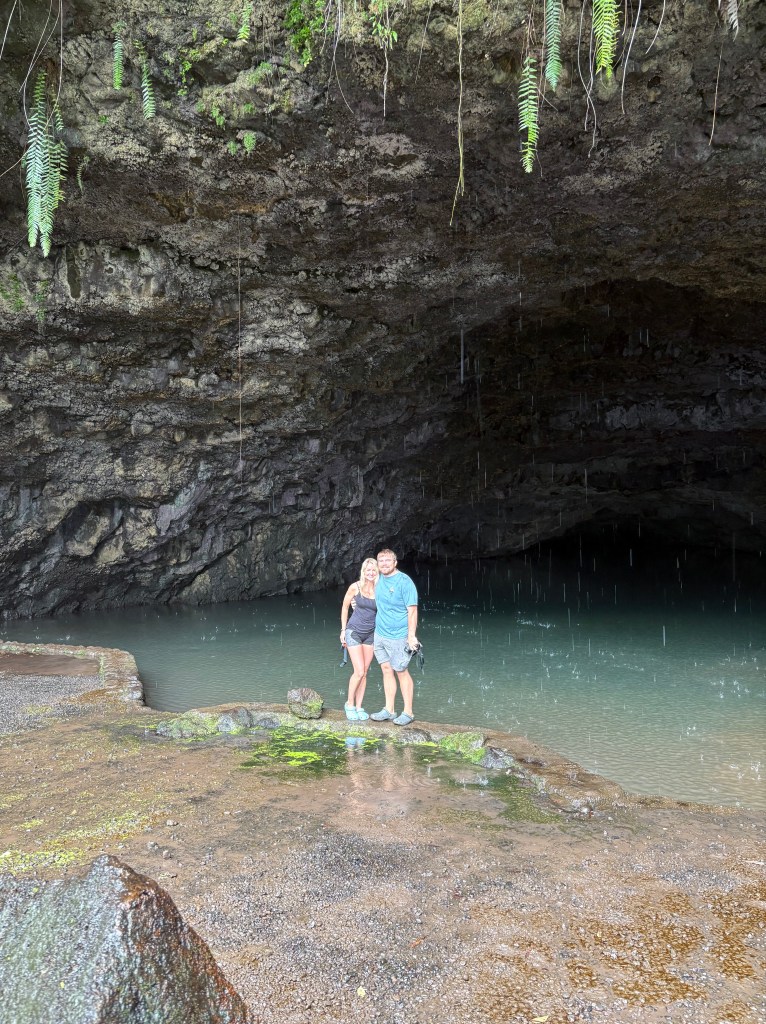
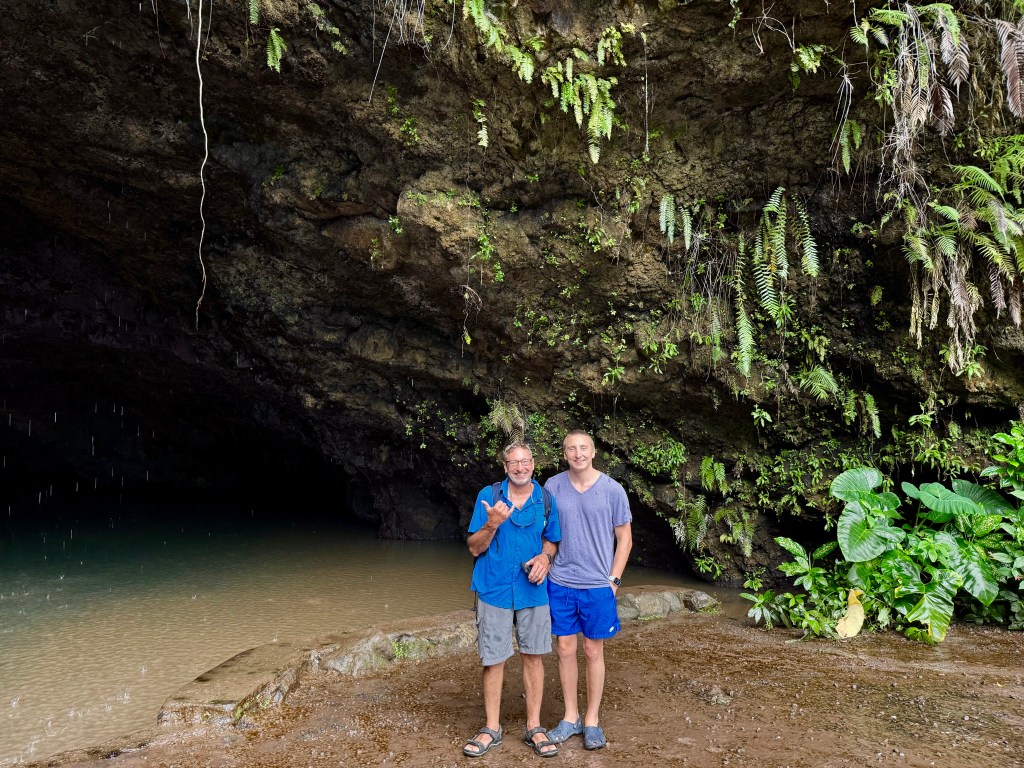
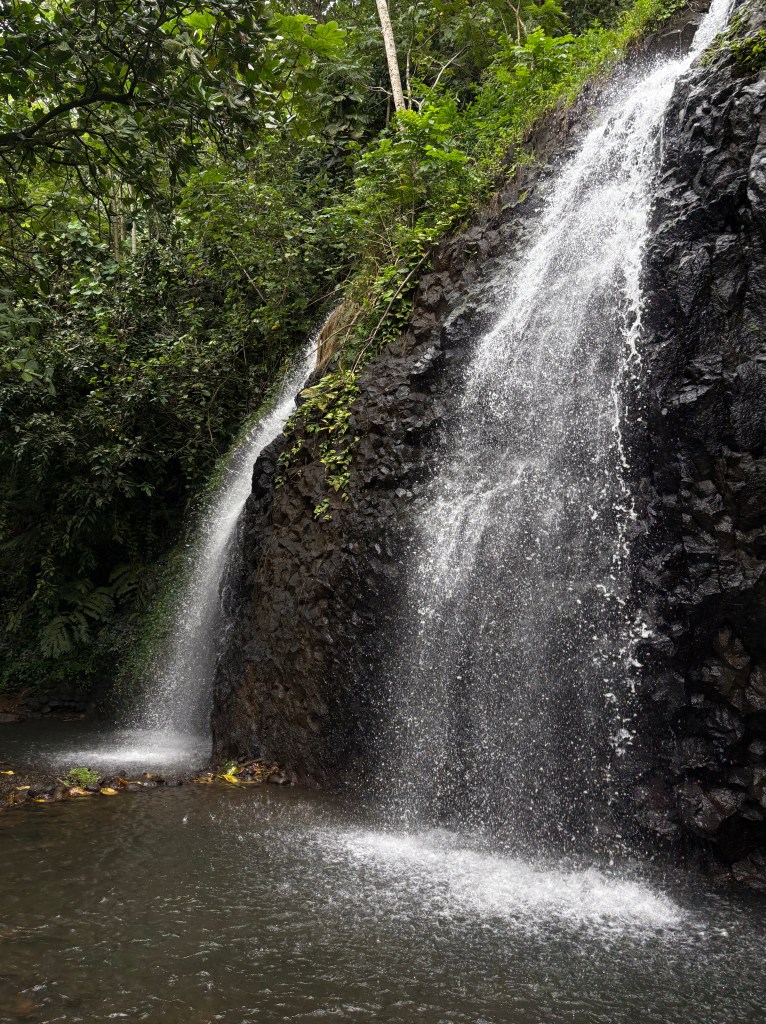
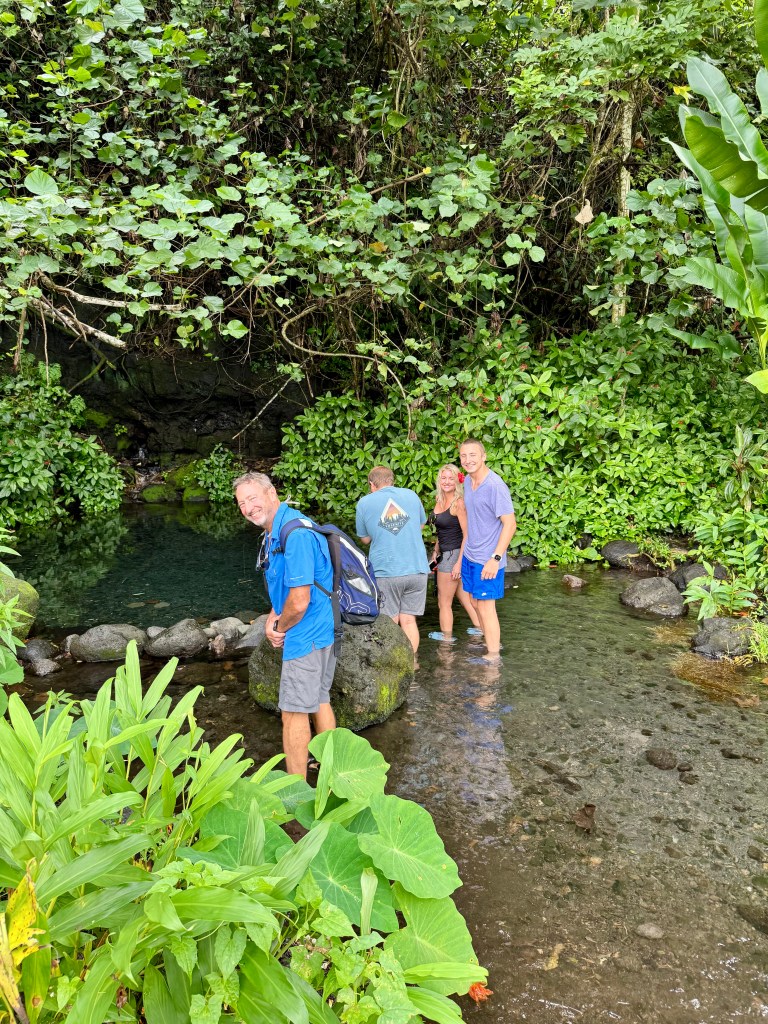
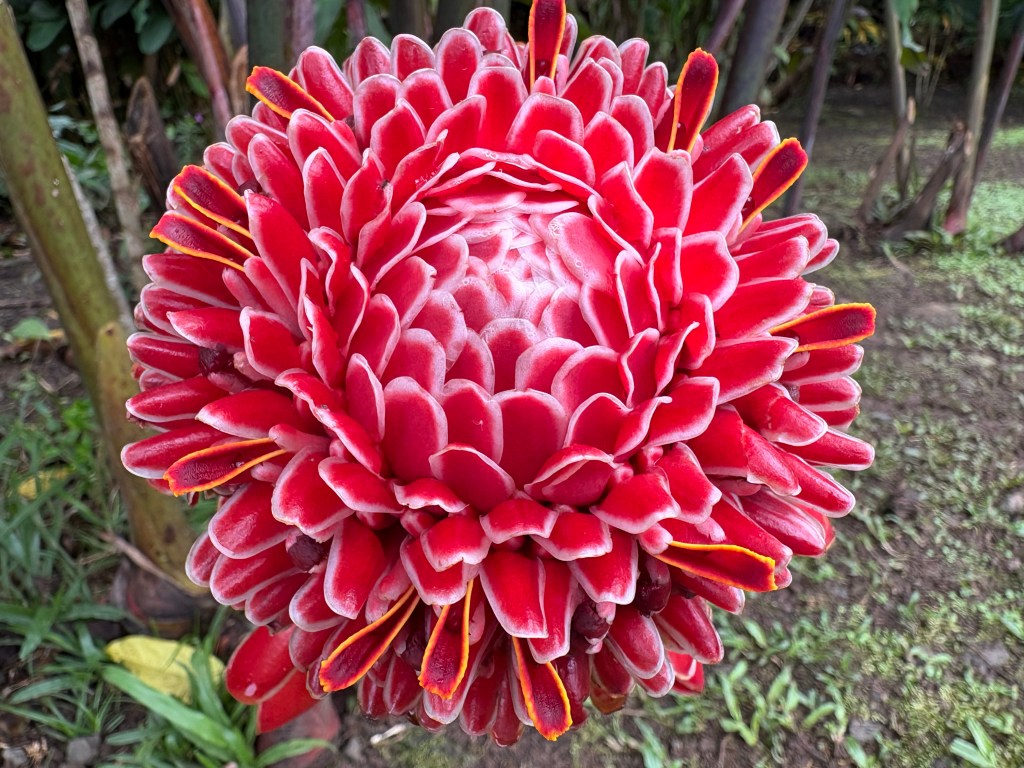

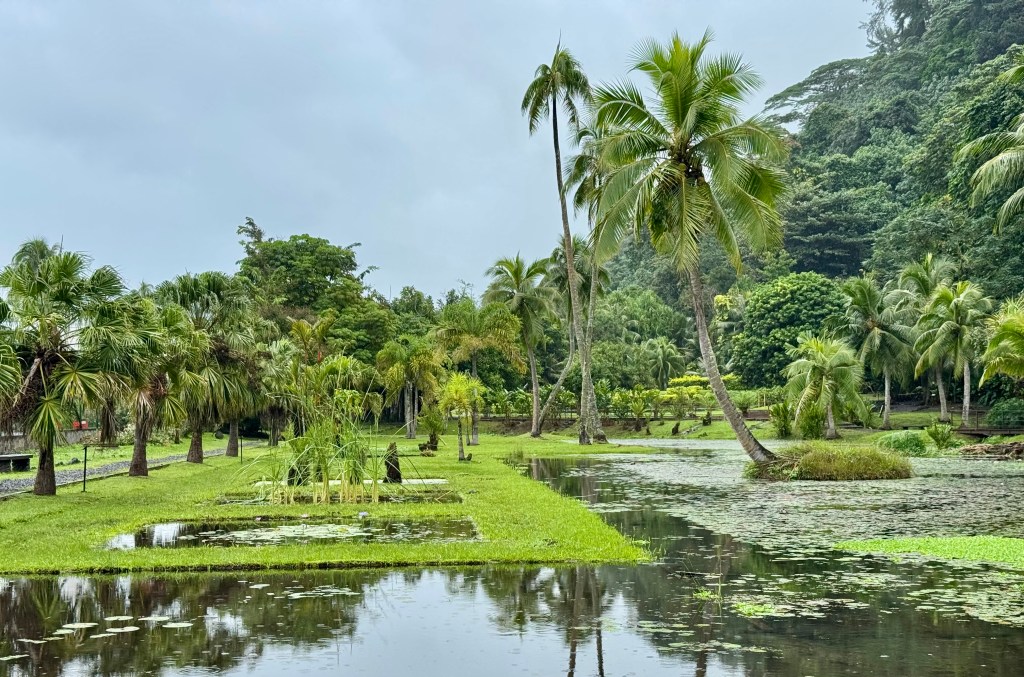
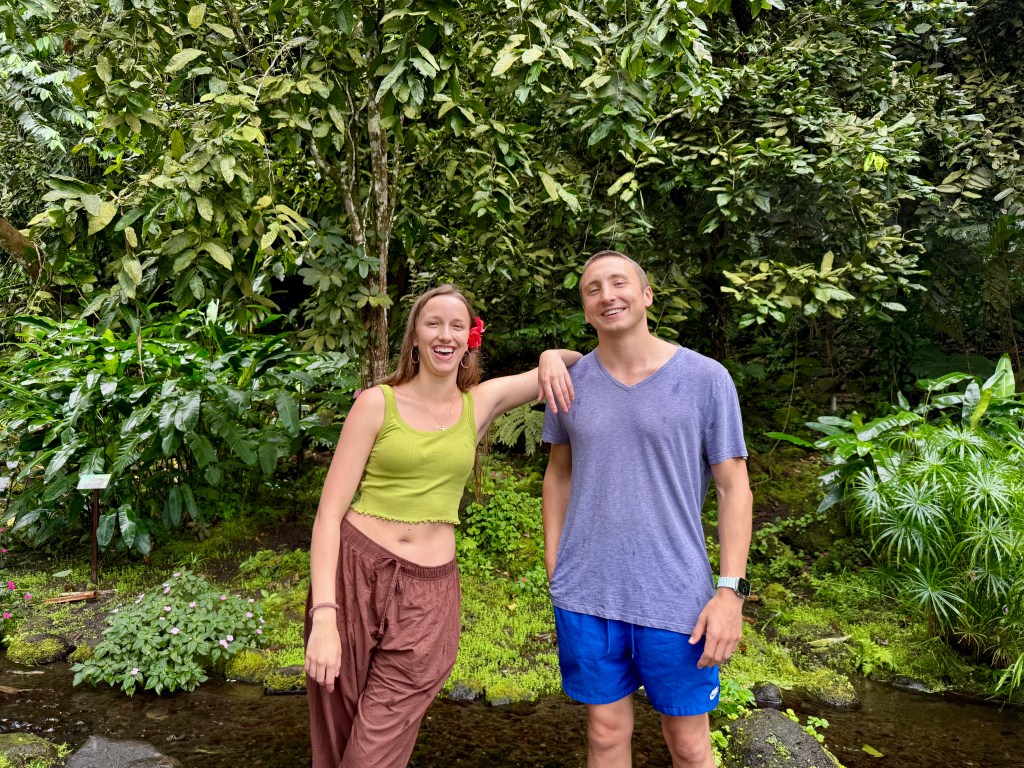
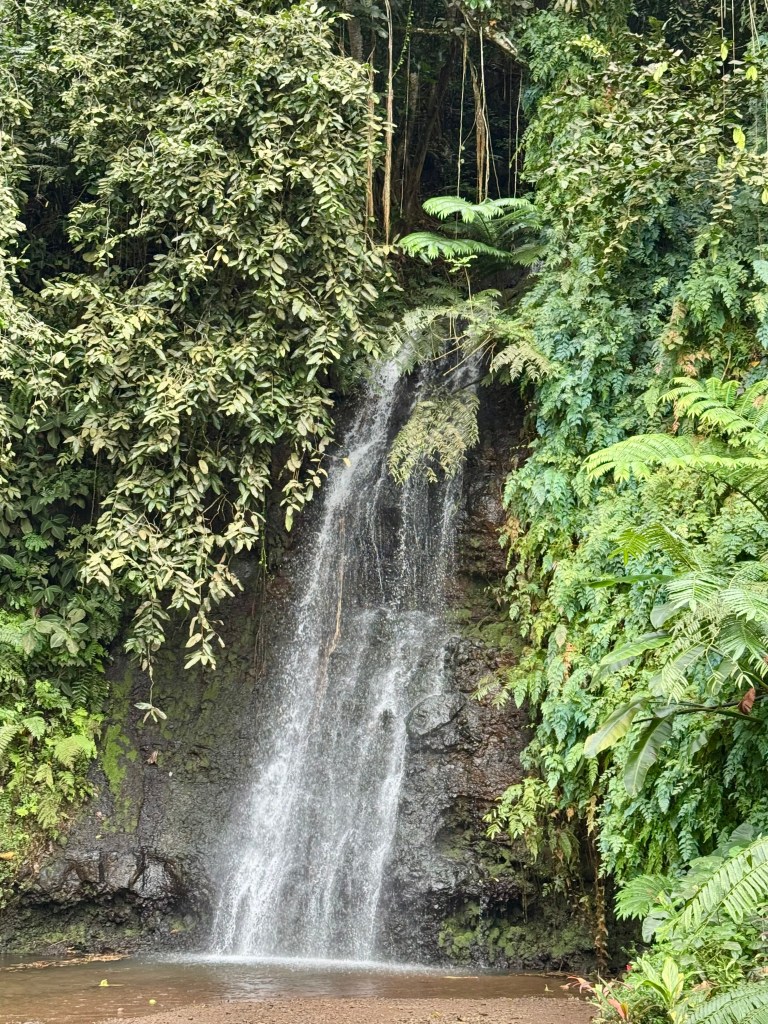
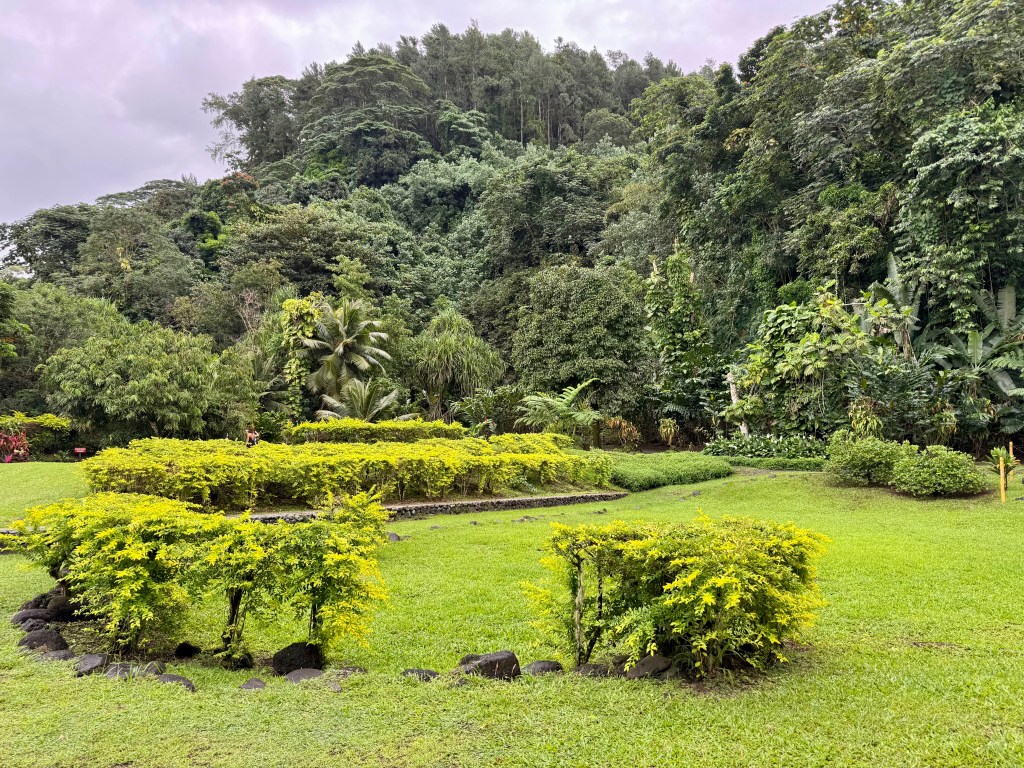
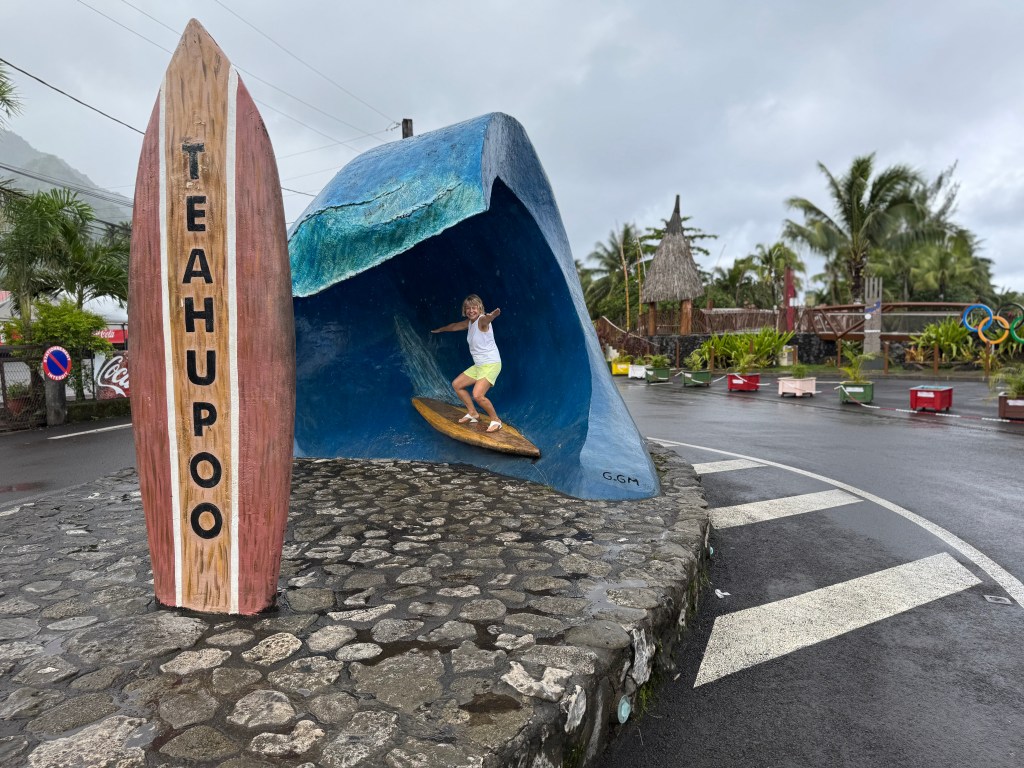
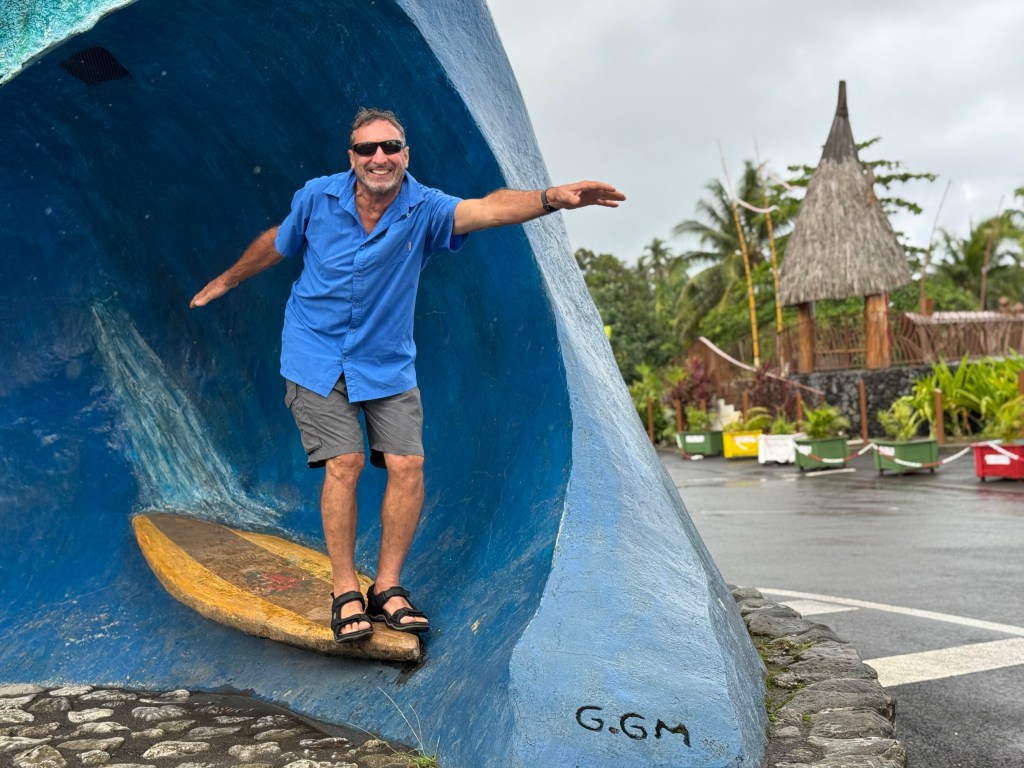
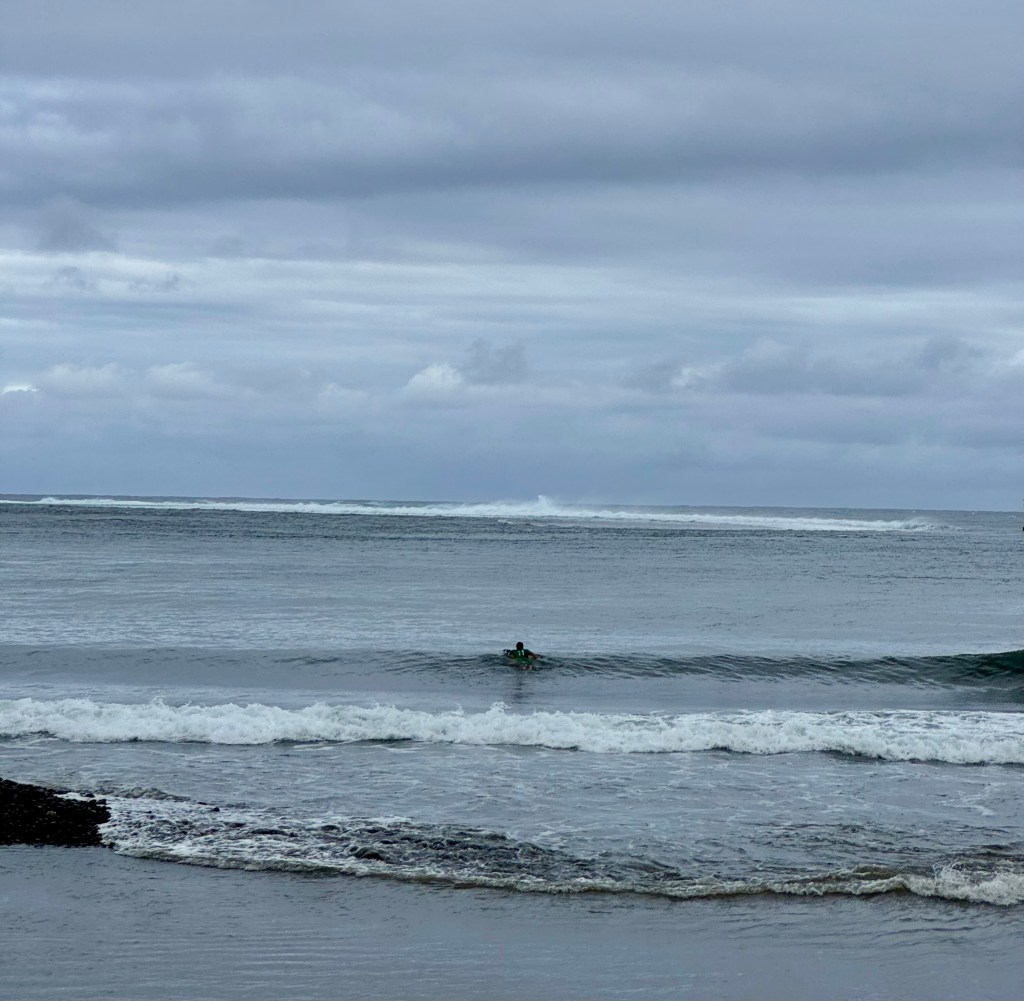
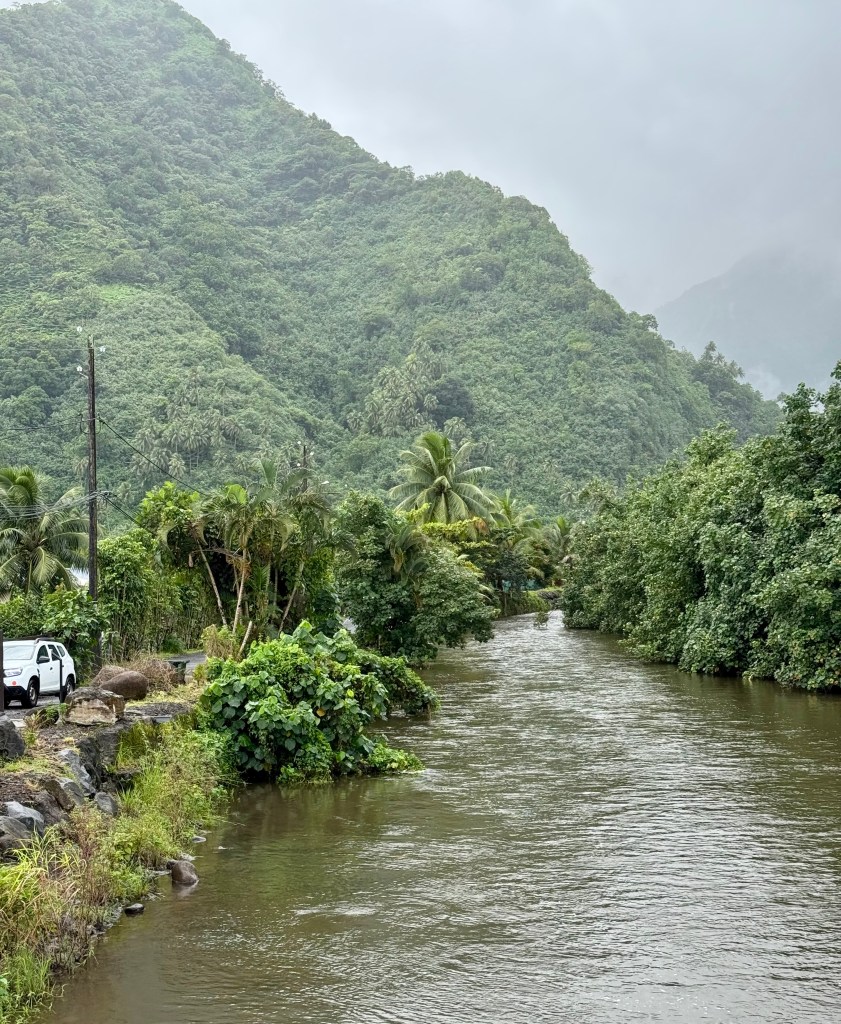
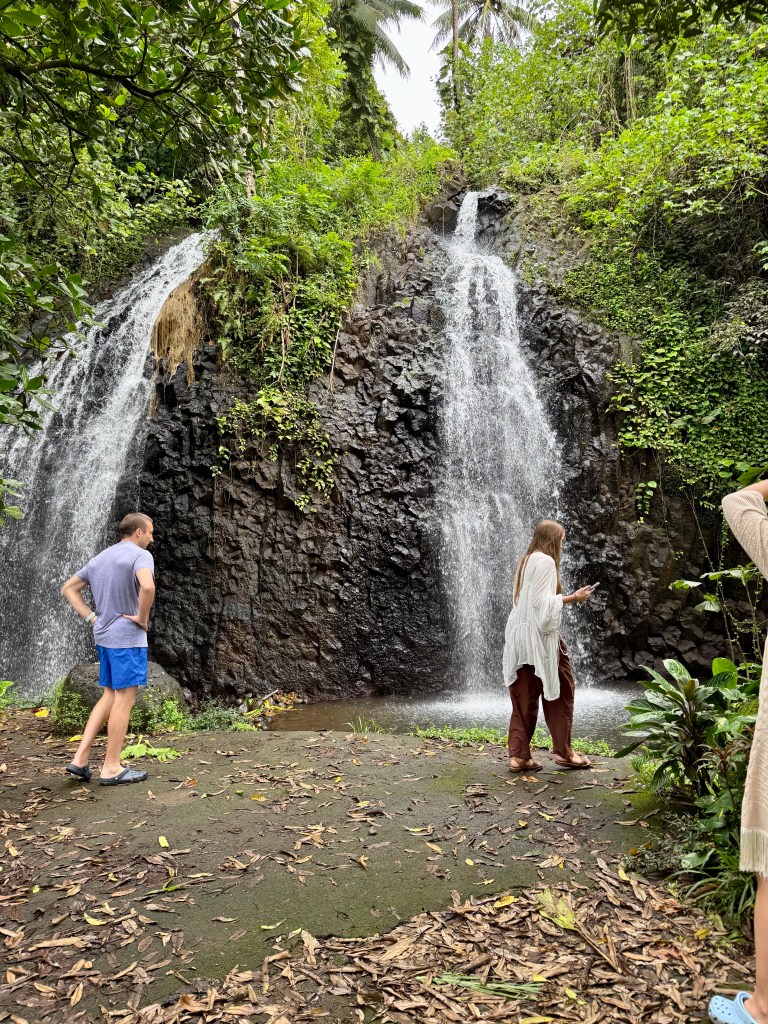
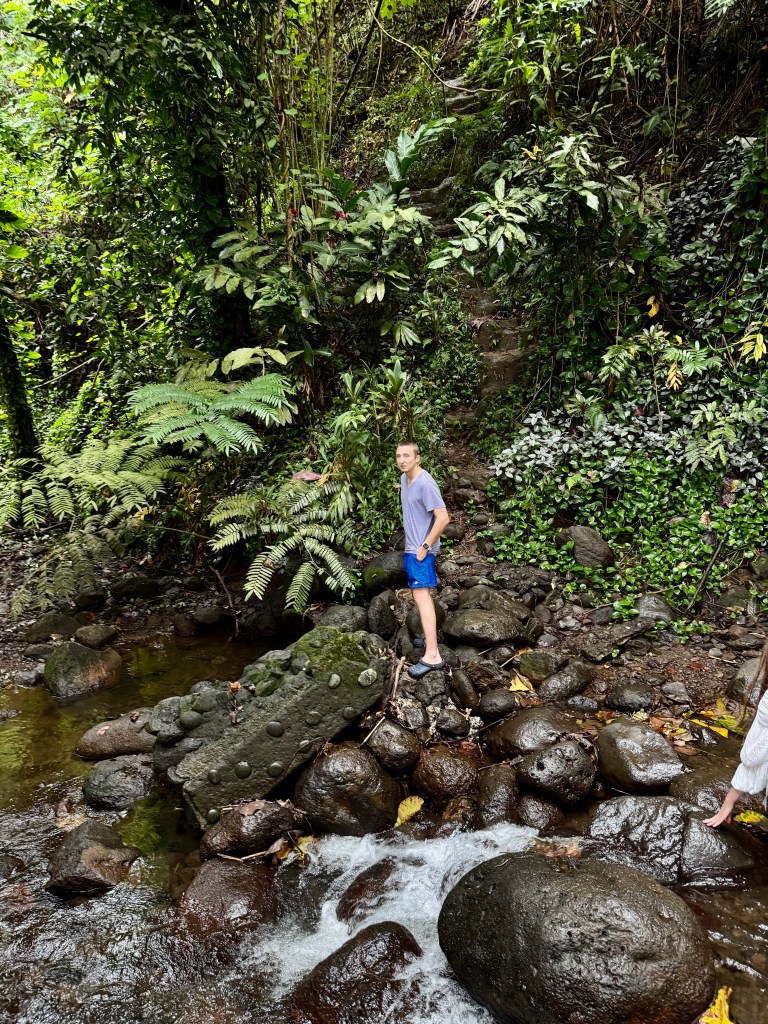
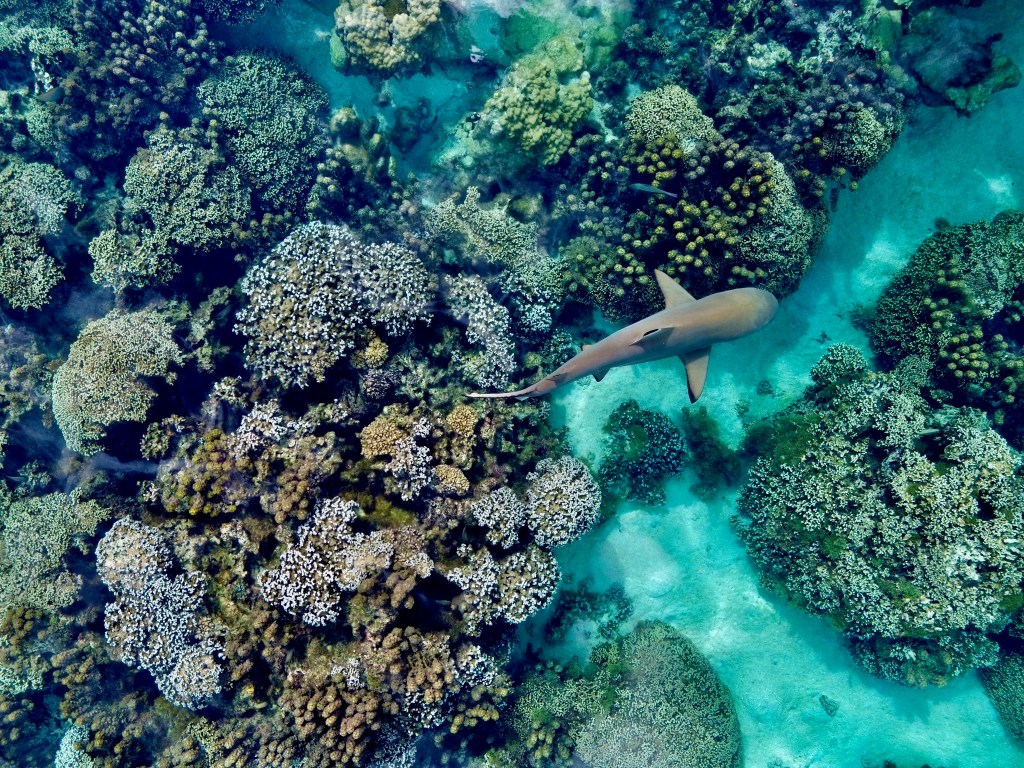
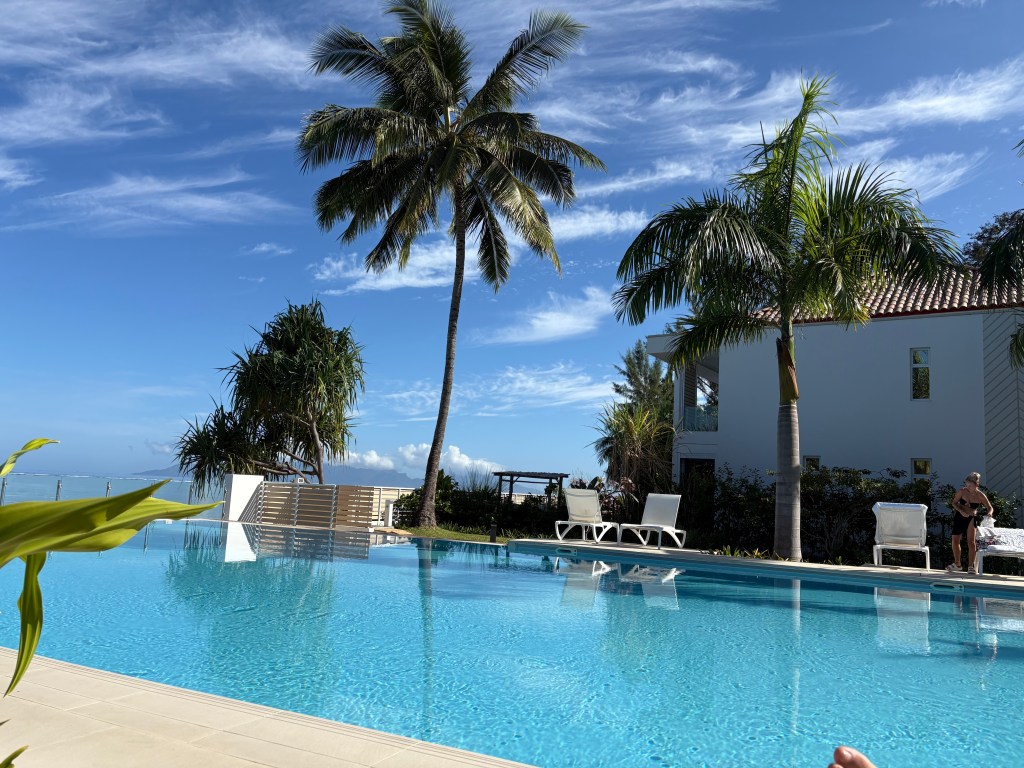
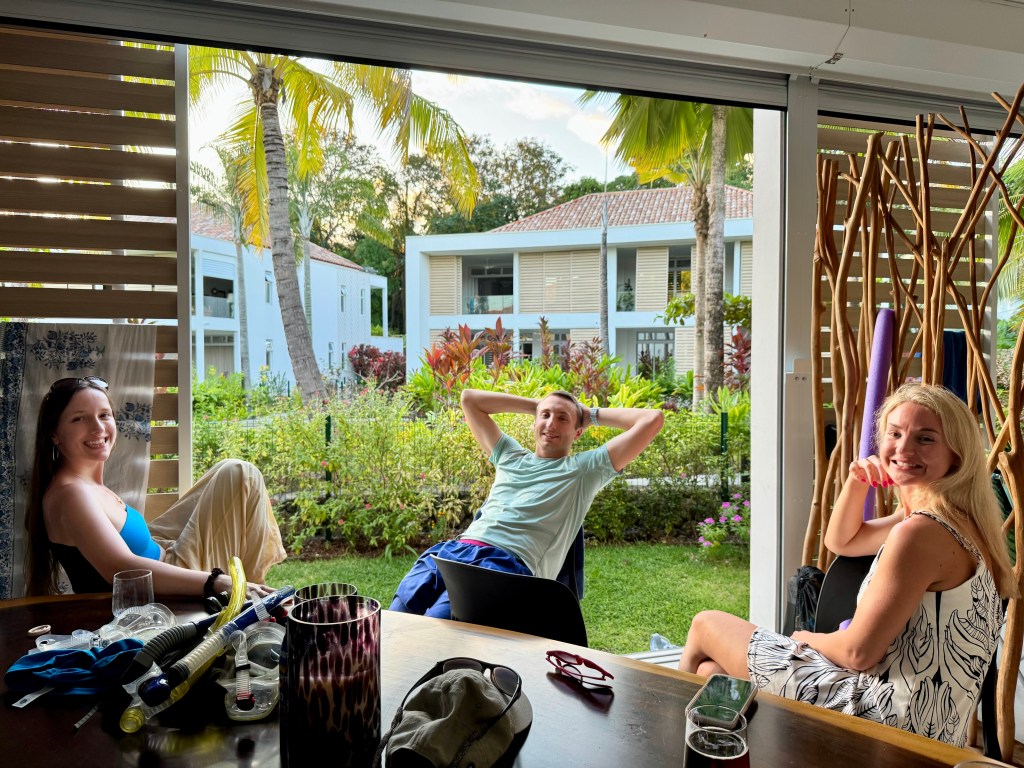
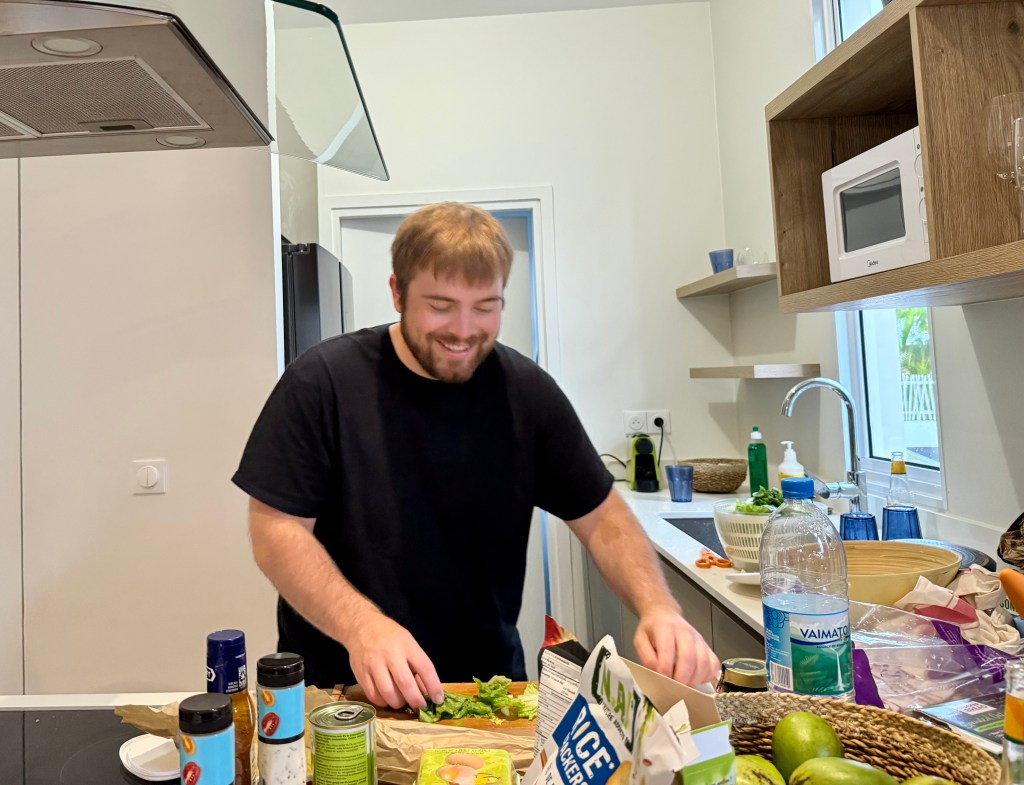
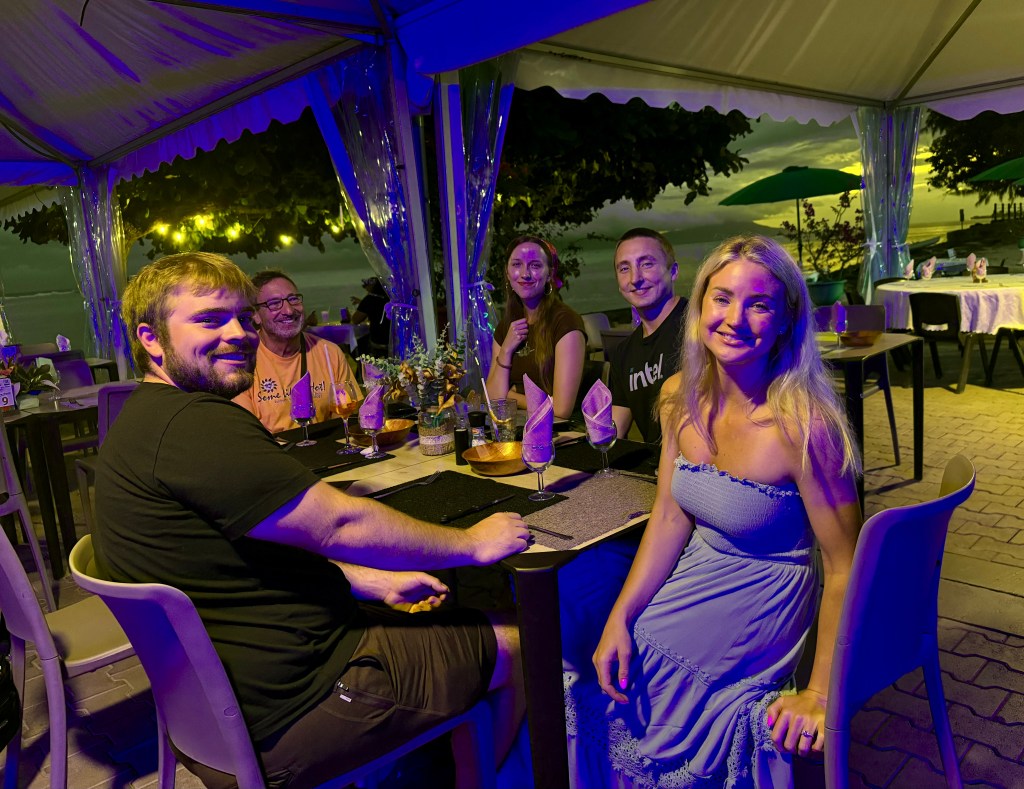
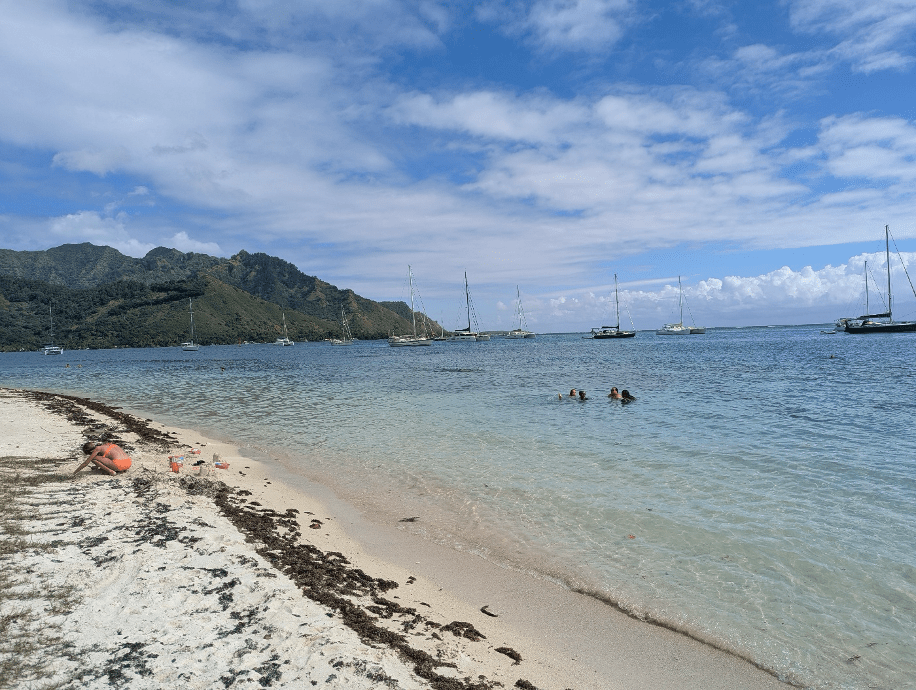
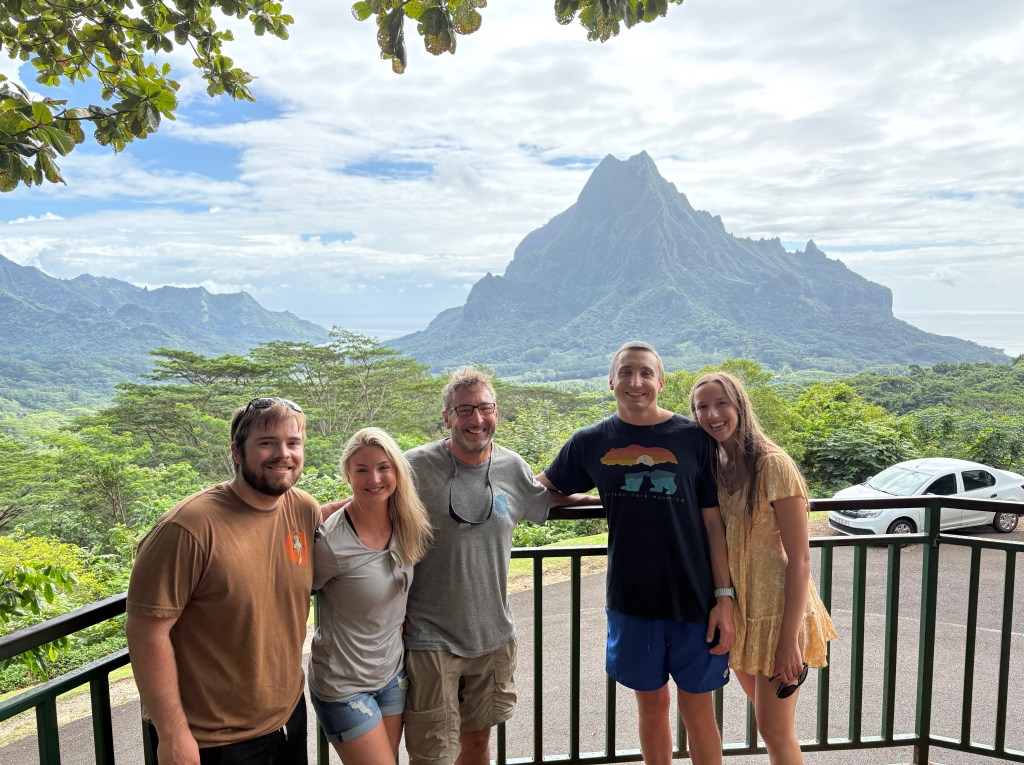
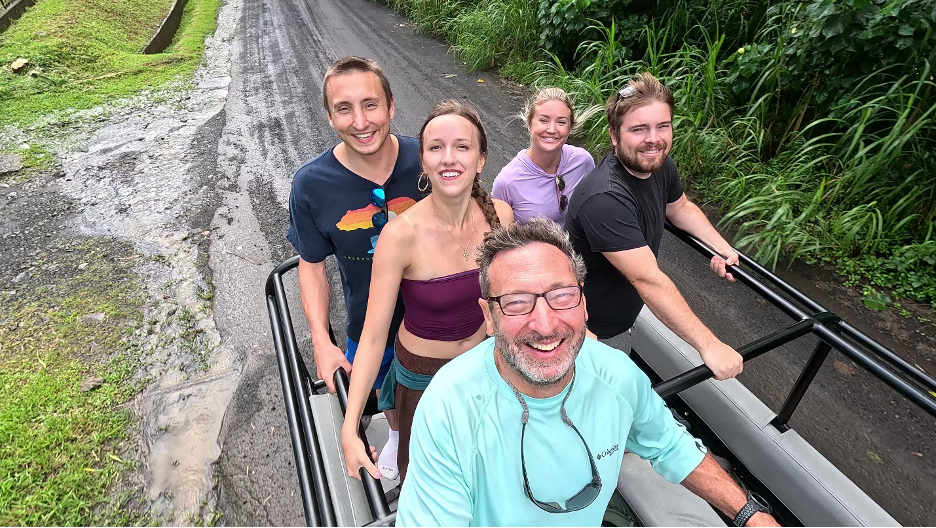
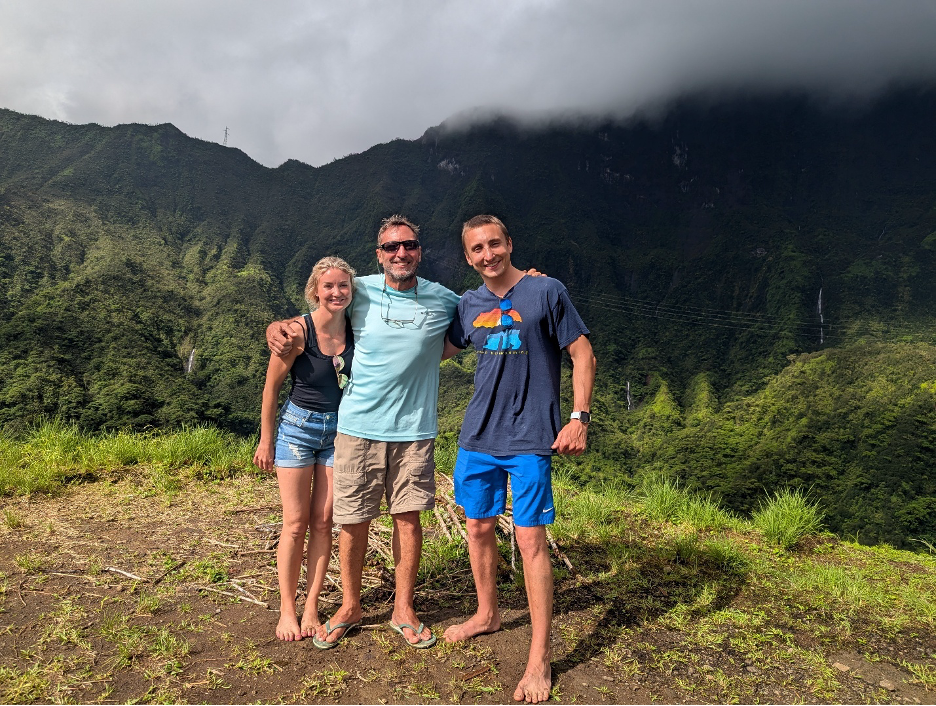
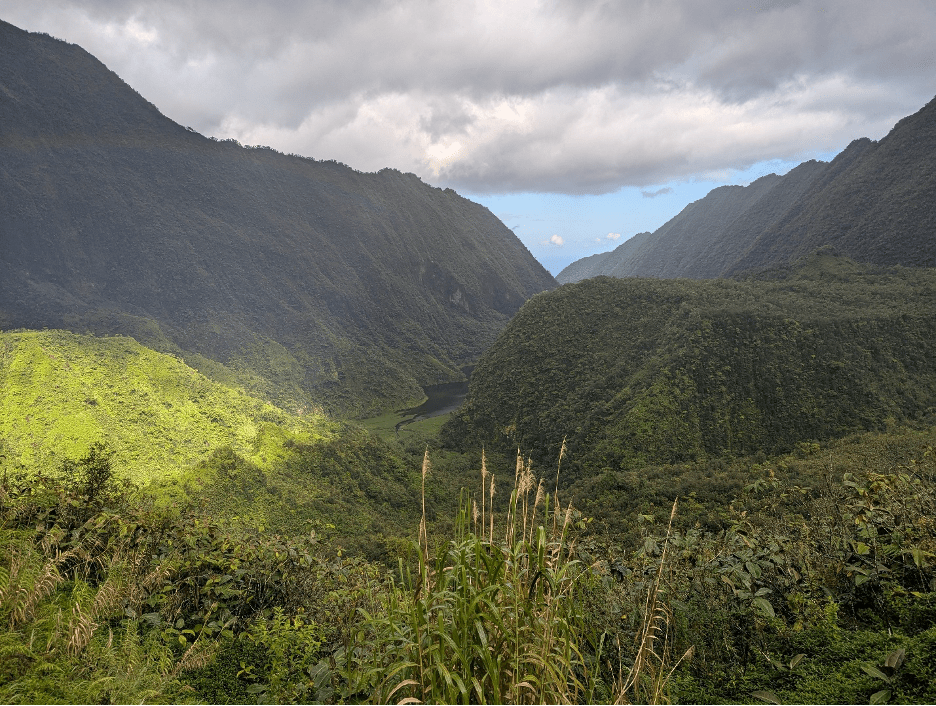
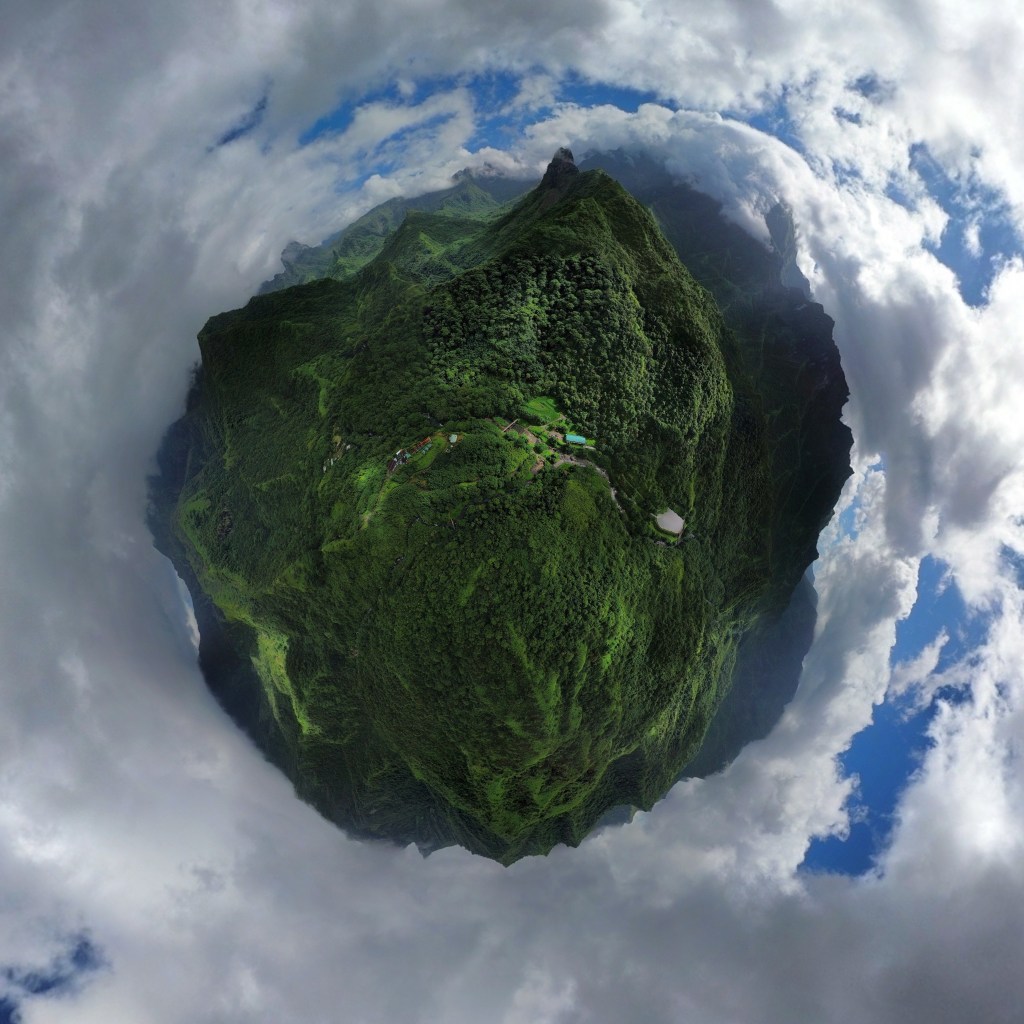
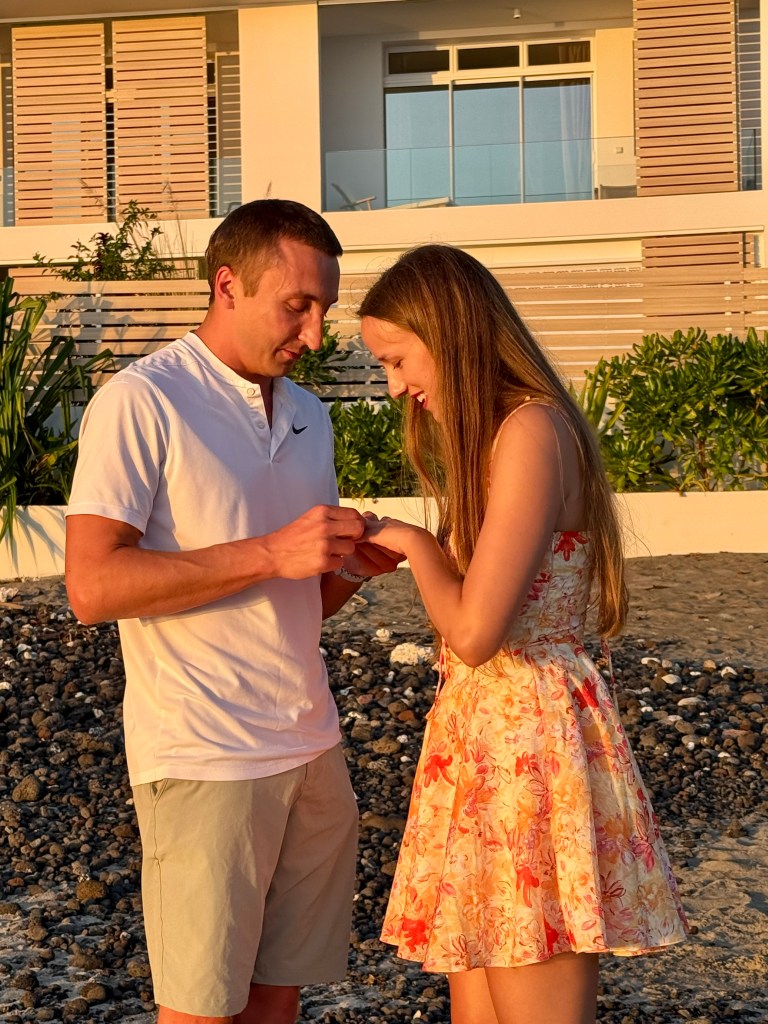
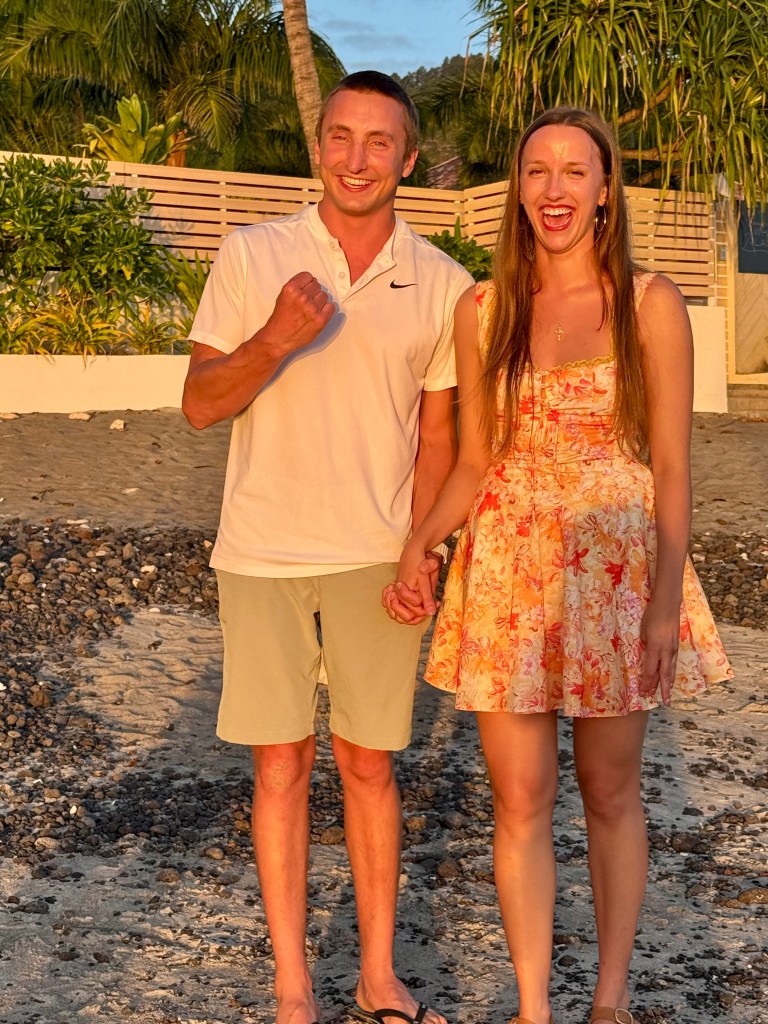
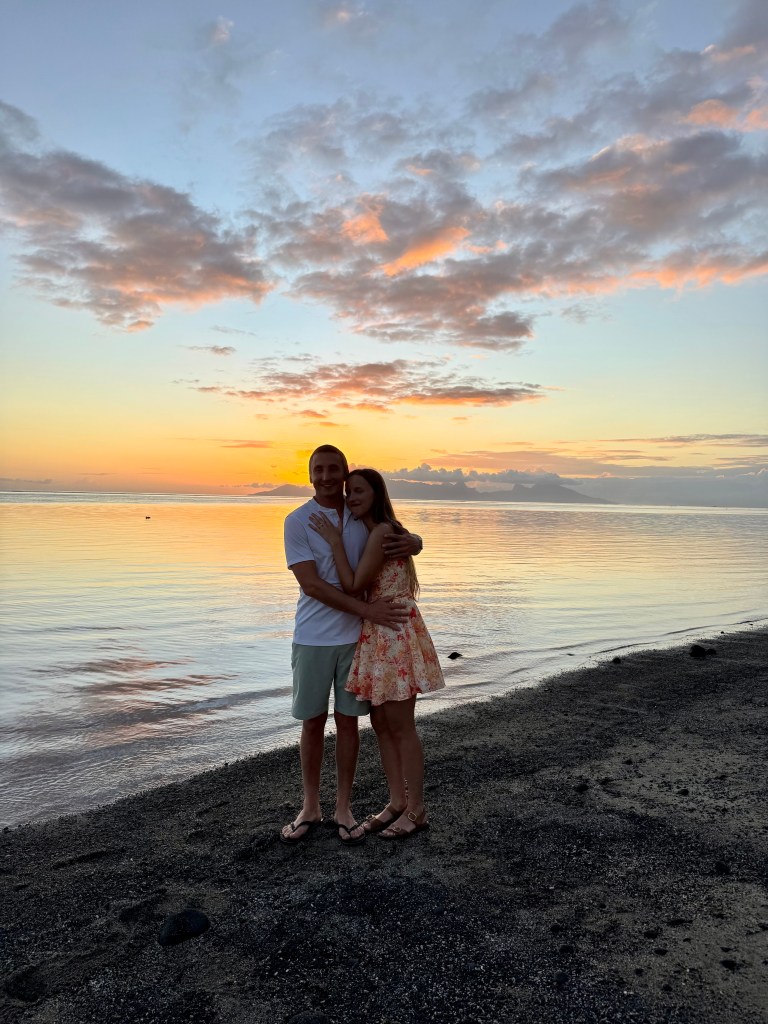

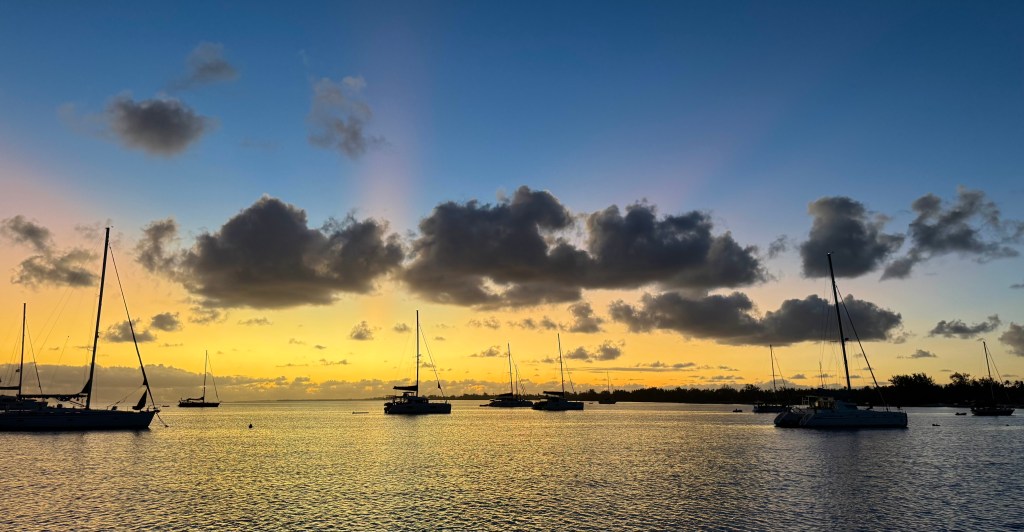
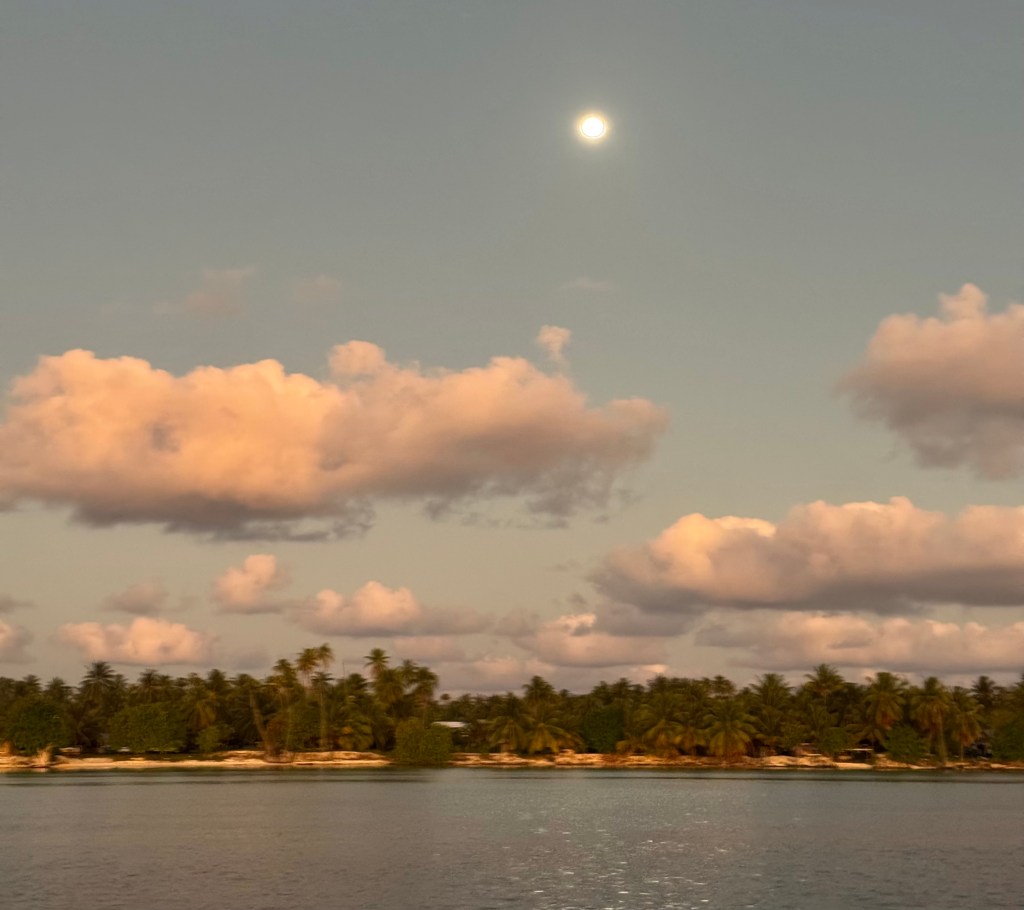
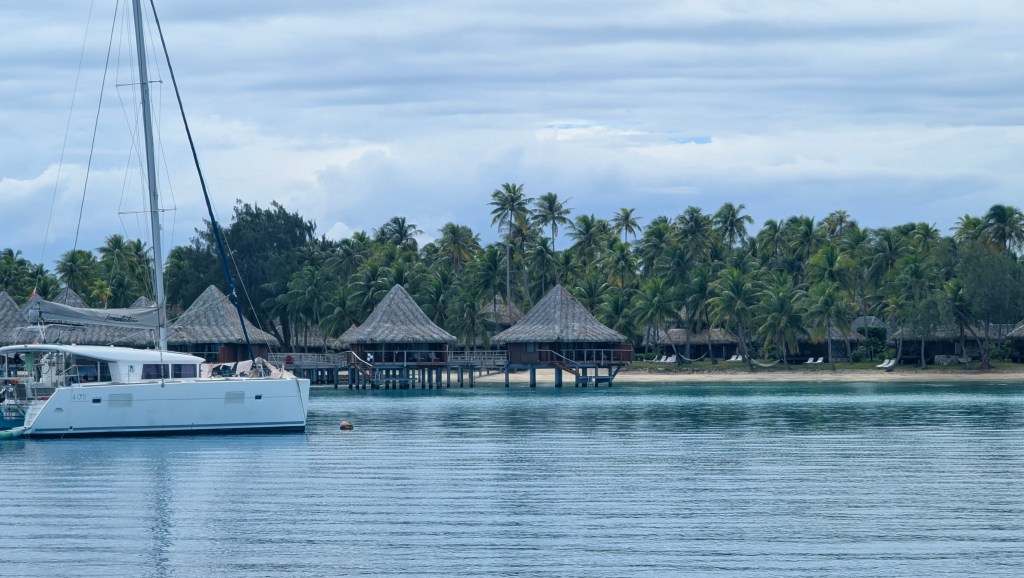

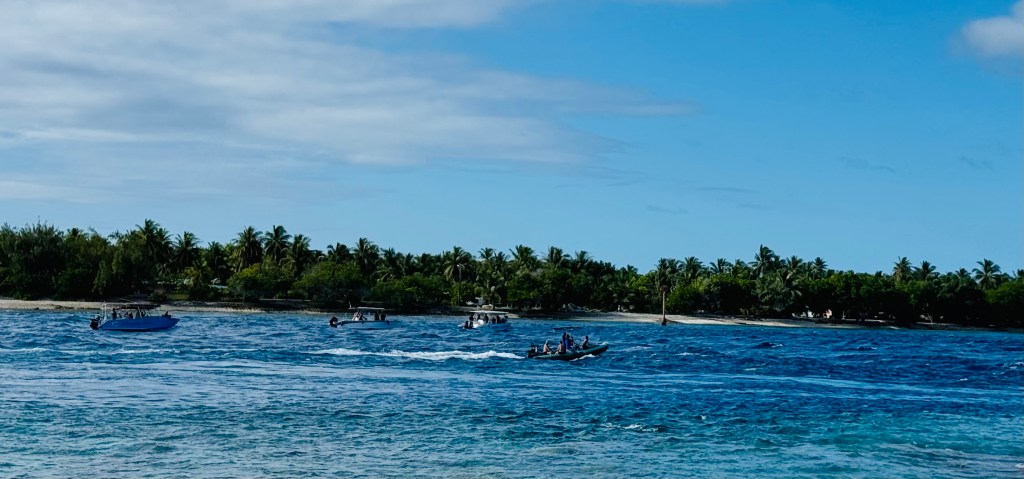
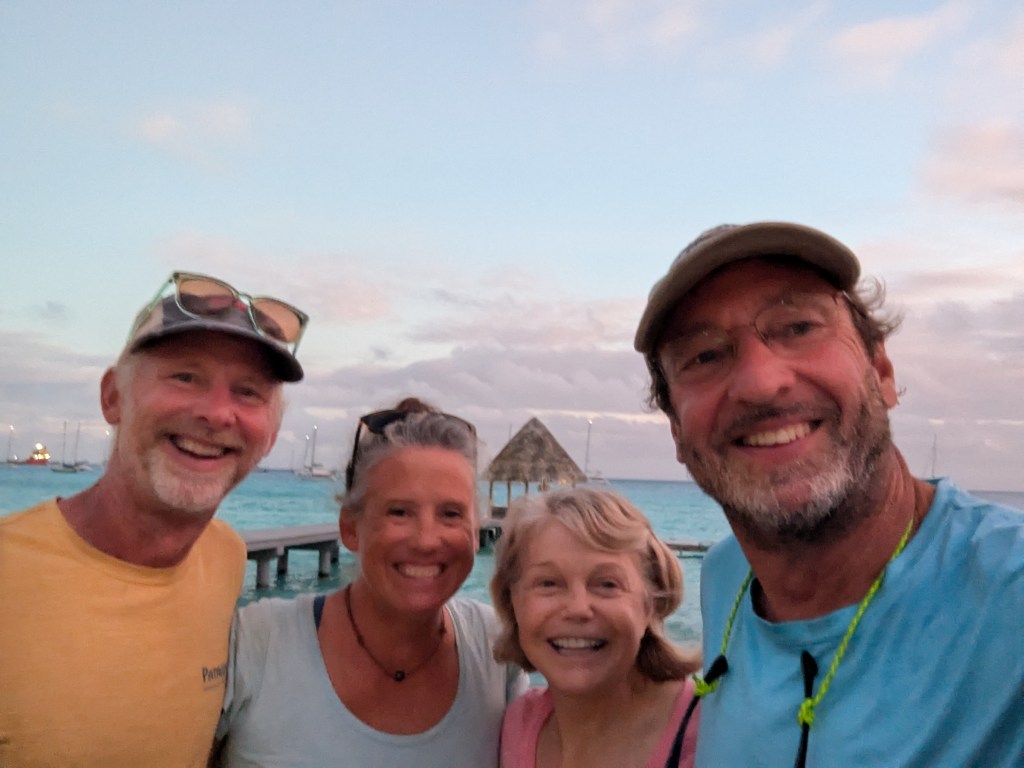
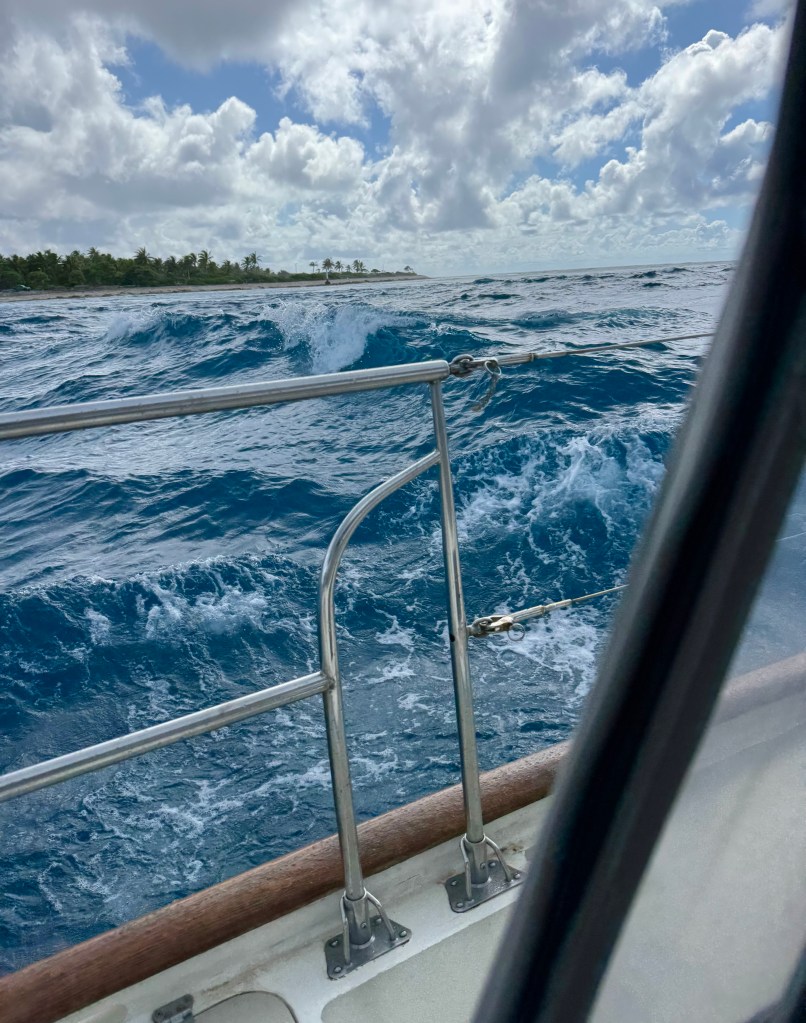
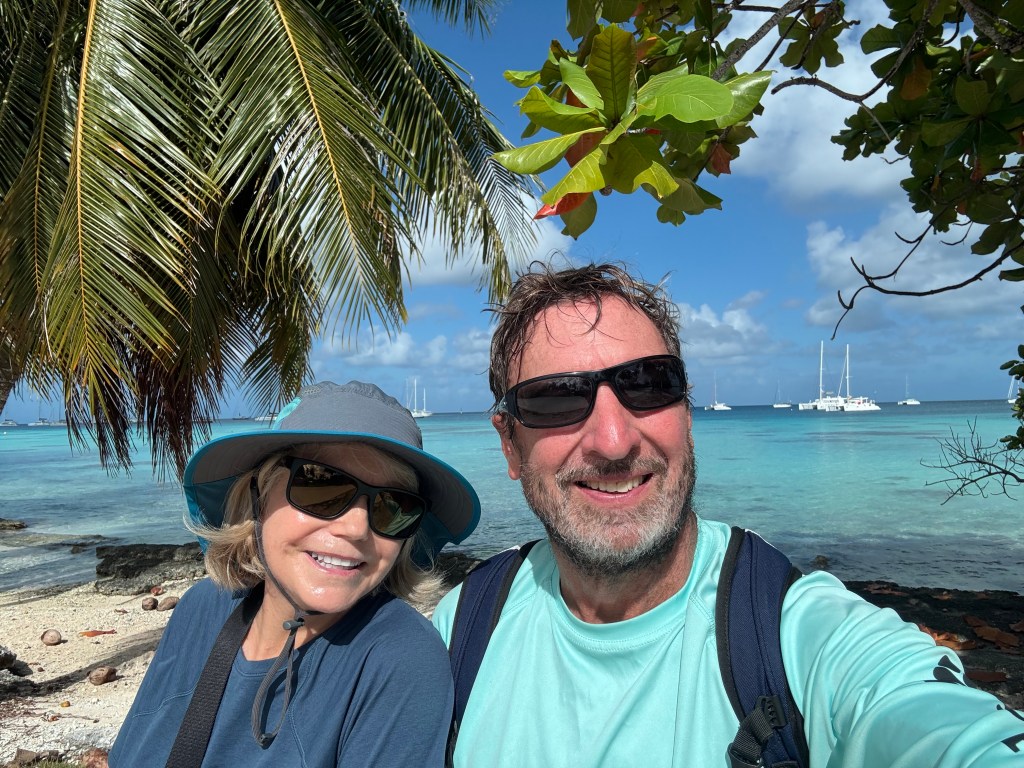
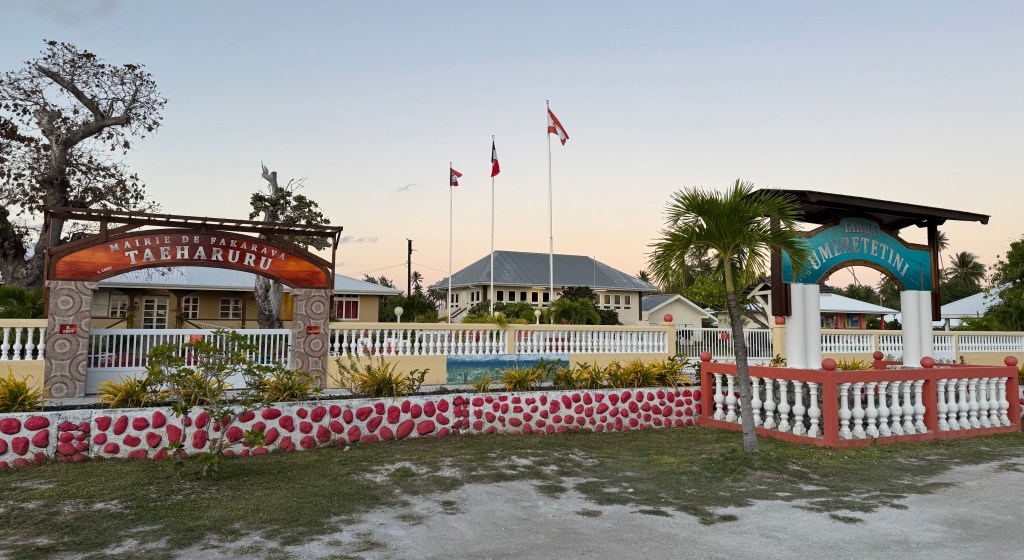
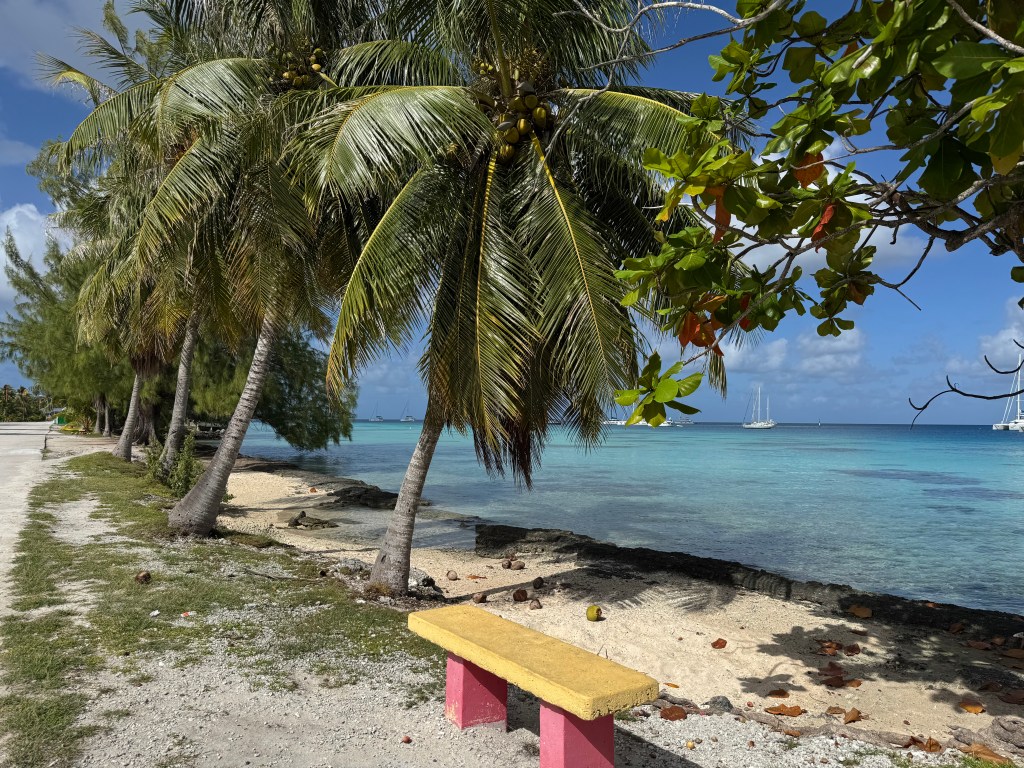
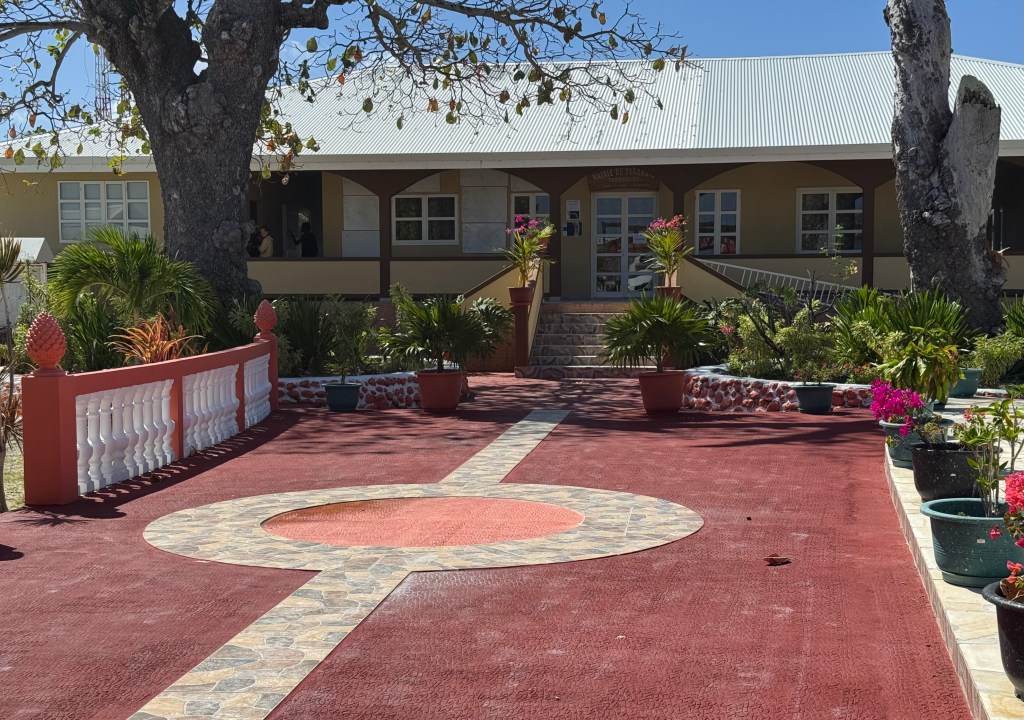
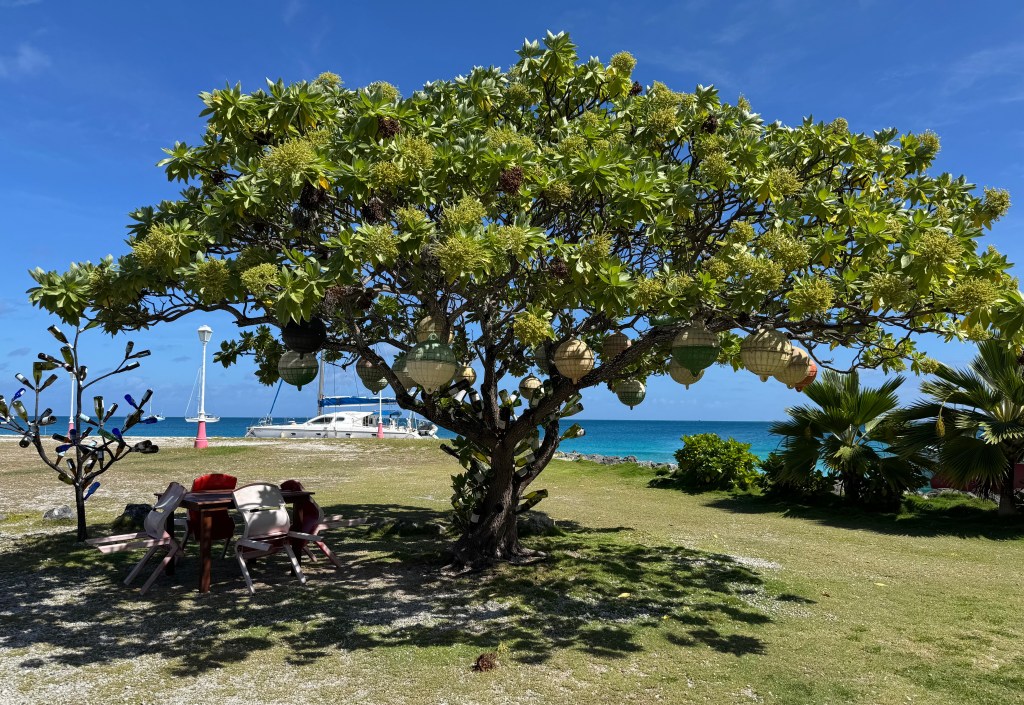
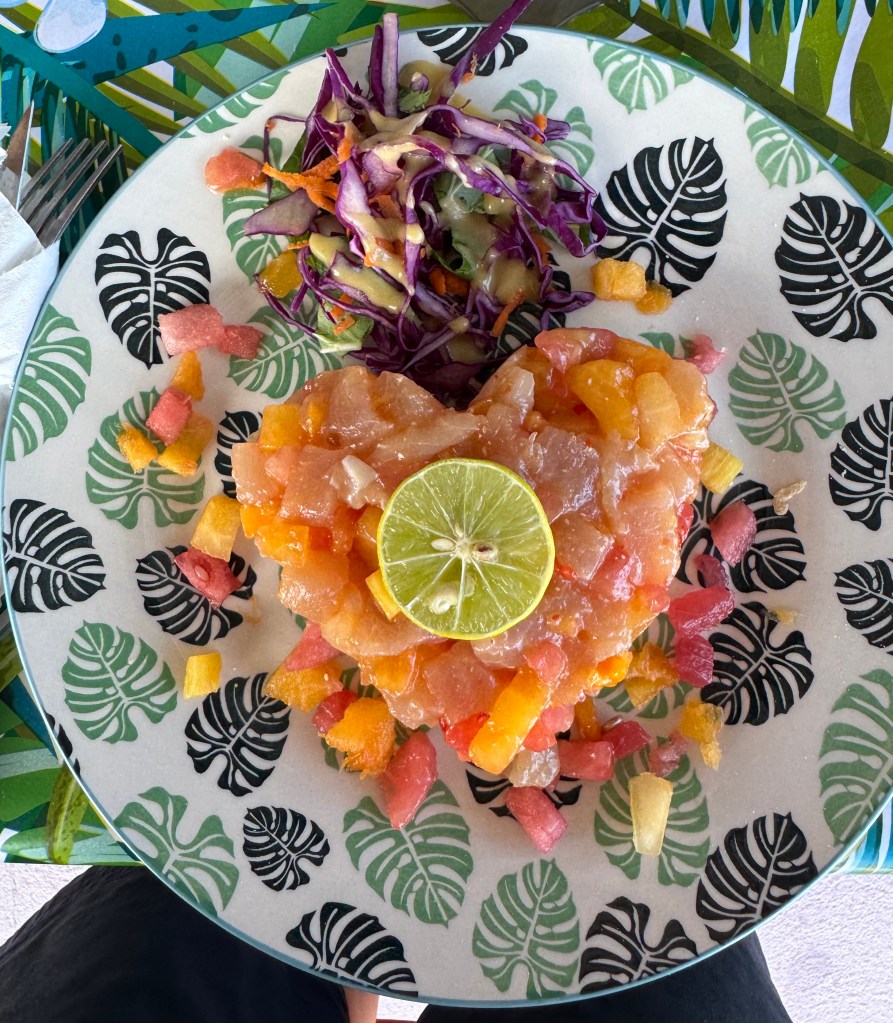
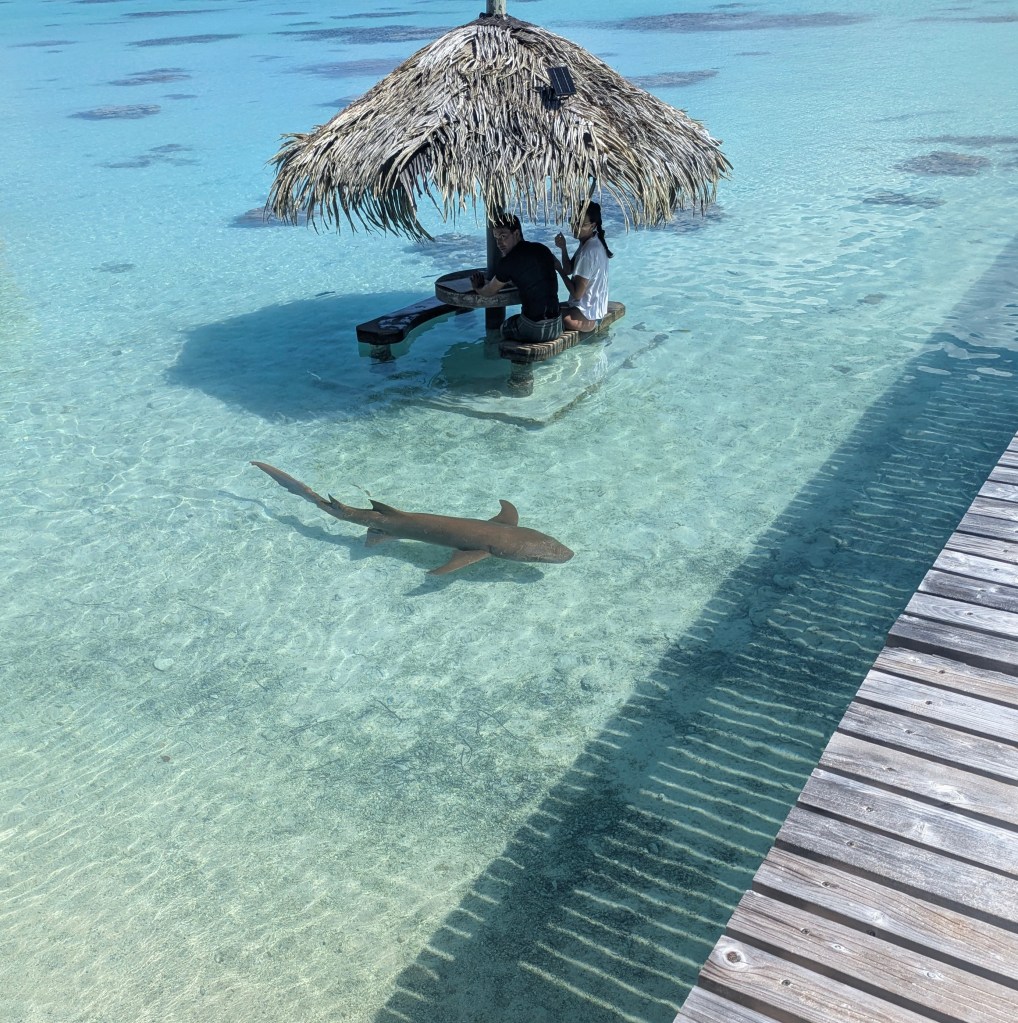
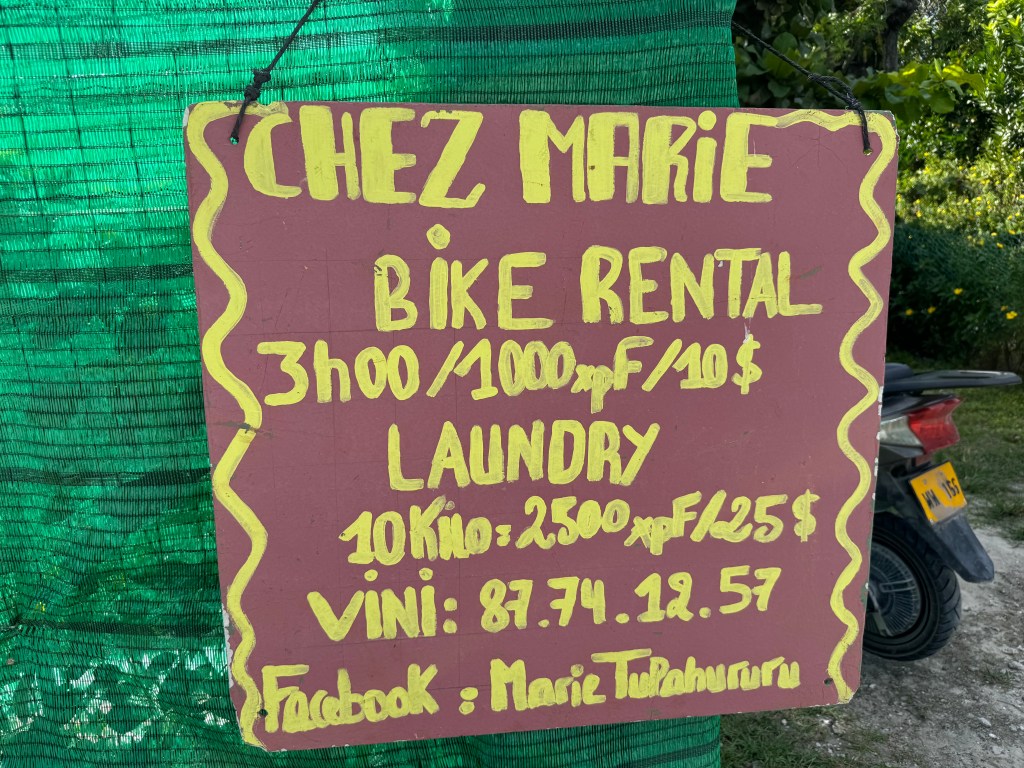
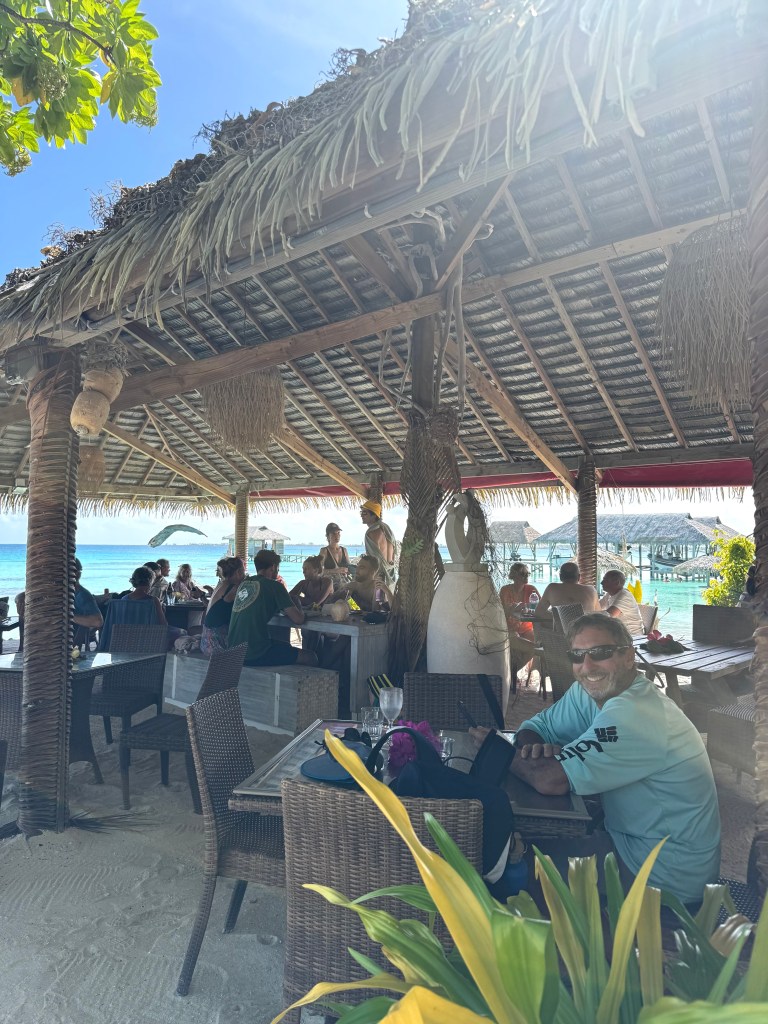
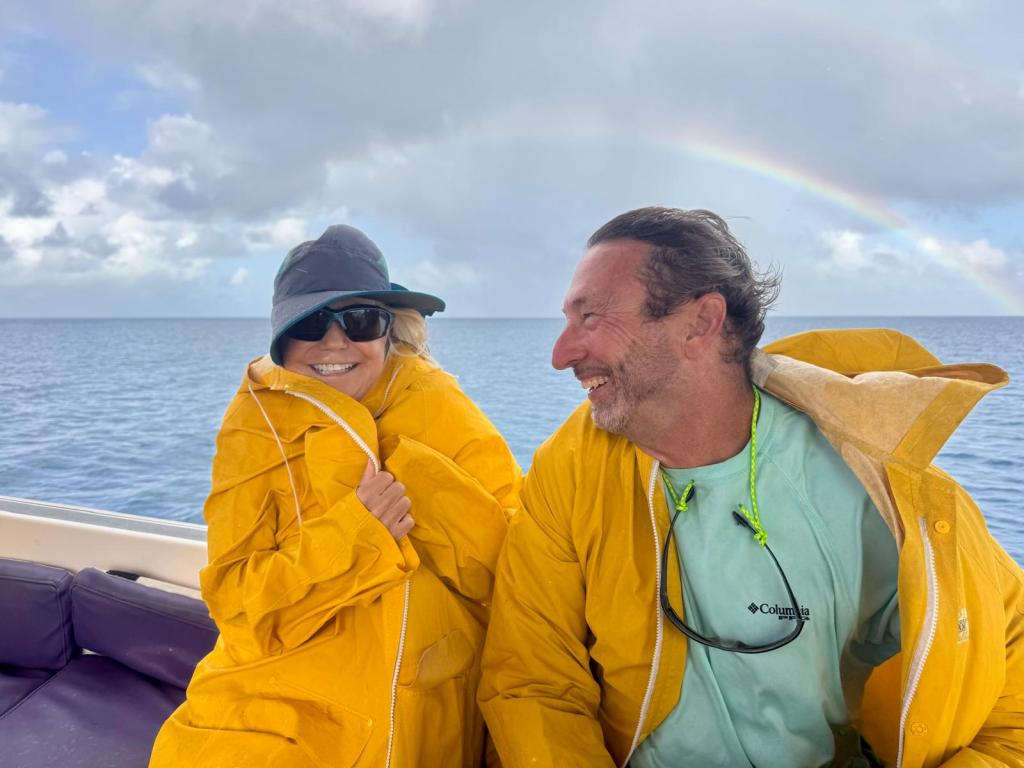
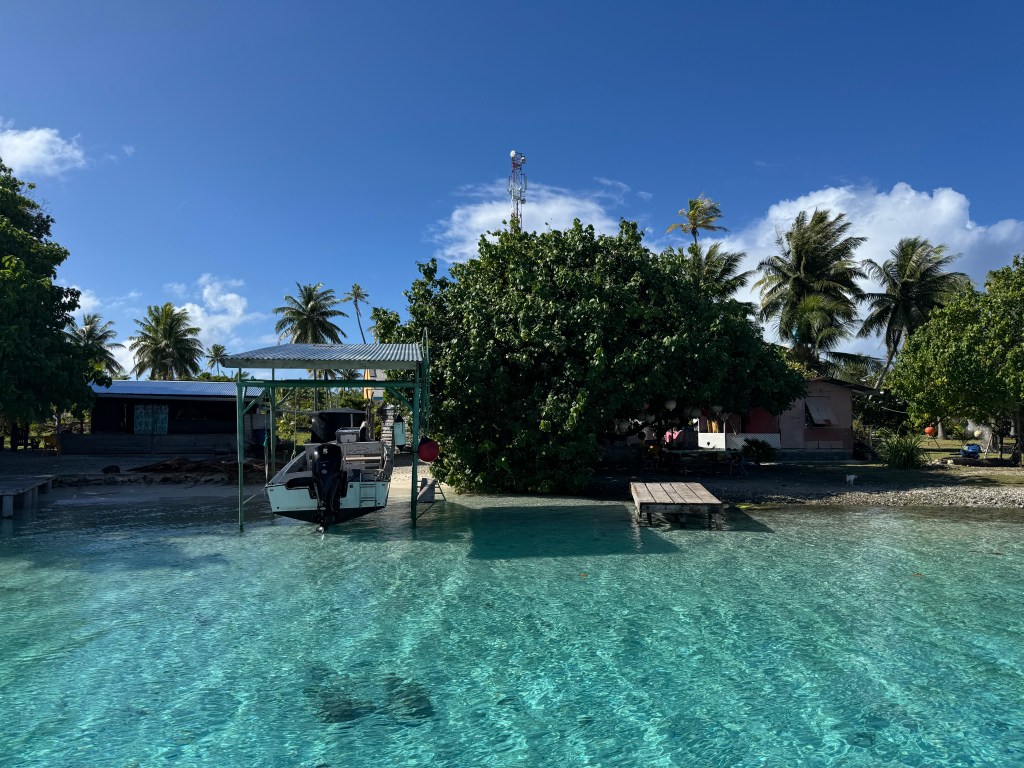
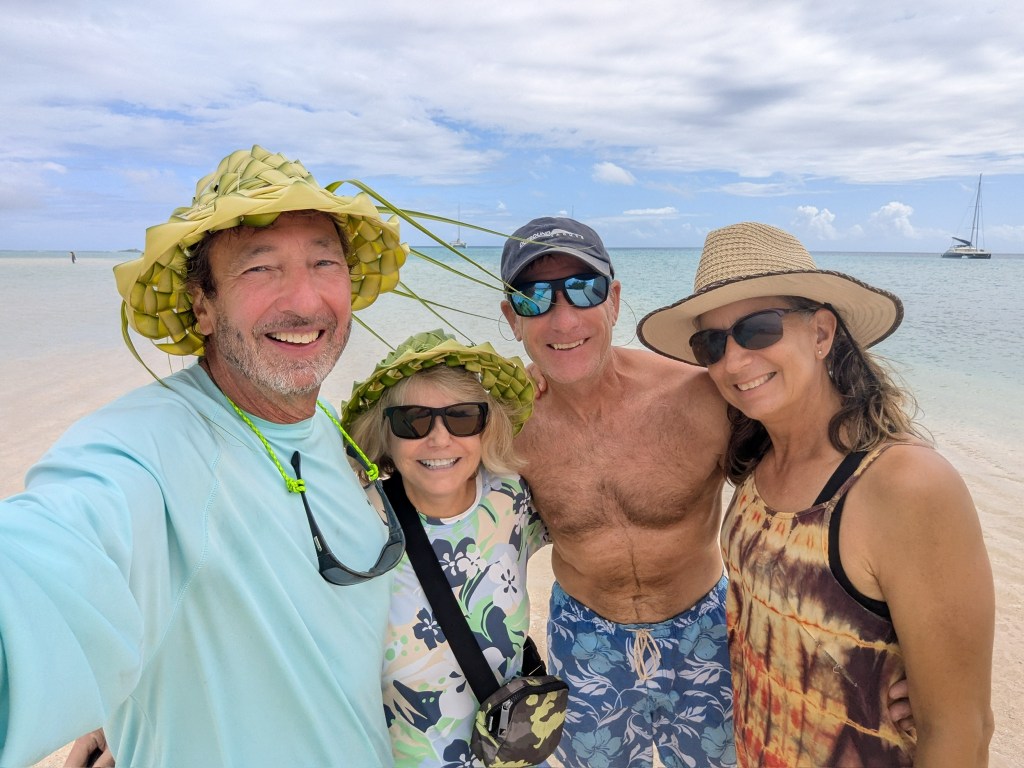

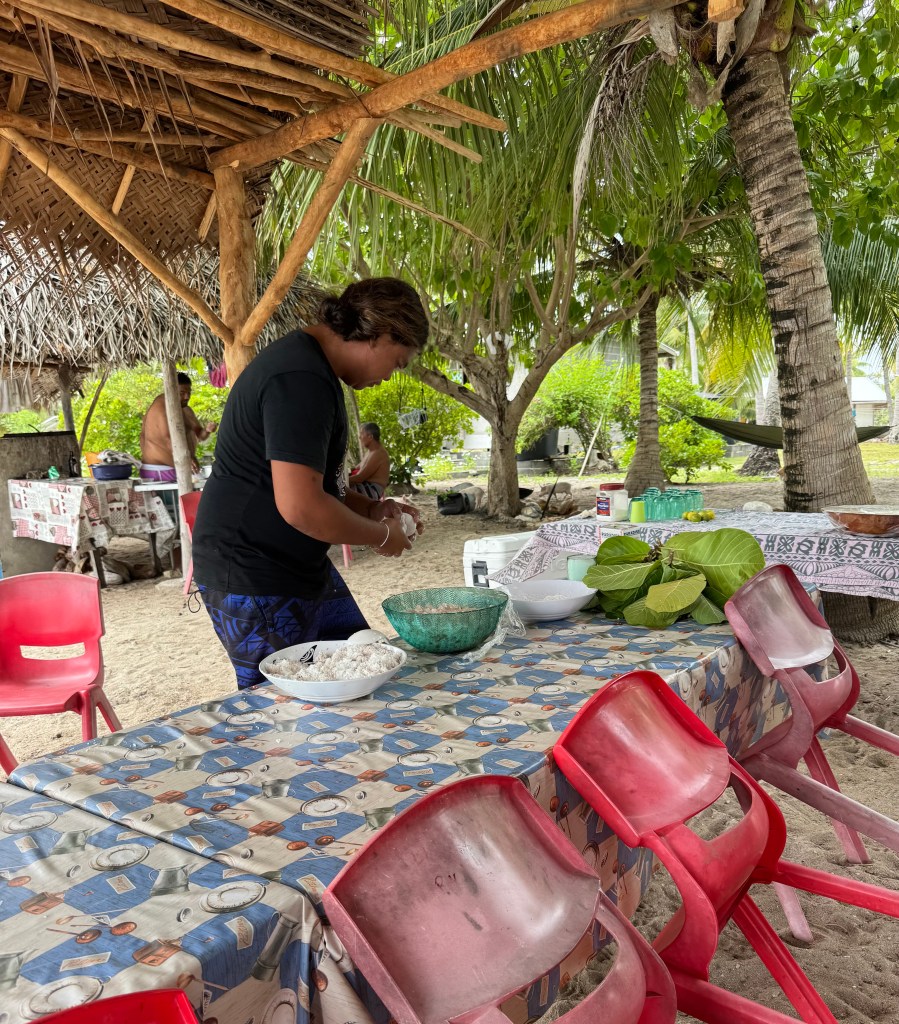
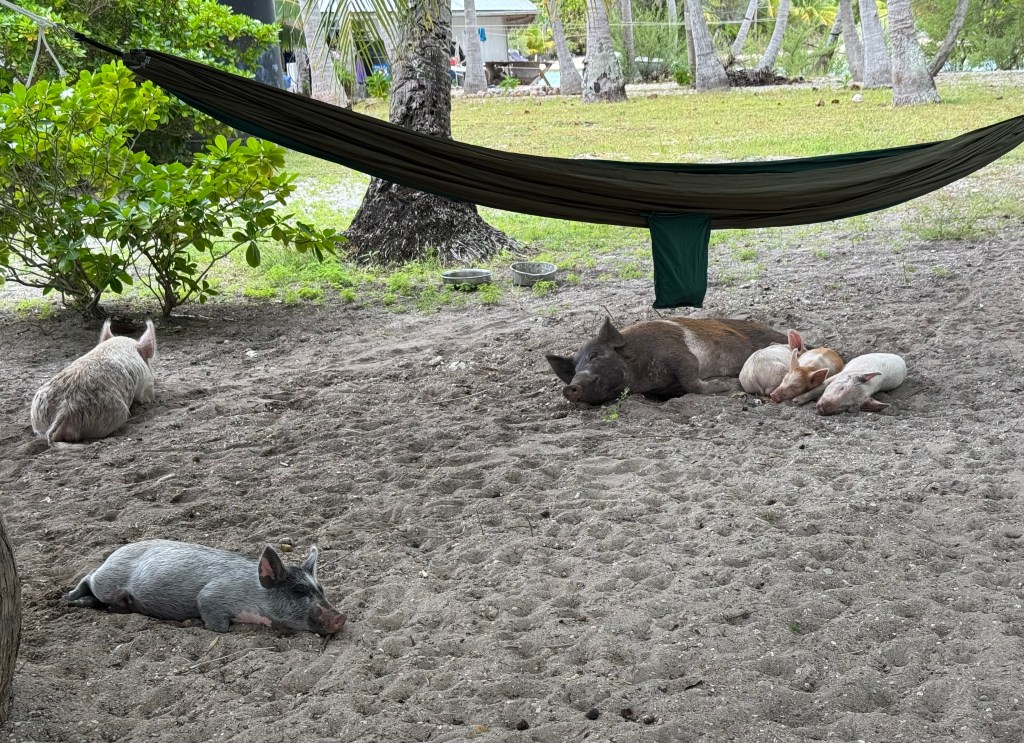
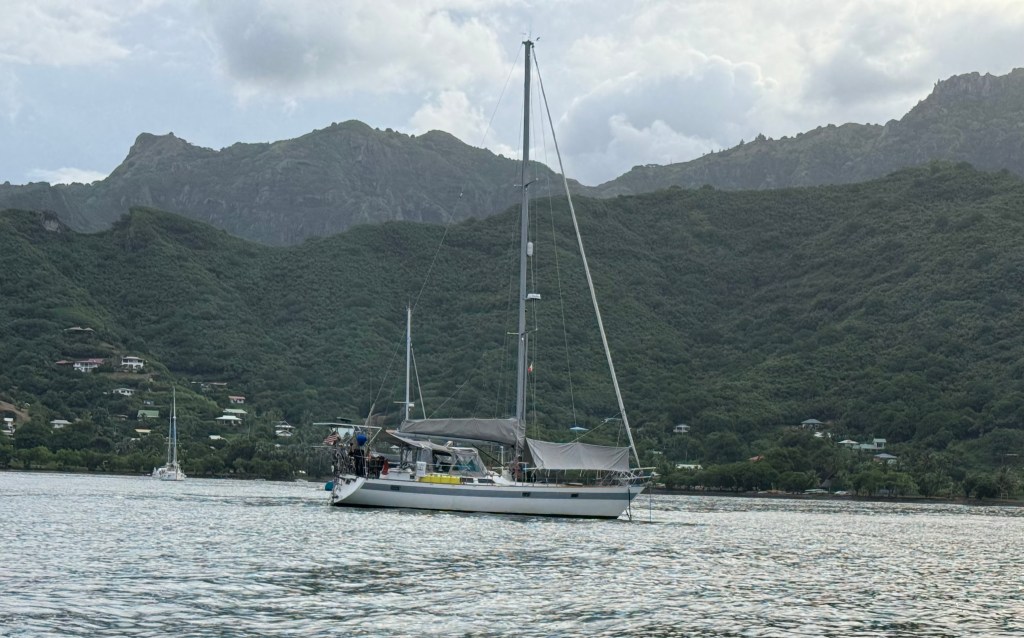

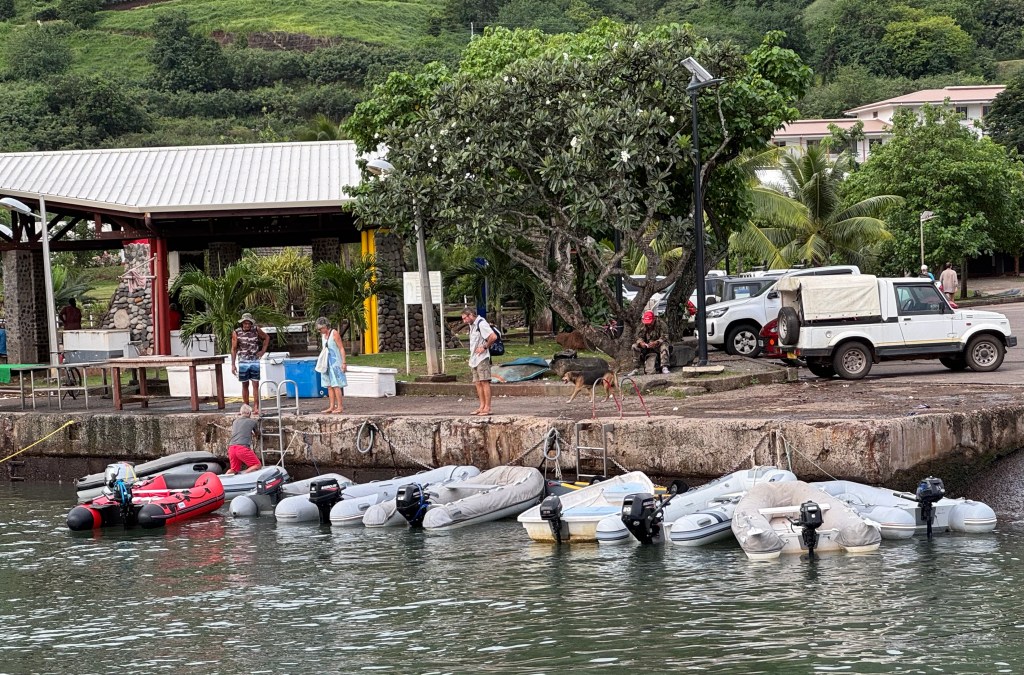
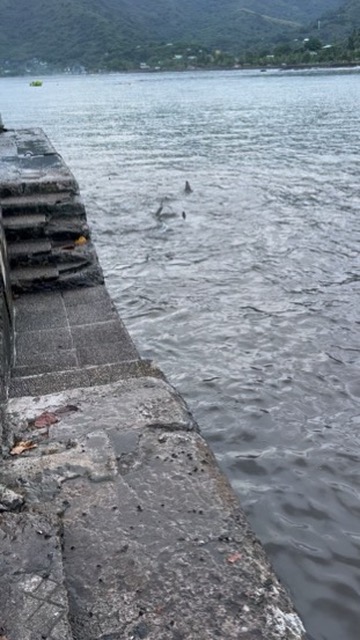
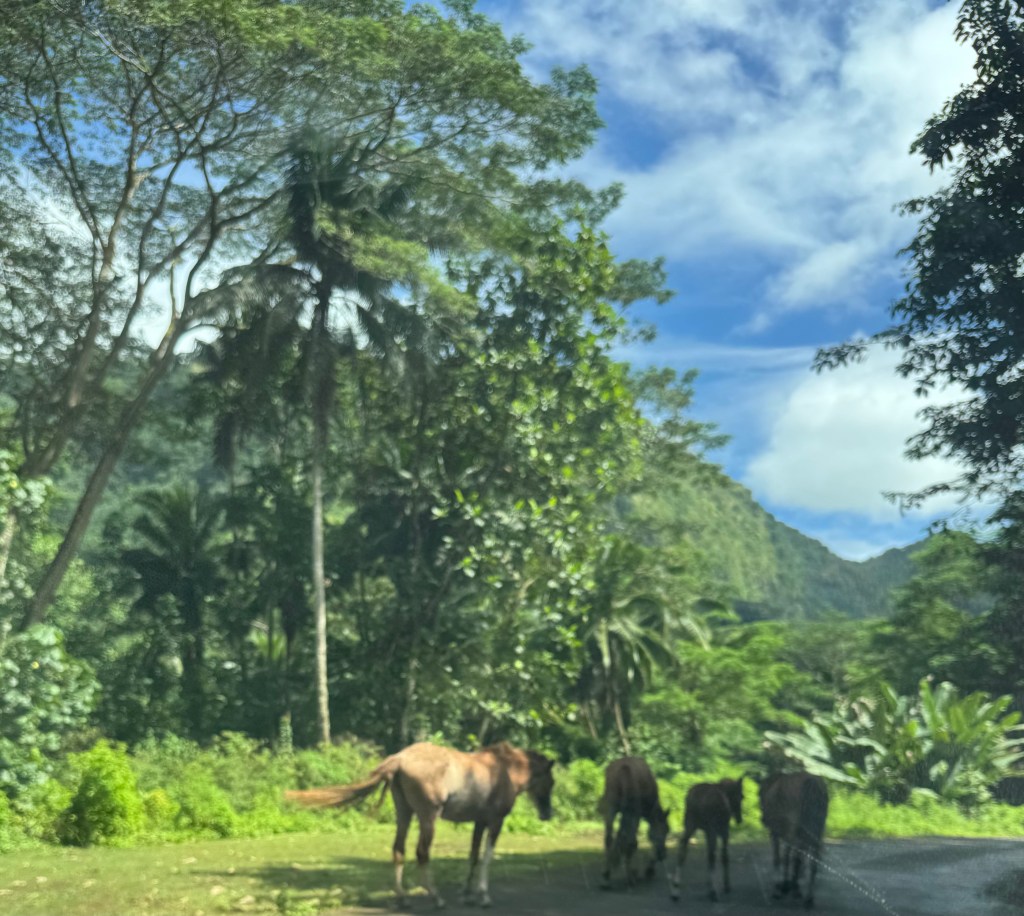

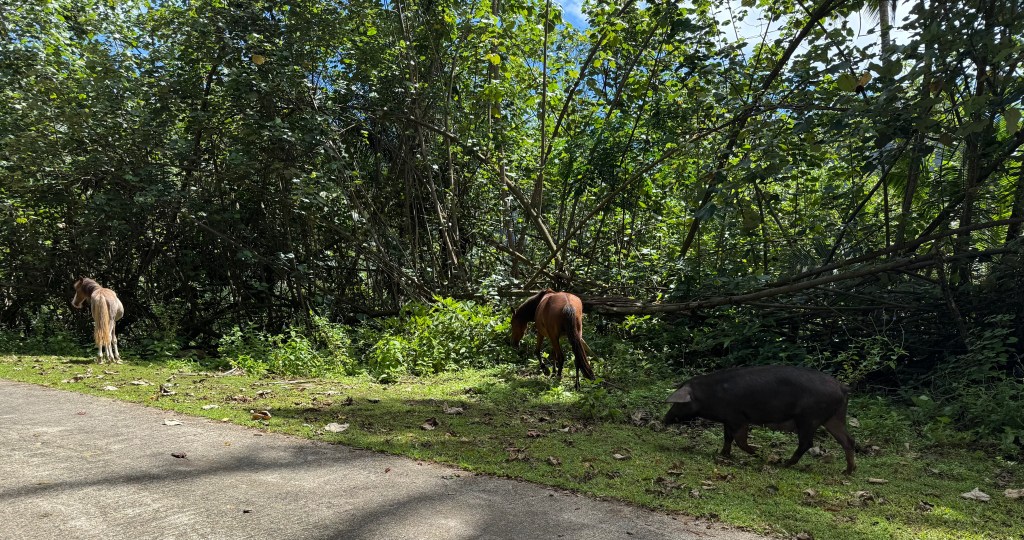
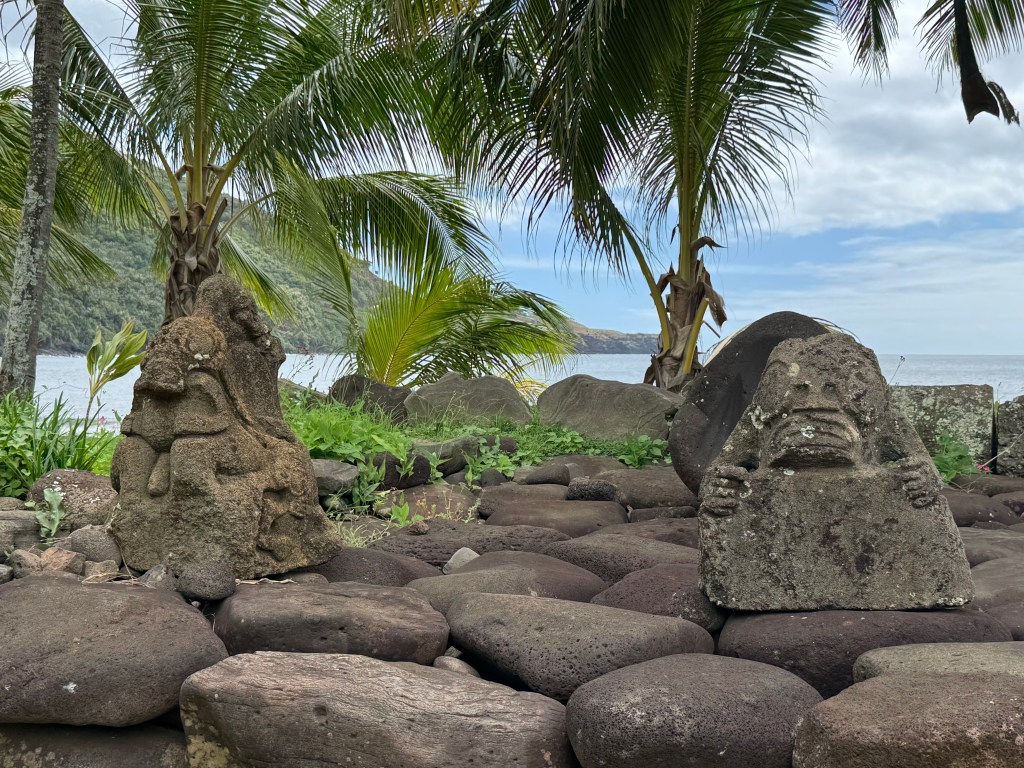
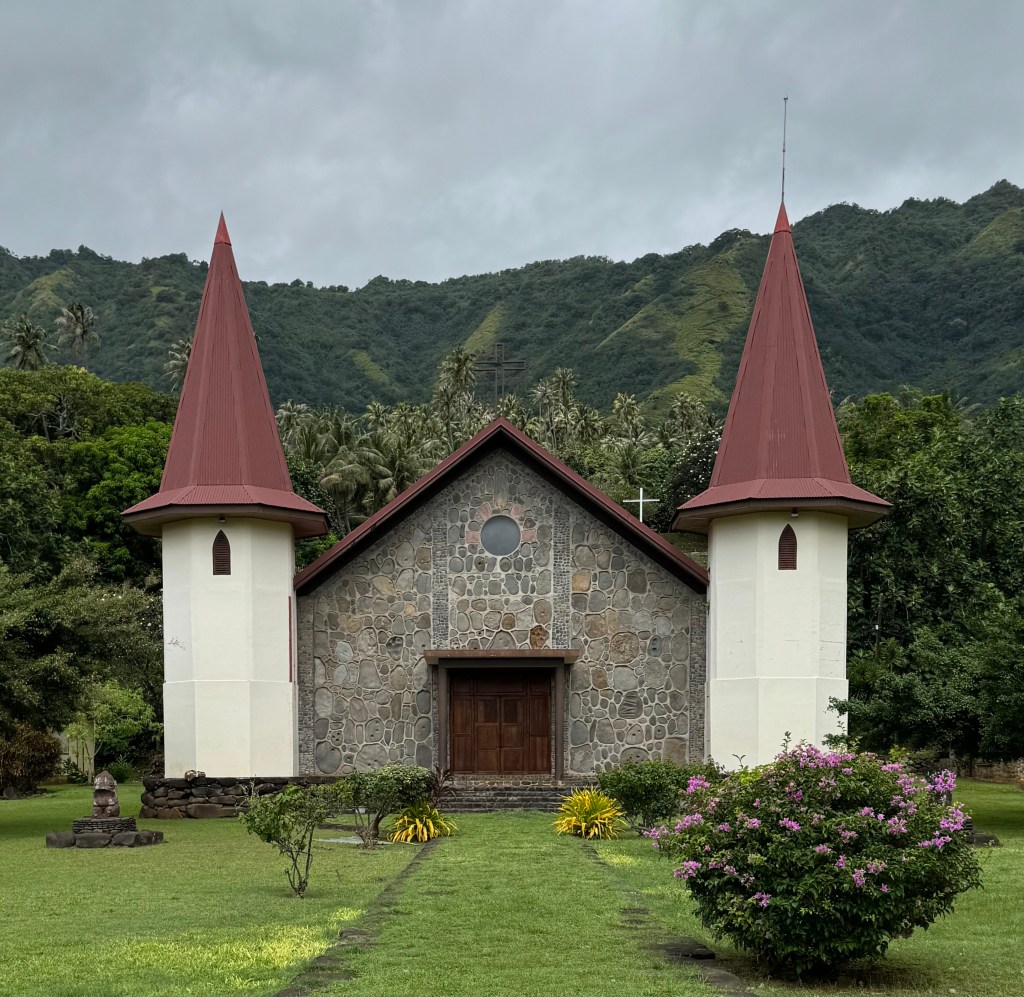
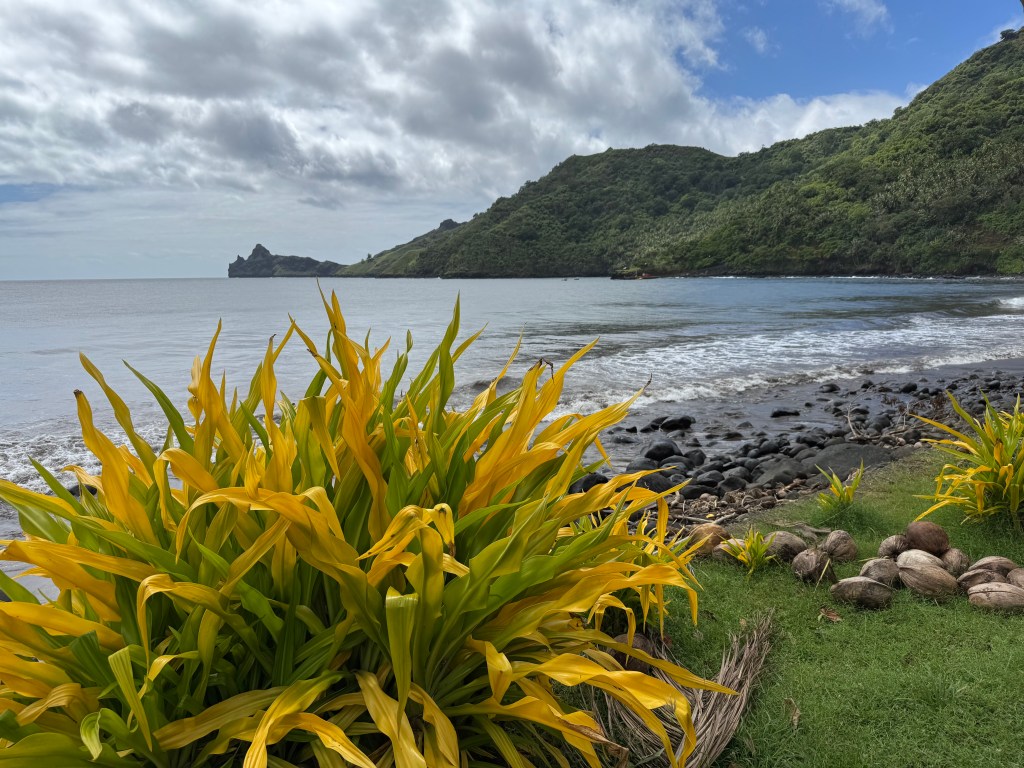


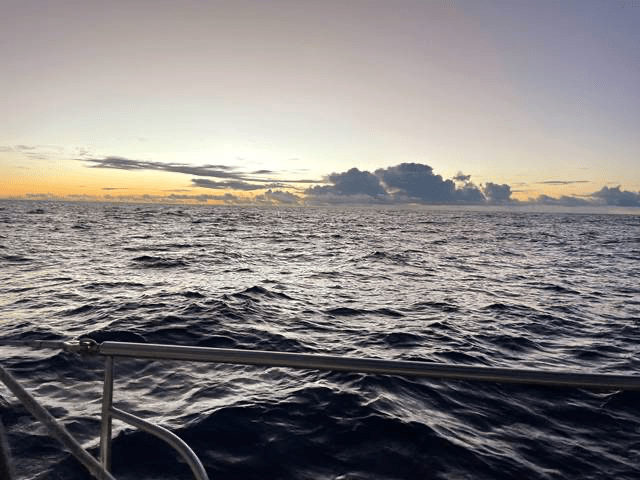

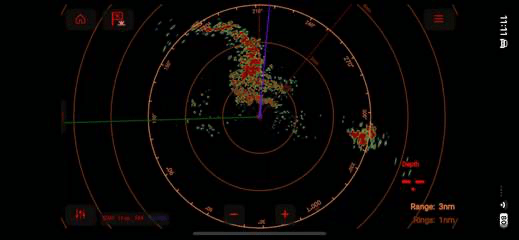

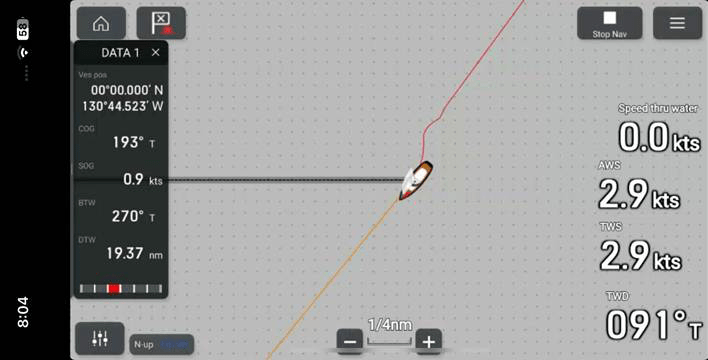
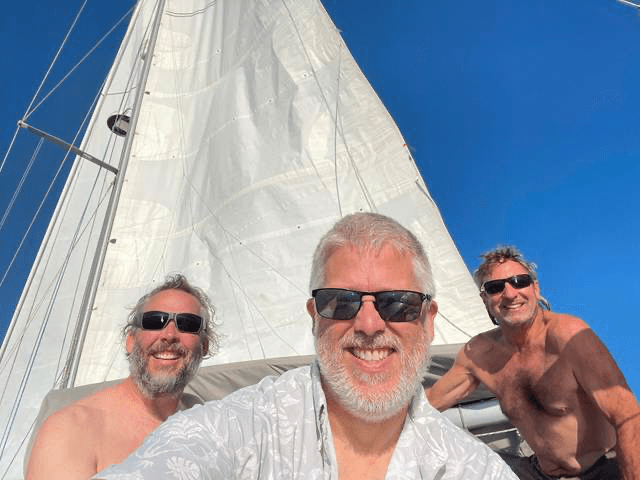

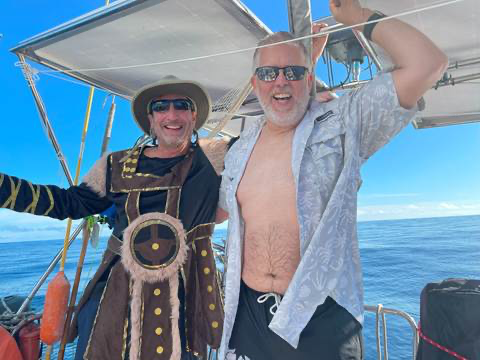
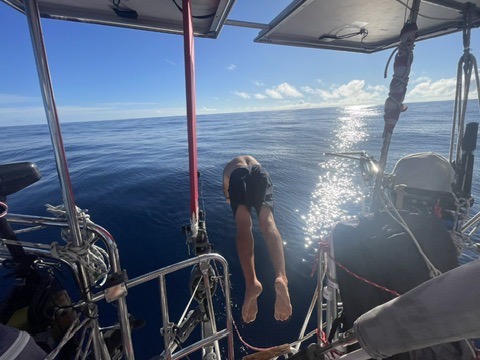
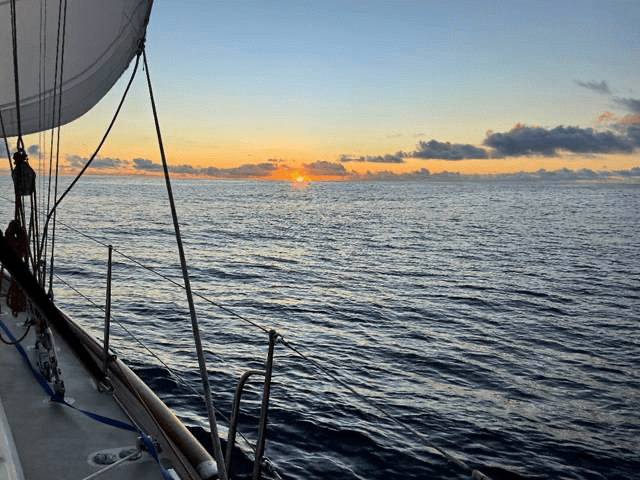
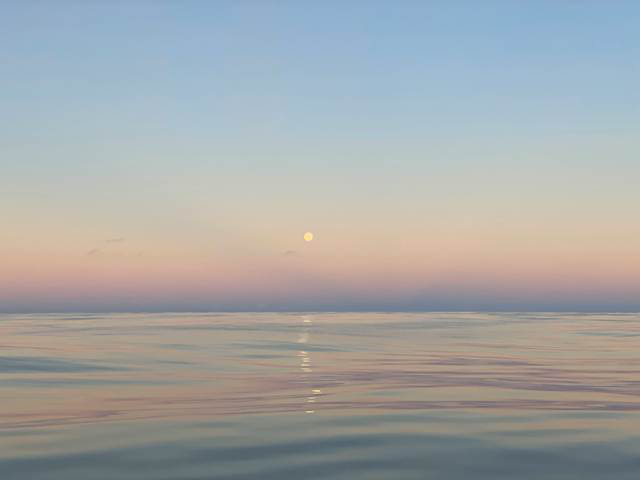
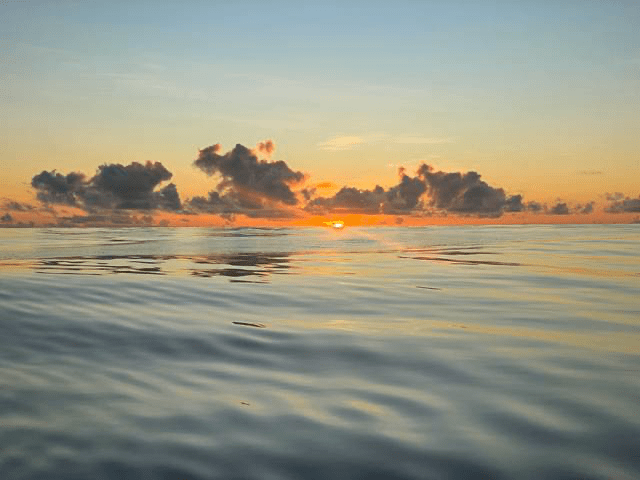
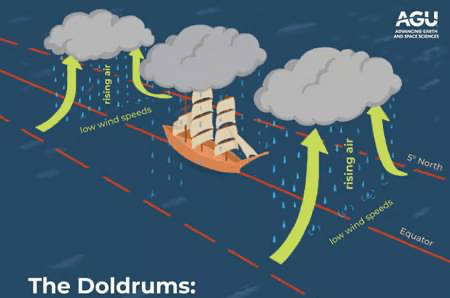
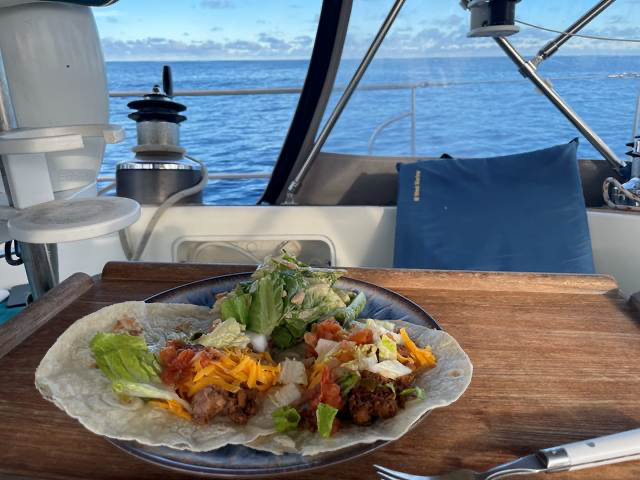


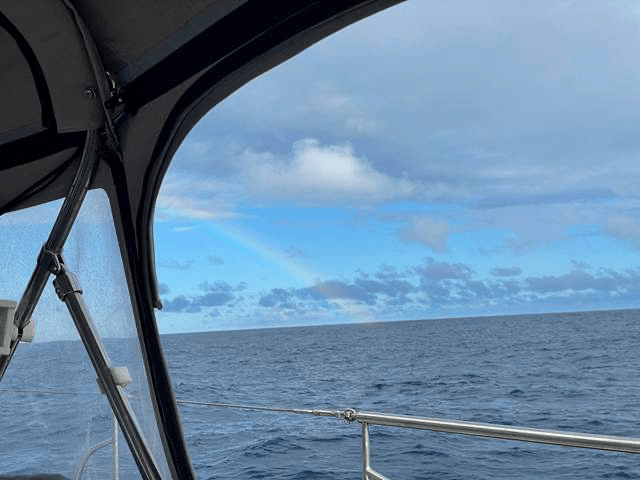
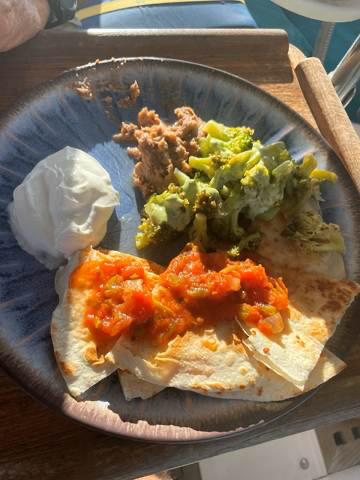
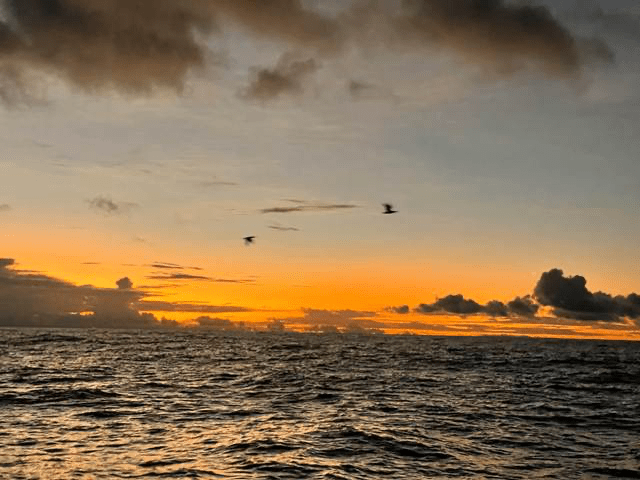
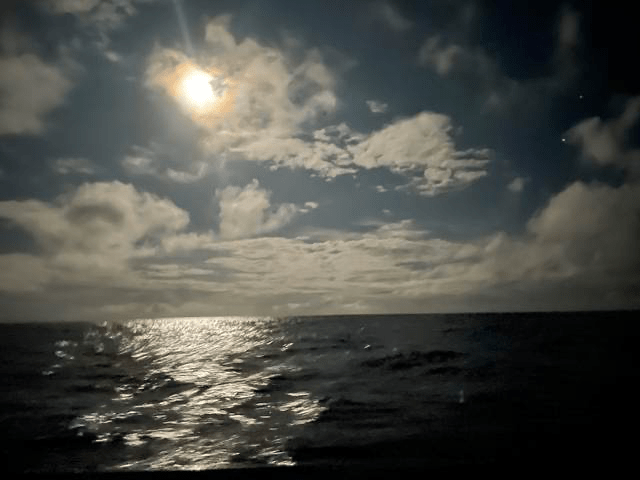
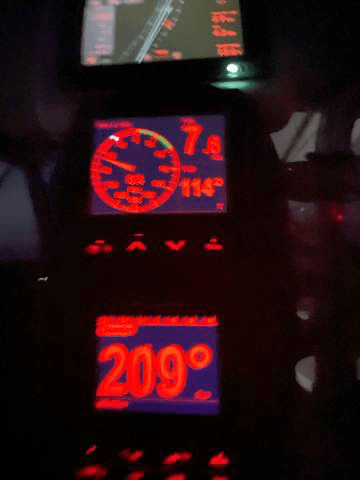
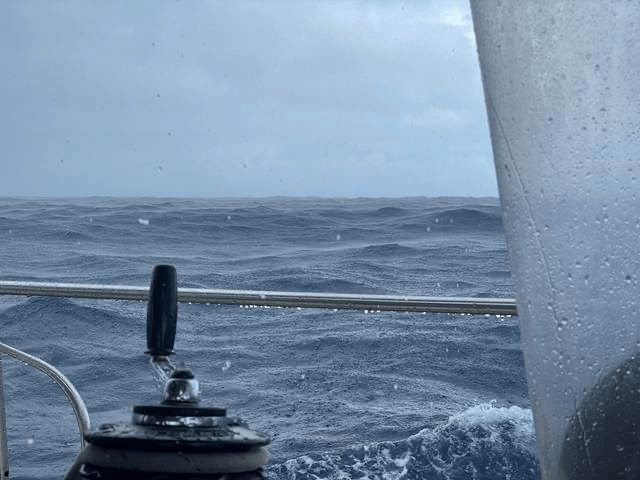


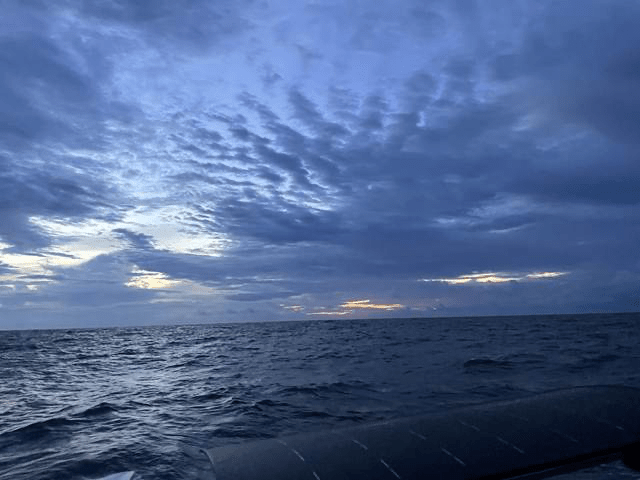
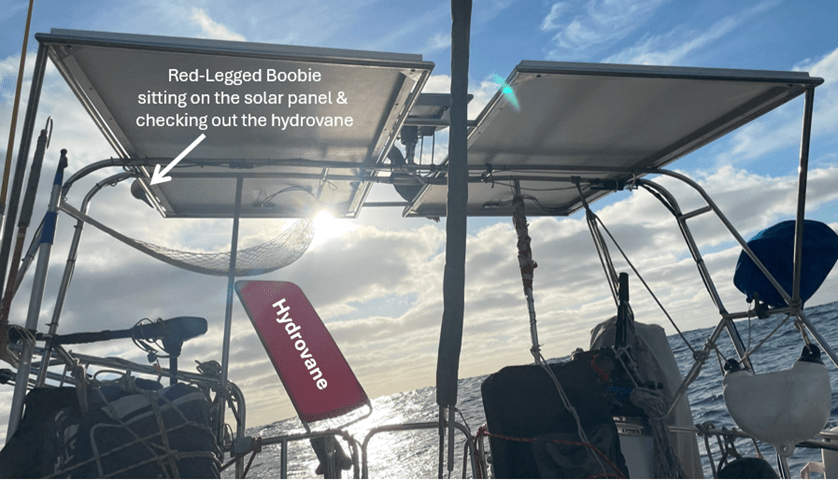
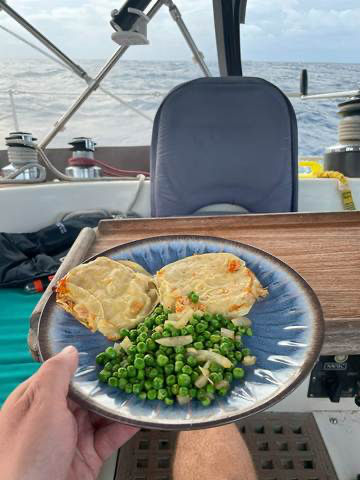
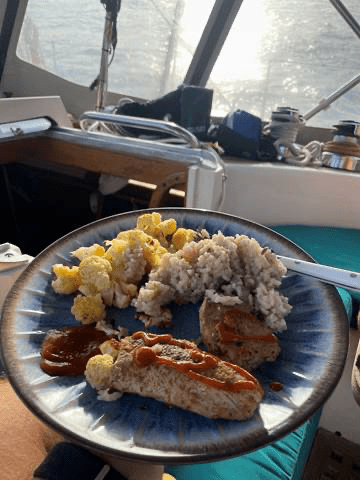
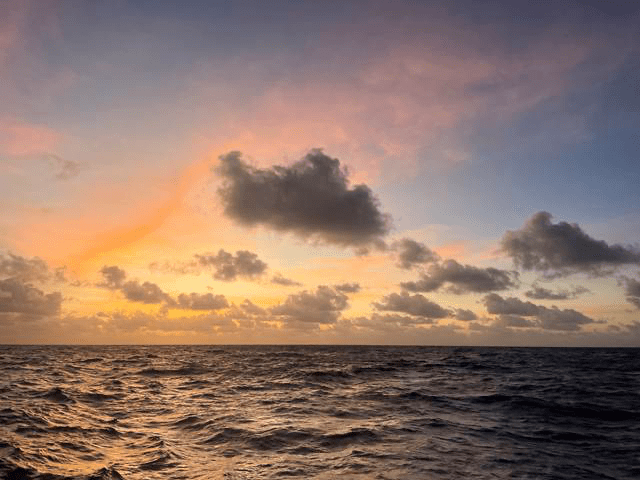
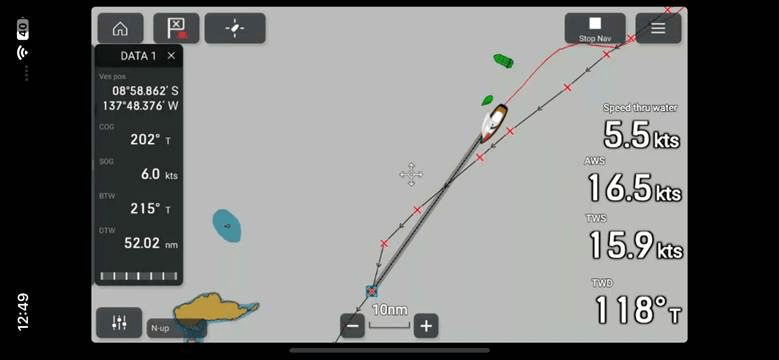
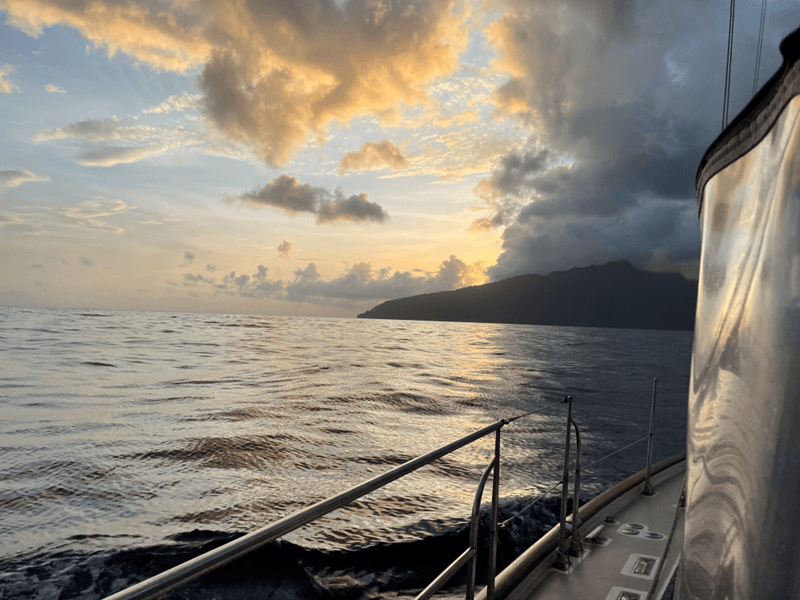

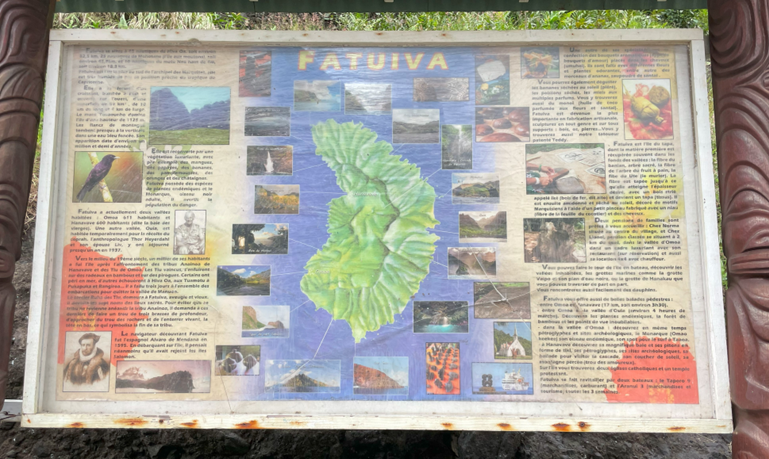

 SV Quid Sea - Sailing with Tracy and Cindy